
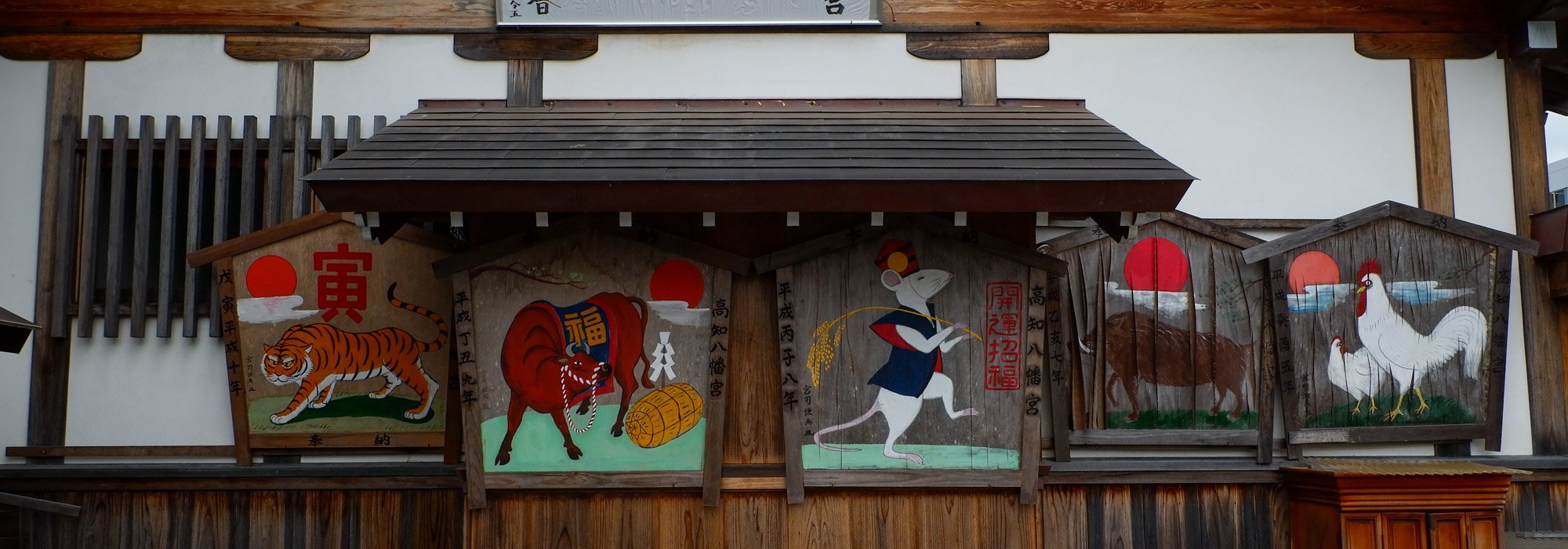
Juunishi
The 12 Japanese Astrological Signs
Juunishi (十二支) means the "12 Earthly Branches" of the Chinese zodiac, also called eto (干支) in Japanese. The term is used to refer to the 12 Japanese zodiac animals, that derive from Chinese astrology. Unlike the Western zodiac that assigned each animal to a month, in the Chinese and Japanese zodiacs, each animal is assigned a 1-year lapse. The Chinese zodiac, also adopted in Japan, is at the confluence of several schools of thought and includes concepts from Taoism and Buddhism among others. Thus, the "12 Earthly Branches" are also blended with notions such as:
- Yin (陰) and Yang (陽) ☯️, that alternate every year; and,
- The 5 elements (wood, water, fire, earth, metal) each affecting the zodiac for 2 years.
The combination of all these notions create a 60 years sexagesimal cycle, that repeats 5 times the 12 signs of the zodiacal cycle.
In Japan, people who have accomplished a 60-years cycle celebrate a special milestone anniversary called kanreki (還暦 "return to the beginning of the calendar"), meaning that a full cycle was completed and that a new one is starting from the person’s same eto or astrological sign at birth.

Origins of the Japanese zodiac
Elaborated on very ancient astronomical and astrological bases, the Chinese zodiac is thought to have appeared during the Han dynasty (202 BCE – 220 AD). It is a formalizing of time measurement in a luni-solar calendar, with 12 ideograms, that would later be paired with 12 animals for year counting.
This way of measuring time was imported in Japan in the 6th century and was officially adopted from 604 by empress Suiko. This calendar was notably used to establish the date of the beginning of Jinmu’s reign, the first mythical emperor of Japan.
Until the end of the Edo period (1603 – 1868), the animals in the Japanese zodiac were used to refer to years, but also to shorter time frames like hours, days and months. They were even used for directions.
In the past, every year of the cycle started at the beginning of spring 🌸 according to the traditional Japanese calendar Koyomi: Risshun on February 4. Nowadays, the Japanese zodiac year starts on January 1rst for a 12 months period, whereas the Chinese New Year is still starting at a non-fixed date, between January 21 and February 20. For example, in 2026, the year of the horse officially starts on February 17 and will last until February 7, 2027.
Stemming from a background rich in myths and legends, this astrological system assigned qualities and flaws to each animal, that are said to have an influence on people’s personalities and fate from birth.

What are the 12 animals of the Japanese zodiac?
There are many legends surrounding the creation of the Chinese zodiac: they are often based on the setting up of a race or a summon by a superior entity. Some versions say that the Jade Emperor, wishing to create a zodiac system, offered a place in it to the first 12 animals to finish a race on the New Year’s Day; others state that Buddha invited the animals to a banquet before his passing and the first 12 animals were those appearing in the zodiac.
As a matter of fact, the animals come in a specific order in the Chinese zodiac, that was replicated in the Japanese one, with a few local adaptations. The Chinese and Japanese zodiacs follow the following order:
There is no cat 🐈 in the Chinese zodiac, and the legend explains its absence by the rat’s enmity, as the rodent tricked the feline so it couldn’t participate in the selection. Another, more factual explanation is that domestic cats were introduced in China only in the 6th century, after the zodiac was finalized, but it sometimes replaces the rabbit or the hare in other Asian countries.

What is the Japanese zodiac sign of the year?
The current cycle started in 2020 with the year of the Metal Rat. It is continuing with:
- 2021: Metal Ox
- 2022: Water Tiger
- 2023: Water Rabbit
- 2024: Wood Dragon
- 2025: Wood Snake
- 2026: Fire 🔥 Horse
- 2027: Fire Sheep
- 2028: Earth Monkey
- 2029: Earth Rooster
- 2030: Metal Dog
- 2031: Metal Boar
A new cycle will start in 2032 by the year of the Water Rat.
Chinese astrology considers that the animals’ characteristics, good or bad, associated with one of the 5 elements and to the yin and yang polarities, all shape the destiny and personality of people depending on which year they are born. Astrologers use these characteristics to build their forecast and decide the sign’s influence on the course of the year.
To ward off bad luck or attract good luck, people may use the kanji of a favorable zodiac sign in the writing of the name of a new-born. It can also be important to wait for the good astrological time to start a project, or to marry for example.
Some years may show a birth rate uptick, such as the years of the dragon, as the creature is supposed to be lucky, or on the contrary, a birth decline, such as the years of the fire horse, as girls born in these years are said to be harder to wed. The signs’ compatibility may also have been taken into consideration to choose business or wedding partners, but these practices tend to disappear.

How to get lucky following the Japanese zodiac?
Japan considers the influence of an astrological sign begins from January 1rst, but amulets and lucky charms bearing its figure can be purchased from the end of the preceding year at temples and shrines. One can also:
- Send nengajo season’s greetings cards illustrated with the New Year’s astrological sign;
- Write a wish on an ema votive plate, also illustrated with the animal, at the 1rst visit at the temple or shrine of the year (hatsumode) in January; and,
- At the same time, draw a eto-mikuji, a prediction for the year hidden in a small figurine of the astrological animal.
The Japanese zodiac animals are popular images that can be found pretty much every where as a decoration, and more often than not as kawaii mascots for stationery goods among other things. Eight of the eto Japanese zodiac signs decorate the cupola of Tokyo Station’s north exit (Marunouchi side), the other 4 ornament a door at Takeo Onsen ♨️ (Saga prefecture in Kyushu), the home city of Tatsuno Kingo the architect designer of Tokyo Station.
When visiting temples and shrines in Japan, you might encounter the zodiac disk ornamenting the ceiling of their main gates, ema of various sizes illustrated with the animals, and even statues of the astrological signs scattered in their grounds.

One can mention for example:
- The Tenman-gu shrines throughout the country, dedicated to Sugawara no Michizane, that all have a statue of an ox, his favorite animal;
- Kami-gamo shrine in Kyoto will particularly attract people born under the sign of the horse, as it is staging every year 2 events themed on the horse: Kurabeuma a horse race taking place on May 5 and Kamo no Uma matsuri on September 8;
- Kennin-ji temple near Gion district in Kyoto, is home to beautiful paintings of dragons, and its sub-temple Ryosoku-in, is protected by a koma-tora, a guardian-tiger;
- Okazaki-jinja shrine in Kyoto is renowned for the many rabbit statues in its grounds;
- Taishakuten temple in Shibamata neighborhood in the east of Tokyo has small statuettes of white snakes, the harbinger of prosperity; and,
- Asakusa Otori-jinja shrine in Tokyo is said to be at the origin of the Rooster celebrations taking place on the days of the Rooster in November, where people buy a kumade lucky rake.