
Nara
🦌 Beautiful Temples and Cute Deers in the City
Nara is a small city of the Kansai area on Honshu island, only 42 kilometers south of Kyoto and is also the capital of the eponymous prefecture. Enlisted in the UNESCO World Heritage, it once was a historical capital of Japan and is now home to a deer herd roaming freely in the streets. When traveling in Japan, Nara makes for a nice discovery over 1 or 2 days at most all year round, but especially in April, May, July, October and November.
At a 50 minutes’ train 🚅 ride from Kyoto and Uji, Nara is a must-see destination in Japan mainly because it was the imperial capital in the 8th century. Now the capital of Nara prefecture, it is famous for its many old Buddhist temples enlisted in the UNESCO World Heritage and its shika deers adored by visitors. By the way, Sento-kun, both the city and the prefecture’s mascot since 2010, is a hybrid creature looking like a little Buddha whose head is topped with a deer antler-like crown.
Nara extends on a plain, surrounded by small forested mountains. It is of easy access from Kyoto or Osaka to which it is connected by 2 railway companies: JR and Kintetsu, whose respective stations are practically next to each other in the city center. The trip lasts 35 to 50 minutes with travel fees amounting to a few ¥100 and do not require a travel pass (an Icoca IC card however makes the use of the gates at the stations easier).
Travelers usually consider Nara as a 1-day trip and rarely stay overnight, especially as the range of accommodation available is not as wide as in the neighboring Osaka and Kyoto, 2 cities that also are more convenient. However, one of Nara’s most important advantage lies in the fact that most of its major places of interest are located within walking distance, between both Nara stations to Nara Park and Mount Wakakusa, and can be covered over a packed single day.

Best times to visit and periods of overtourism
Nara is a pleasant city all year round, with 2 very busy times:
- The beginning of spring, during the sakura 🌸 blossom season to watch in Nara Park and on Mount Wakakusayama;
- In autumn for the red koyo 🍁 foliage.
The warmer days are beautified by seasonal flowers, such as: azaleas and wisterias in May, hydrangeas in June and July, while in summer the green leaves help maintaining a cooler atmosphere.
The large Nara Park is home to many monuments and treasures of Japan and constantly attracts flocks of tourists, both from the archipelago and overseas. Thus, Nara met an attendance record in 2024, with 14,87 million visitors, of which 2,98 million were foreigners. Japanese tourists being the largest part of the crowds, expect the busiest times to be on weekends, national public holidays or holidays periods such as the Golden Week in May or the Silver Week in September.
People who don’t enjoy the crowds may prefer winter, which is a quieter period, to explore Nara.

Note on the shika deers of Nara Park
The shika deers are the kawaii asset of Nara, and many tourists come just to meet them and watch them bow for a treat. In the Shinto cult, these animals are considered the messengers of gods and therefore are left roaming freely on large religious or sacred sites, such as Nara Park or Miyajima island. In total, there is an estimated overall number of about 2,5 million deers on the Japanese archipelago.
The deers are a symbol of Nara city, that designated them National Treasures. This specific status doesn’t prevent measures to control the shika population, however, as it has been growing by 10 % each year since the reopening of Japanese borders in the end of 2022. Consequently, the latest record number of shika (1,388 animals en 2019) has been broken in August 2025 with 1,465 animals of all ages living in the park.
This growth is partly caused by the increasing number of tourists, as visitors like to feed the deers with shika sembei, a special pet food sold by the Nara Deer Preservation Foundation. However, even if they are used to humans, the deers remain wild animals and there are a few safety guidelines to follow:
- Avoid touching them and don’t try to catch them;
- Avoid the stags, especially during mating season (September to November) as they are more aggressive;
- Don’t touch the fawns;
- If feeding them, only give the authorized shika sembei, as any other food may potentially be harmful to them;
- Keep an eye on young children, who are at the same height as the deers.
Every year, there are about 200 injuries due to biting or antler goring. To avoid attracting deers, do not take anything from your backpack when they are around, and avoid holding something they may confuse with food (tissue, paper, etc.) in your hand.

Best things to do in Nara in 1 day
The historical Nara period (710 – 784) was named after the years during which the city was the imperial capital, known as Heijo-kyo, and most of the sites visited nowadays have been founded at the times. In its heydays, Heijo-kyo extended over more than 4km², precisely between the 2 poles of attractions of the contemporary city that are the classically touristic city-center around Nara Park and the historical area around Heijo-kyu Palace in the west.

Nara’s touristic city-center is a testimony of the ancient city’s eastern side and is located on a plain between JR and Kintetsu’s Nara Stations and Mounts Wakakusa. Very easy to access, it gathers the most famous and the must-see monuments of the city, that can be explored over a full day.
It mainly consists of Nara Koen, a large urban green park encompassing more than 1235 acres, where shika deer roam free. The must-see places are:
- Kofuku-ji, the first temple encountered when arriving in Nara, listed in the UNESCO World Heritage, is famous for its 2 majestic pagodas. The 5-story tall one is unfortunately not visible until 2032 due to renovation works.
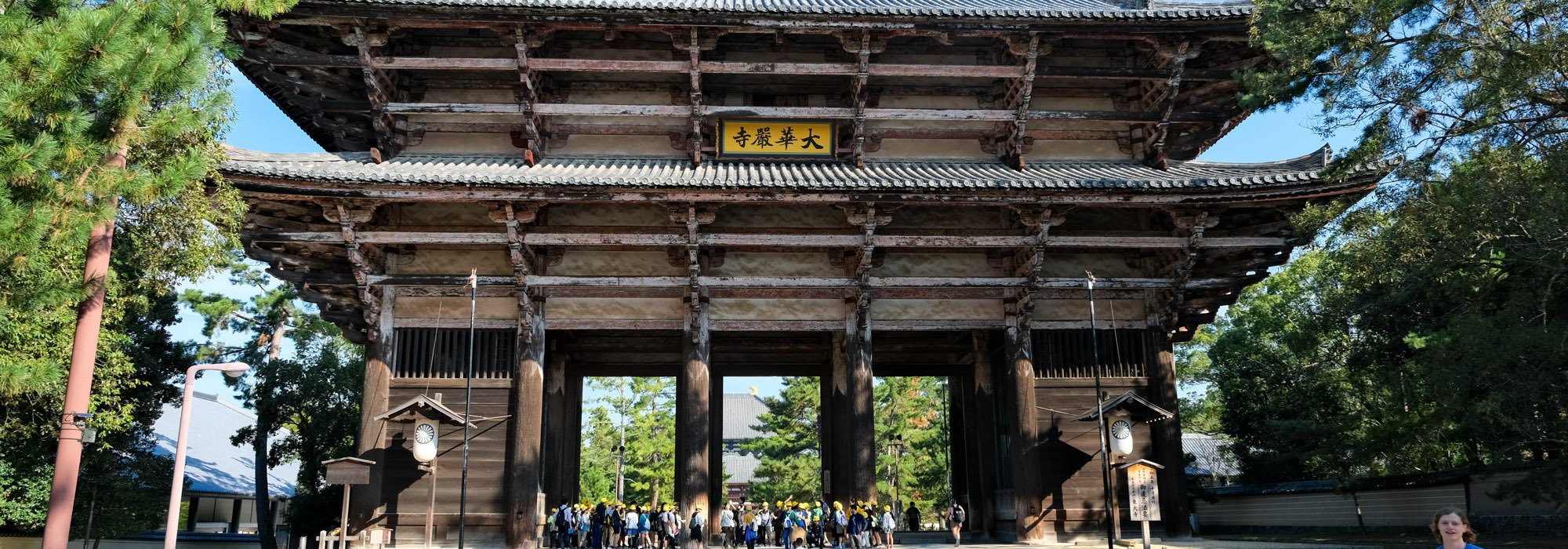
- Todai-ji, the great eastern temple, the main attraction of Nara displays a monumental architecture, both impressive and authentic, that shelters a large bronze Buddha of the 12th century. Its large enclosure is also home to other pavilions (additional admission fee may apply) and we particularly recommend visiting Nigatsu-do for its panoramic view.
- Kasuga Taisha, a large Shinto shrine famous for its many stone or bronze lanterns that line up along its pathways. On a more subdued note, its spiritual atmosphere is fostered by the surrounding nature. It is a shika deer spot and it is also home to the lovely Man’yo botanical garden.
Back to Nara JR station, the narrow streets of the picturesque Naramachi district provide a gourmet break in one of its cafés, an occasion to buy souvenirs or dive deeper in the culture with small museums homed in former machiya townhouses of the Edo period.
Other interesting sites can be discovered in the same area, depending on personal interest or time available:
- Yoshiki-en and Isui-en: these 2 neighboring green spaces feature traditional gardens, with the possibility to attend to a tea ceremony and watch memorable landscapes that include the Todai-ji or Mount Wakakusa in the background.
- Nara National Museum: is home to a permanent collection of Nara’s Buddhist statues and ritual bronze objects. It regularly displays the treasures of the Shoso-in, a temple at the eastern end of the Silk Road, in temporary exhibitions.
- Mount Wakakusa: this 342 meters high hill has an easy hiking trail with a panoramic view on Nara Park, but is only open in spring for the sakura blossoms, then in autumn.

Nara in 2 days: the west of the ancient city
The discovery of historical Nara can be prolonged over a 2nd day, around the reconstitution of Heijo’s former imperial palace. Due to its western location slightly off the city center and the requirement to take another train (Kintetsu) to reach it, the area is less busy with tourists, but it can easily offer a full day of interesting visits such as:
- Heijo-kyu, the large archaeological site offers a revival of the 1,000 years old imperial palace in all its glory, completed by a historical museum, both served by Yamato-Saidaiji station.
Then, in the same area and from Nishinokyo station, visitors can reach:
- Toshodai-ji, a Buddhist monastery built 1,300 years ago in a monumental architecture.
- Yakushi-ji, a temple also founded in the 7th century, dedicated to the Buddha of Medicine, whose enclosure is also in the UNESCO’s list. Its renovated pavilions are laid out in a perfect symmetry, highlighted by 2 pagodas.

Exploring Nara prefecture
Travelers who have enough time or who would like to move away from the beaten tracks can use Nara City as an introduction before exploring the eponymous prefecture, that has many other remarkable sites:
- Koriyama Castle 🏯 (Yamato-Koriyama station, Yamatoji JR Line), in spring for the blooming of its 800 cherry trees and its Yamatokoriyama Oshiro Matsuri festival taking place from late March and early April.
- Horyu-ji (Horyu-ji station, Yamatoji JR Line), a 7th century monastery that was the 1rst Japanese site designated on the UNESCO World Heritage List. It preserves the oldest wood buildings of Japan, and can be visited in about 1,5 hours.
- Hozan-ji: beautiful Buddhist temple of the Risshu Shingon Buddhist school, on the side of Mount Ikoma, and reachable with Kintetsu Railway.
- Chogosonshi-ji: Buddhist temple of the Shingon school located on Mount Shigi and attached to Heguri city (Oji station, Yamatoji JR Line + bus or Shigisanguchi station on the Kintetsu Line).
- Asuka, of a more easy access from Osaka (Kintetsu Railway), is a village that homed the imperial capital before Nara. It combines historical remains and Japanese countryside, for a leisurely visit in spring or in fall. Its Oka-dera temple is said to be the inspiration for the famous Dragon Ball manga by Akira Toriyama.
Lastly, Mount Yoshino, famous for its 30,000 sakura, is also a historical site used as a refuge by the Southern Court in the beginning of the Muromachi period and until 1392 (Kintetsu Railways from Osaka).
Nara can be visited in at least 1 day, going on a 1-day trip from Kyoto or Osaka. The place is sure to please families, couples, group or single travelers, in any season, and is a must-see of the Kansai area and of Japan broadly speaking.