
New Year Traditions in Japan
Japan has been celebrating the New Year’s Day on January 1rst since the end of the 19th century. It is, without a doubt, the most important family celebration in the country that still retains essential aspects of traditional Japan.
The time of the beginning of the year is called Oshogatsu (御正月). Public administrations, many tourist attractions, and even shops are closed during Oshogatsu, usually from December 29 to January 3, and often longer when a weekend closely precedes or follows these dates. December 28 thus become the last working day of the year in Japan (仕事納め shigoto osame).

Traditions before the New Year
As soon as December 25 has passed, Japanese put away the Christmas decoration to focus on the preparations of the New Year’s Day celebrations.
The end of the year
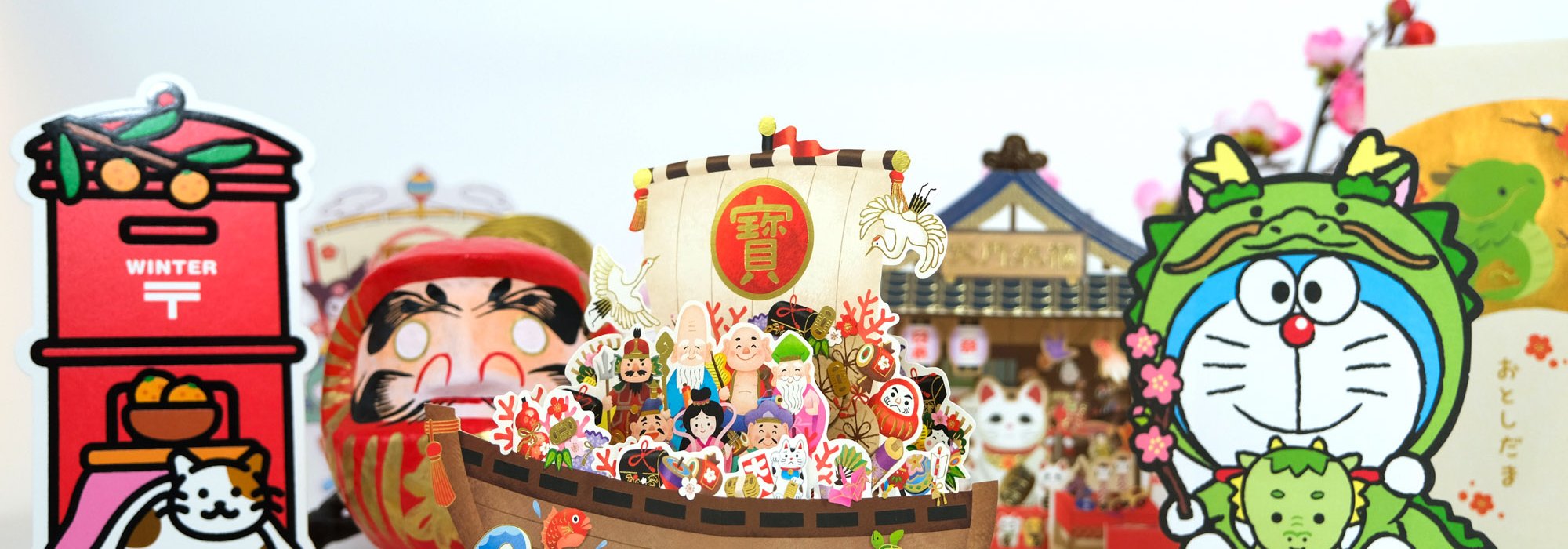
The tradition is to mail greeting cards called nengajo (年賀状), which must be delivered on the morning of January 1. The Japan Post ensures a timely delivery of the greetings, if the cards are entrusted to them no later than December 28.
The card can be a postage-paid postcard, or nenga hagaki (年賀葉書), with a stamp bearing the image of the Chinese horoscope’s animal of the coming year. This type of card also displays a lottery number, which is very popular with Japanese people. With this number, they can enter a lottery game with big prizes such as trips or money.
In 2003, a record number of 4,4 billion greeting cards were sent. Ever since, however, the number has been decreasing, with 3,3 billion cards printed in 2015 and only 490 million for 2025 New Year’s Day. The digital greeting cards, much cheaper, is preferred.
At home, the front door is decorated on each side with a pair of kadomatsu (門松), an ornamental floral composition of bamboos and pines, which is a symbol to welcome gods. A rice straw rope, or shimenawa (しめ縄), is suspended on the front door, in a Shintoist ritual practice to protect the house from demons.
The last days of December are dedicated to Osoji (大掃除), a rite of purification consisting of a thorough cleaning of the house. Everything is washed from the floor to the ceiling, not only at home, but also in schools and even at work! The susuharai (煤払い) tradition is a full day dedicated to washing off the dirtiness of the past year and is performed between December 13 and 28.
The week before New Year’s Eve is devoted to bonenkai (忘年会), parties with friends or colleagues to "forget the year". It is a very busy period for izakaya pubs and it can be difficult to book one. In 2019, 65,5% of the companies entertained a bonenkai, but only 8% in 2020 and 13% in 2021 due to the Covid crisis.
Shinto shrines throughout Japan set up a chinowa ring for December 30, so that worshipers can perform the New Year purification ritual called Oharae (大祓).
A lot of shops also take the opportunity of the year end to organize huge bargain sales.
Omisoka: New Year’s Eve
New Year’s Eve on December 31 is called Omisoka (大晦日) and is a rather traditional family gathering, except for young people who may go partying with friends. A soba or udon noodle soup called toshikoshi (年越し, "up to the new year") is served and the custom is to completely finish the dish.
People usually watch TV, especially variety shows that broadcast skits and traditional or modern songs. The most popular program is Kohaku Uta Gassen (紅白歌合戦), "The red vs. white song contest", a music show aired on the New Year’s Eve since 1951 on the NHK. It is staged as a competition between an all-female singers’ team and an all-male singers’ team for the audience’s votes. While it used to be incredibly popular for decades (with an 81,4% record audience in 1963), its audience has been on the decline over the recent years, with audience scores for the 2015–2016 show at 39,2%, to reach its lowest score in 2021-2022 with only 34,3% of the viewers.
Moreover in 2020, and for the first time in 12 years, the idol band AKB48 was not in the guest-list, a sign of changing times. The New Year’s Eve 2024 marked the 75th Kohaku aired on the NHK.

Around midnight, people go to the Buddhist temple or the Shinto shrine for the first temple visit, called hatsumode (初詣), where they ring a bell as a form of prayer. Temples and shrines can be overcrowded and people often wait in line, sometimes for several hours.
Some temples and shrines are extremely popular and receive more than a million visitors during the early days of the year, like:
- Meiji Jingu and Sensoji in Tokyo;
- Fushimi Inari Taisha in Kyoto;
- Sumiyoshi Taisha in Osaka, and,
- Tsurugaoka Hachimangu in Kamakura.
Then, back home, it is time for the New Year’s Day feast called osechiryori (お節料理), made of a variety of dishes and whose tradition dates back to the Heian period. The food is prepared in advance and stored in compartment boxes (jubako / 重箱). They are usually prepared by the mother, but the trend is now to buy takeaway osechiryori boxes from the supermarket.

Decorated envelopes called otoshidama (お年玉) are given to children. Grandparents or older relatives usually make this present into which they slip Yen 💴 notes as a gift of cash. The amount varies according to the child’s age and can range from ¥500 to ¥10,000 (~US$3.17 to ~US$63.49), and the habit lasts until they come of age. The envelopes normally display a traditional motif, but pop culture-themed envelopes are also increasingly popular, displaying for example illustrations of One Piece.
In Tokyo, several train 🚅 or metro lines continue their services during New Year’s Eve, even when they do not usually run during the night. This is the case, for example, of the Yamanote line, that maintains trains running every 10 minutes, on average, all night long.
On a side note, the Coca Cola Company has been sponsoring a countdown video before midnight in Shibuya since 2016. On the first year, more than 67,000 persons participated in the event. This celebration was however suspended in 2021 and 2022 due to the Covid crisis.
Since 2019, alcohol’s sale and consumption is forbidden from December 31, starting 6 p.m. to January 1 until 5 a. m., like during Halloween 🎃.

Customs of the beginning of the year
Read the linked article to know How to say Happy New Year in Japanese.
Ganjitsu: January 1rst
On January 1rst, the Japanese get up early to watch the first sunrise of the year, called hatsuhinode (初日の出). Hatsuhinode can be enjoyed from several wonderful tourist locations:
- Tokyo Metropolitan Government Building’s Observatory in Shinjuku;
- Mount Fuji, especially from the Five Lakes; climbing is also possible, provided the help of a mountain guide, to enjoy the sun rising or goraiko (ご来光);
- Port Tower in Chiba;
- Mount Moiwa in Sapporo;
- Miho no Matsubara Beach in Shizuoka;
- Uppama Beach in Okinawa, and,
- Katase Higashihama Beach in Kanagawa (Enoshima).
At 9 a.m., it is time to drink the first sake 🍶 of the year (toso / 屠蘇), along with eating a generous breakfast. Then, people return to the temple to receive predictions of good fortune (omikuji / 御神籤). It is also usual to practice traditional games, such as flying kites.
January 1rst (ganjitsu 元日) is a holiday, and many shops and companies are closed on this day and up to next two to three days. Most konbini, however, stay open. It’s like a mini Golden Week, during which the Japanese can relax, go on trips to meet their families, or go abroad. Train stations and airports are really busy and booking accommodations can be difficult at this time of the year. So, plan accordingly and a long time in advance if you wish to visit Japan during the New Year celebrations. Big cities, on the contrary, become less crowded and visiting tends to be more interesting and enjoyable.

The early days of January
On January 2, the Emperor of Japan presents his greetings to the visitors of Tokyo Imperial Palace. Aside from the anniversary of the Emperor (from 2020 on, on February 23), this is one of the rare occasions for the public to see the Emperor in person. The imperial family welcomes the very dense crowd several times during the day from a balcony protected by glass. It did not happen however in early 2021 and 2022 due to the Coronavirus 🦠 pandemic.
On the first days of the year, the tradition is to avoid cooking, but eating treats is encouraged. The favorite desert at this time of the year is mochi (餅), a Japanese delicacy made of glutinous rice. Delicious though it may be, it is the cause of numerous deaths by suffocation each year, especially among the elderly (in the 2014–2015 celebrations, 9 people died, and 128 were injured).
Starting January 1rst, many shops sell lucky bags or fukubukuro (福袋). From ¥3,000 (~US$19.05) to as much as ¥5,000 to ¥10,000 (~US$31.74 to ~US$63.49), the bags contain a set of products that often cost twice their purchase prices! Japanese people love this tradition and the happy surprise it involves. Apple’s lucky bag is one of the most famous: available on January 2, it offers devices for sometimes five times the purchase value.

Even after New Year’s Day, after-work parties can also be organized to celebrate the New Year. They are called shinnenkai (新年会) and while less common than the bonenkai, these events partake in the same kind of festive mindset.
A custom to attract "good fortune" is also practiced in the early days of January: touring the neighborhood’s temples and shrines dedicated to the 7 Lucky Gods (Shichifukujin) like a small pilgrimage.
January 4th is considered the 1rst working day of the year, and the day when everybody come back to work after the New Year’s celebrations.
The year of the… (horoscope)
Japan follows the Gregorian calendar; however, each new year is associated with a sign of the Chinese zodiac:
- 2024: Dragon 🐉
- 2025: Snake 🐍
- 2026: Horse 🐎
- 2027: Sheep 🐑
- 2028: Monkey 🐒
- 2029: Rooster 🐓
- 2030: Dog 🐕
- 2031: Pig 🐖
- 2032: Rat 🐀
- 2033: Ox 🐃
- 2034: Tiger 🐅
- 2035: Rabbit 🐇 (or Cat)
- 2036: back to the Dragon and so on.
The Chinese New Year is not celebrated in Japan (except among Chinese expatriates, of course!)
Kanpai wishes you all a Happy New Year!