
Kanazawa
The Little Feudal Pearl of Ishikawa
Kanazawa is the capital of Ishikawa Prefecture, located in western Honshu between the Sea of Japan and the Japanese Alps. The old town, clustered around the castle park and the famous Kenrokuen garden, showcases traditional Japanese craftsmanship and feudal-era architecture. Its main highlights can be covered in a single day, or you can stay 2 to 3 days to dig deeper into the city and its surroundings.
Kanazawa, a city of art and history on the shore of the Sea of Japan at the gateway to the Noto Peninsula, welcomes 8 million tourists a year. Most of them pass through the great Tsuzumi-mon gate at the exit of the JR station bearing the city's name. This "pearl of Ishikawa" is easily reached from Tokyo in 2.5 hours thanks to the direct Hokuriku Shinkansen 🚅.
Still relatively sheltered from overtourism thanks to its distance from the Golden Route, Kanazawa is a destination whose popularity is steadily growing, built on its traditional heritage and the remnants of its feudal past — so distinctive that it is sometimes nicknamed "Little Kyoto" or the "Edo of the Japanese Alps."
The city packs a number of sites related to Japanese history, culture and art into a compact area — enough to fill a solid day of sightseeing for travelers in a hurry, or to serve as a 2- or 3-day stop on a route between the Kanto and Kansai regions using the Hokuriku Arch Pass.
It's a pleasant destination year-round thanks to landscapes enhanced by seasonal changes, particularly in winter, when it's blanketed in thick snow.

A Prosperous Domain Under the Tokugawa Shogunate
The name Kanazawa, meaning "golden marsh," was first recorded around 1480, after traces of gold were found in the local crops.
The town began taking shape around the middle of the 16th century on the site of the present-day castle 🏯, between the Sai and Asano rivers, as a "peasant kingdom" founded by farmers and low-ranking samurai affiliated with the Pure Land sect, amid the Ikko-Ikki popular uprisings that swept the entire country at the time.
Oda Nobunaga put an end to Kanazawa's uprising in 1580 and handed the Kaga domain (Ishikawa Prefecture, around Noto and Toyama) to one of his vassals. Three years later, however, the territory passed into the hands of Maeda Toshiie (1538–1599), founder of the Maeda clan, who was raised to the rank of daimyo (feudal lord) that same year. The Maeda managed to hold onto their position by skillfully navigating Toyotomi Hideyoshi's rule and then allying themselves with Tokugawa Ieyasu. As a result, after the Battle of Sekigahara (1600), the Maeda domain was considerably expanded, and the clan became nearly as powerful as the Tokugawa themselves.
Kanazawa became the economic and political center of the Kaga domain. The Maeda directed most of their wealth toward crafts and culture, acting as patrons and encouraging skilled artisans and merchants to settle in the city. This is how the region built the reputation it still carries today, in fields such as gold-leaf gilding, gold-powder maki-e lacquerware, Kaga-Yuzen kimono 👘 dyeing, and Kutani ceramics.
The castle town proved highly attractive, growing to 50,000 residents by 1600 (compared with 60,000 for Edo), and doubling that number by 1700. The Maeda ruled over Kanazawa and the Kaga domain until 1868 and the end of the Edo period. Their legacy is still celebrated today during the annual Hyakumangoku Matsuri festival. Over 3 days on the 1rst weekend of June, visitors can watch a historical parade with 2,500 participants, an Obon dance festival, and a Toro Nagashi lantern 🏮-floating ceremony.

In the Footsteps of Takayama Ukon
Takayama Ukon (1552–1615), also known as Hikogoro Shigetomo or by his Latin name Justo, was a daimyo lord who converted to Christianity. Persecuted for his faith, he found refuge in Kaga province. He was beatified by the Vatican in 2017 in Osaka as a Japanese Catholic martyr.
This Catholic Christian, or kirishitan in Japanese, was baptized at age 12 by Father Dario. Takayama Ukon went on to pursue a military career marked by several successes, while also evangelizing the local population. His influence came to an abrupt halt in 1587, when Toyotomi Hideyoshi rose 🌹 to power and firmly opposed Christianity.
Stripped of his lands and power, Ukon fled to Kanazawa, where he gained the protection of Maeda Toshiie’s powerful clan. During the 27 years he spent in the region, he put his architectural talents to use, helping design the castles of Takaoka and Kanazawa. He also kept working for his beliefs, as shown by Kanazawa Catholic Church and the Holy Spirit Monastery Cathedral — 2 buildings that can still be visited in the city center today.
Though less prosperous in the 1rst half of the 20th century, Kanazawa was spared the destruction of World War II, allowing it, since the 2000s, to capitalize on its rich cultural past and historic districts. Given its artistic character, the city has been twinned with Nancy, France — a hub of Art Nouveau — since 1973.

The Must-See Highlights of Kanazawa in 1 Day
The historic city center can be explored in a single day. It's about a 20-minute walk from JR Kanazawa Station, or easily reached by city bus or taxi. It consists of a trio of tourist attractions clustered together in the feudal heart of the city, around the castle:
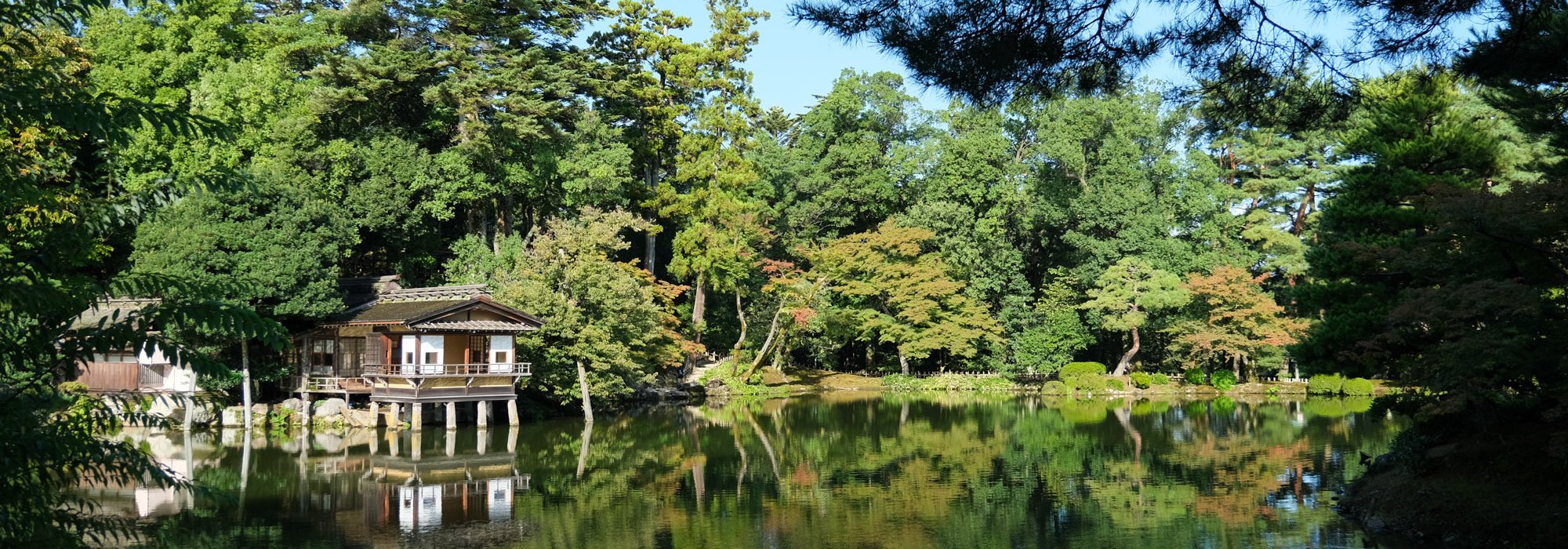
- Japanese garden Kenroku-en, one of the 3 most beautiful in Japan, is worth visiting year-round:
- The 21st Century Museum of Contemporary Art, one of the most visited museums in Japan, whose permanent collection features some of the best-known Japanese and international artists, along with striking installations such as Leandro Erlich's swimming pool. Note: the museum will be closed for renovation work from May 2027 through the end of March 2028; and,
- The city's castle, whose main appeal is admiring the cherry blossoms in spring (late March to early April). Most of the buildings recalling its defensive role, scattered across its expansive lawns, are recent reconstructions. It does, however, house a lovely Japanese garden: Gyokusen Inmaru Teien.
Visitors wanting to immerse themselves further in the feudal era can explore the samurai district Nagamachi, a short walk west of the castle grounds. Its cobbled lanes wind between old residences enclosed by typical earthen walls, with large wooden houses — some of which are open to visitors, such as the Nomura-ke samurai residence.

Kanazawa in 2 or 3 Days
A longer stay in Kanazawa allows you to discover the city's Edo-era lifestyle, its cuisine, and its craftsmanship:
- Omicho Market, a few minutes' walk from Kanazawa Station, is a delight for fish and seafood lovers. This large, 300-year-old covered market houses close to 170 shops. Its daily delivery of fresh produce draws tourists and locals alike, who come to enjoy sushi and kaisen-don at the surrounding restaurants.
- Oyama-jinja shrine, dedicated to the founder of the Maeda clan, is worth a visit for the unusual architecture of its Shinmon main gate, which blends Chinese and European influences.
- The 17th-century strolling garden Gyokusen-en covers around 2,370m² and borders Kenroku-en garden on its northeastern edge. It houses a teahouse where traditional tea ceremonies are still held (reservation required).
- Higashi Chaya, on the eastern bank of the Asano River, is the former geisha district, made up of 2 main cobbled lanes lined with preserved buildings recognized as Japanese cultural heritage. While most now house souvenir shops, local craft stores, and restaurants, the district is also home to 2 genuine Chaya teahouses offering local geisha performances (advance reservation required). You can also simply stroll among the shops and take a break for a typical matcha tea paired with a sweet.
A few hundred meters northeast of Higashi Chaya, the stroll can continue into the Utatsuyama district, home to around 50 temples and shrines. It's easy to spend more than an hour there exploring the lanes and the roughly 10 places of worship open to the public.
Heading back toward the castle, another Chaya district, Kazuemachi, awaits on the western bank of the Asano River. It's the perfect spot to settle into a bar or restaurant at the end of the day, surrounded by classic Japanese charm.
Finally, at the southern edge of the castle's tourist area, the D.T. Suzuki Museum occupies a modern building dedicated to the thinker who popularized Zen Buddhism in the West, and who was born in the neighborhood. Featuring an exhibition space and 3 gardens, the museum also hosts meditation sessions.

Experiencing Kanazawa's Artistic Craftsmanship
Kanazawa is the ideal place to take part in a hands-on craft workshop, with a varied offering to fit every budget (starting rates between ¥1,000 / ~US$6.46 and ¥6,000 / ~US$38.77 ). Workshops, best booked in advance, typically last 1 to 2 hours and involve decorating or shaping a small object, which you can take with you right away or have shipped later to an address in Japan. It's a great way to try your hand at a local craft and go home with a truly authentic souvenir, such as:
- Kutani ceramics, through a decorating workshop or a potter's studio tour;
- Traditional ornamental knot-tying, or Mizuhiki;
- Kaga-Yuzen kimono fabric dyeing (as a tote bag or handkerchief), notably at the Kaga-Yuzen Kimono Center near the castle;
- Gold work, whether in leaf or powder form, for kintsugi repair or maki-e lacquerware.

Day Trips from Kanazawa
Kanazawa is well located for day trips in western Japan, depending on your interests and the kind of experience you're after, including:
- Renting a car to open up more off-the-beaten-path spots in Ishikawa Prefecture, such as Nata-dera temple, the Hiyo Koke no Sato moss garden, and the 4 mountain hot-spring villages of Kaga Onsen.
- The Noto Peninsula and its seaside scenery offer an interesting contrast to Kanazawa on a coastal road trip. Its hot-spring town, Wakura Onsen, is being rebuilt and is gradually reopening to visitors following the earthquake of January 1, 2024. From July 7, 2026 through September 2029, Noto Airport is becoming the world's 1rst official Pokémon airport, renamed the Noto Satoyama Pokémon With You Airport for the occasion.
- The Japanese Alps, and in particular the UNESCO-listed gassho-zukuri villages of Shirakawa-go and Gokayama, are also accessible by bus.
- The western part of Toyama Prefecture, once part of the Kaga domain, offers unusual outings such as discovering wood carving in Inami, or visiting sites linked to Takayama Ukon and the Maeda clan in Takaoka. Toyama city itself is worth a detour for its castle and its glass museum.
Kanazawa is close to the region that was severely hit by a magnitude 7,6 earthquake on January 1, 2024 (also known as the 2024 Noto earthquake), but the city itself was only marginally affected, and no damage remains visible there today.
This former feudal city strikes an excellent balance between culture, traditional architecture, artistic craftsmanship, museums, and food. It can easily be worked into a 1- to 3-day stop on a first trip to Japan, whether traveling with family, friends, or solo.