
Hokkaido
The Large Island in the North of Japan
Hokkaido is the second largest Japanese island, covering an 83.456 square kilometers superficies in the northernmost part of the archipelago. Both a prefecture and a region, it is home to more than 5 million inhabitants, including the Ainu minority, an indigenous people of Japan. Its wilderness and its snowy weather are its most important assets.
Hokkaido is located between the Sea of Japan in the West, the Okhotsk Sea in the North and the Pacific Ocean in the east, while connecting with the Sakhalin and Kuril Islands, whose ownership is is claimed by both Japan and Russia. It is one of the Japaneses’ favorite destination thanks to:
- Its weather dryer and cooler than the rest of the archipelago in summer – temperatures seldom exceed 25°C in July and in August; and,
- Abundant snowfalls creating wonderful landscapes in winter. Due to its closeness to the Siberian climate, negatives temperatures are standard from December to early April.
Forest is covering nearly the three-fourths of Hokkaido’s territory, and the island is appreciated for its ski resorts and its beautiful national parks 🏞️ with mountain peaks and volcanic lakes, home to a rich wildlife and flora.
A large rural and agricultural region, it is divided into 14 sub-prefectures to facilitate the management of such a large territory. There are nonetheless a few big cities to visit, such as its capital Sapporo or Hakodate, its southern gateway.

How to travel in Hokkaido?
The simplest and fastest way to go to Hokkaido is flying, especially when focusing the visits around Sapporo and its airport Shin-Chitose. The flight ✈️ connection between Shin-Chitose and Tokyo is by the way one of the busiest in the country, thanks to a 1,5 hour flight from Haneda. Sapporo is also connected to Osaka by a 2 hours flight.
Since 2016, the Shinkansen 🚅 bullet train also connects Tokyo to Hakodate in a 4,5 hours travel, running by the Seikan railway tunnel, the 2nd longuest tunnel in the world. The extension of the high speed line to Sapporo, initially envisioned for 2031, has be delayed to 2039 due to the complexities of the project. Generally speaking, Hokkaido’s railway network allows to conveniently connect the centers of its main cities.
Ferry ⛴️ is naturally also a solution to reach Hokkaido, with several ports to depart from like Aomori, Sendai, Niigata, Akita and even Nagoya or Maizuru (Kyoto prefecture) and reaching Hakodate, Muroran and Otaru.

Lastly, even more than in other parts of Japan, driving can be a good solution to move around the various national parks or to go to the north of the island; however, make sure to check the weather forecast as bad weather can make driving difficult in this wilder part of the country.

Why explore Hokkaido?
Hokkaido, called Yeso or Ezo in the past, was annexed to the Japanese territory in the beginning of the Meiji era, in September 1869, and then received its current name of "province of the northern seas." In 2018, the island celebrated its 150th anniversary under the Japanese flag 🇯🇵. The island’s colonization started in the 17th century, but it was already home to the Ainu, an indigenous people with a distinct culture who had been living here since at least the prehistorical Jomon era. Nowadays, the Ainu are a minority in the island’s population and tend to hide their origin to avoid being discriminated. However, their cultural legacy remains in specific toponyms such as Sapporo or Shiretoko.
Its wide spaces and the low population density allowed the island to become the 1rst producer of rice and fish in Japan, and to globally have a well-developed agricultural sector, including cattle farming. Local specialties include fishery products such as crabs 🦀 and sea urchins, but also the famous Sapporo beer 🍺.

Tourism is an essential part of the island’s activities, with 2 leading seasons:
- Summer, whose a cool weather attracts tourists fleeing the heat and humidity of the other Japanese regions. They go on a hike in middle and high mountains, do camping, and also visit the main touristic cities of the island: the southern gateway Hakodate, the capital Sapporo, and the flower towns of Furano and Biei.
- Winter, with abundant snowfalls making Hokkaido an essential destination for amateurs of ski and onsen ♨️ hot baths. Spa resorts such as Noboribetsu or Jozanki welcome sport lovers for a few pleasant relaxing days.

While excursions in nature make a large part of its attractiveness, Hokkaido also has an interesting choice of city leisure.

Sapporo, the capital
Sapporo is the island’s capital and the 5th most populated Japanese city. Political and economical center of the island, it is at the junction of its eastern and western sides, facing the Sea of Japan. It famously hosted the 1972 Winter Olympics 🏅, whose traces remains at its ski resort on Mount Moiwa. The city-center is structured around the large Odori avenue, where the ice sculpture festival Yuki Matsuri is held every year in February and can be viewed from the observatory of its TV tower.
It is also the place of origin of the Sapporo breweries and home to the Sapporo Beer Museum. The streets around the JR station are highlighted by places commemorating the Japanese colonization in the end of the 19th century (like the Clock Tower) and Sapporo University’s Botanical Garden provides a nice walk in the heart of a varied vegetation and preserved 19th century buildings. It also has its own shotengai: Tanukikoji Shopping Street.

Otaru, the picturesque port city
About 1 hour train ride from Sapporo, on the Sea of Japan, Otaru, once nicknamed the "Wall Street of the North" can fill a 1-day trip. While it may be quite foreign for Asian tourists, it remains familiar to Western travelers who wander in streets lined with 19th century-style banks. Otaru is well-known for its sushi 🍣 street, its stained-glass museum and more importantly for its old port warehouses along a waterway network. The waterways are lit up with ice lanterns 🏮 during the nightly Yuki Akari no Michi festival in February.

Hakodate, the southern access
Founded as soon as the 15th century in the south-east end of the island, Hakodate is facing Aomori, on the Tsugaru Strait. As the first point of access on the territory, it was home to the short-lived Republic of Ezo in 1868-1869. The Goryokaku star fortress inspired by Vauban’s military forts, is embellished in spring by the blooming of the sakura 🌸 in its park. Its museum Hakodate Jomon Culture Center is home to a reconstitution of the indigenous people’s life, and Mount Hakodate in the south offers a beautiful view on the city. Its northern side also gives access to the Onuma quasi-national park overlooked by Mount Komagatake.

The 6 National Parks of the island
Hokkaido is famous for its wilderness and preserved large horizons, and has 6 national parks, from south to north:
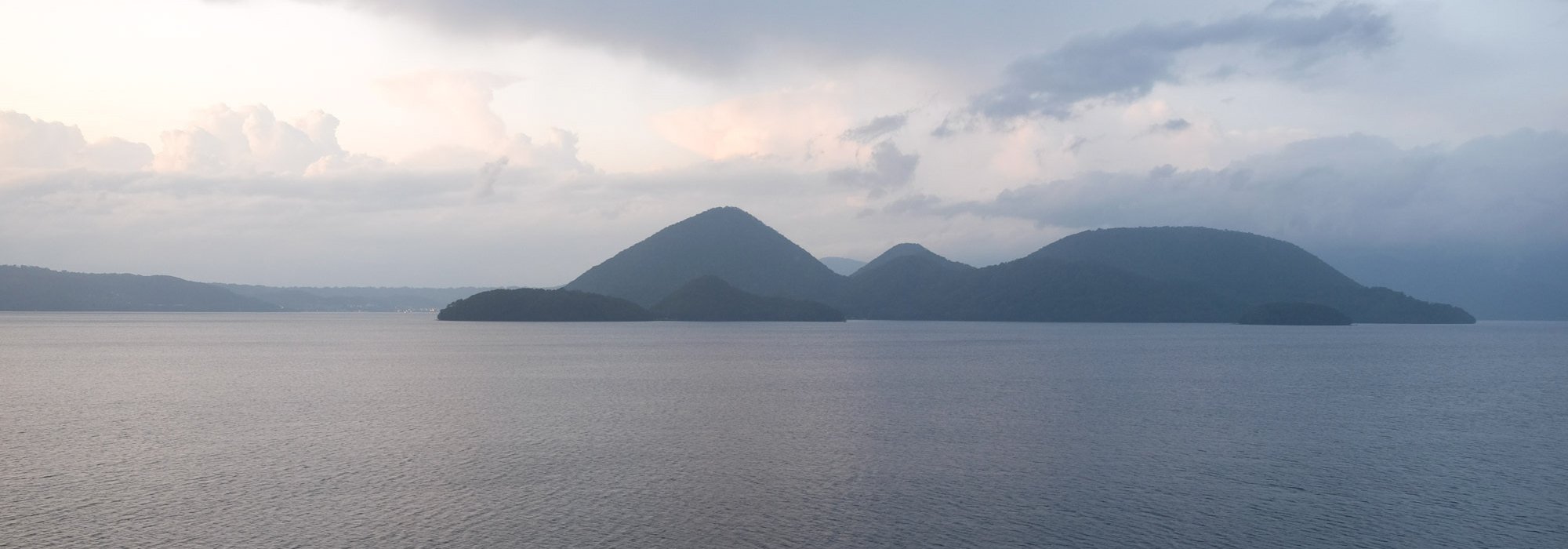
- Shikotsu-Toya, extending to the south and the west of Sapporo and opening on the Pacific coast. It combines sceneries of active volcanoes and large caldera lakes, such as the famous Lake Toya. Mount Yotei, a 1,898 meters-high stratovolcano, is nicknamed "the Fuji of Yezo" due to its specific shape 🗻. It is featured in the video game Ghost of Yotei released on October 2nd, 2025 for PlayStation 5. Additionally, the park is home to the famous Niseko ski resort situated inland, and the onsen hot springs of Noboritbetsu on the coast near Muroran. The Aïnu Upopoy National Museum is also located nearby.
- Daisetsuzan is located at the center of the island, encompassing about 2.268 km². It is home to its highest peak, Mount Asahi (2.291m) and is covered in snow from November to mid-May, allowing the city of Asahikawa to host its annual snow festival Fuyu Matsuri in February. In the warmer seasons, Biei and Furano villages are covered in flower fields and the start of the autumn koyo 🍁 foliage season begins in September on Mount Daisetsuzan.
- Akan-Mashu lies in the east of Daisetsuzan, and between Abashiri (in the north) and Kushiro (in the south). Formerly inhabited by the Ainu, it has 3 marvelous lakes: Akan, Kussharo and Mashu ringed by hiking trails. They are home to the marimo, a cute spherical green algae species. The popular thermal resort Kawayu Onsen offers a nice relaxing time after a walk.
- Shiretoko encompasses the eponymous peninsula that stretches on the Sea of Okhostk. The park is enlisted in the UNESCO World Heritage for its unique marine and forestry ecosystem. The trail of the 5 lakes Shiretoko Goko welcomes hikers of all levels. Cruises are offered all year long to admire the cliffs on the sea, and specifically in winter to discover the ryuho drift ice.
- Rishiri Rebun Sarobetsu is the northernmost national park on the island. It extends on 2 islands, Rishiri and Sarobetsu, as well as on the coasts of Wakkanai. It is characterized by peat lands and coastal dunes.
- Kushiro-Shitsugen, in the south of Daisetsuzan and in the east of Akan-Mashu, is home to the largest marshland of the country and is also the natural habitat of the red-crowned crane.
Therefore, Hokkaido is the ideal destination for outdoor activities: ski ⛷️, camping, hiking 🥾, various aquatic sports. However, this natural environment is to be explored with caution: higuma bears 🐻 are plenty and usually don’t fear the humans. So make sure to check the safety instructions before jumping into the Japanese northern wilderness, especially during the bears’ activity period between July and October.