
Nagahama Bonbaiten
The Big Plum Blossom Bonsai Exhibition
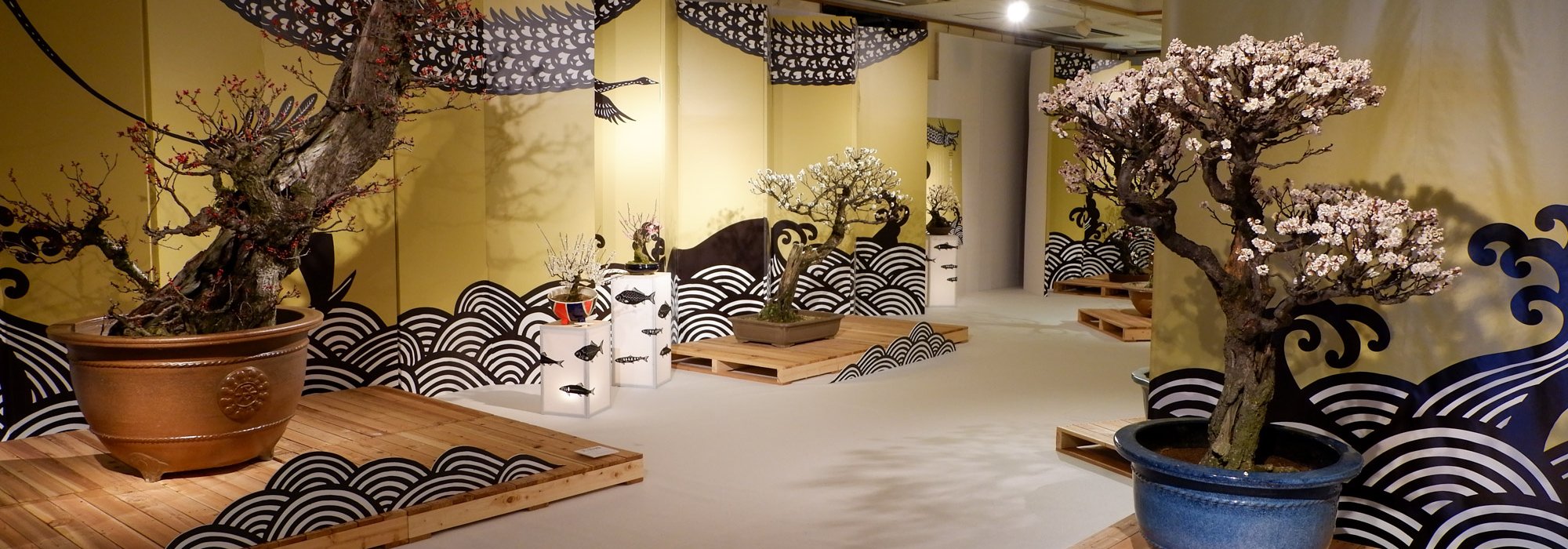
Nagahama Bonbaiten is an exhibition of plum blossom bonsai hosted in the ancient traditional Keiunkan residence, located in Nagahama city on the shore of Lake Biwa, in Shiga prefecture in Japan. About 90 ume bonsai, some of which are several centuries old, are displayed during this floral art event every year from January to early March.
Nagahama, a quiet small town on the banks of Lake Biwa near Kyoto, offers an original way of enjoying the plum blossoms (ume) in Japan. An important exhibition of plum blossom bonsai, called Nagahama Bonbaiten, is taking place here just after the New Year’s celebration and until early March: about 2,000 potted plum trees of 400 different species are shown by rotations of 90 ume trees. Selection of the plum trees is based on their blooming stage: from the early development of the buds to the final plum blossom, also factoring the various hues of white, pink and red.
The nearly hundred of bonsai offer an elegant yet impressive sight, underlined by a successful light-up and staging. Some of these trees are quite gigantic, reaching up to 3 meters high, a feat accomplished only by those that are several centuries old. During the dolls festival Hina Matsuri taking place on March 3rd in Japan, the traditional altar is setup with bonsai instead of dolls.
Being true living art forms, each displayed bonsai is introduced with its official name and its main characteristics, such as the shape it reminds of. No need to be a connoisseur, anyone can be moved by the quality of the work undertaken to preserve these potted trees. It is undoubtedly one of the largest ume bonsai exhibition in Japan.

A traditional and authentic stage at the Keiunkan estate
Nagahama Bonbaiten has been existing since 1952 and takes place in the historical Keiunkan (慶雲館), a former guest house built in 1887 to receive emperor Meiji (1852 - 1912) in the city. The large tatami room is thus used to display the majestic bonsai, and visitors can enjoy both the traditional setting and the plum blossoms. Matcha tea amateurs can drink their favorite beverage at the tea room specially arranged for the occasion.
The residence’s Japanese garden, built at the same period by Jihei Ogawa VII (1860 – 1933), remains asleep at this time of the year and complement the visit. The pine trees are covered with their winter protection called yukitsuri (雪吊り). Bamboo decorations are interspersed along the pathways and lit-up at night, when the Keiunkan extends its opening hours for an evening illumination of the plum blossom bonsai.

Nagahama Bonbaiten is announcing the beginning of spring in Japan, at a time of the year when tourism is slower, which provides the exhibition an enjoyable confidentiality. Easy to access from Kyoto by train or by car, this exhibition is a nice discovery of Lake Biwa’s shores in the quietness of winter’s end.