
Takayama Jinya
The Former Hida Province’s Government Town
Takayama Jinya is the former governmental office of the old feudal town of Takayama in the Japanese Alps. This administrative buildings complex was the ruling center of Hida province for 3 centuries and was repurposed into a museum documenting the daily life of the local officials.
Takayama Jinya, located on the western side of the Miyagawa River and facing Shiroyama, is an administrative complex that operated nearly 300 years between the end of the 17th century and 1969. After several years of renovation work to restore its Edo period look, Takayama Jinya opened to the public in 1996.

The origins of Takayama’s Jinya
The Kanamori clan has been ruling over Hida province for nearly a century when the shogun decided of its transfer to the Dewa province up north (current Akita and Yamagata prefectures) in 1692. From then on, Takayama area’s abundant resources of wood and ores (gold, silver and copper) were directly ruled by the shogun’s administration.
The province thus became a Jinya, an administrative unit for small feudal domains or territories that were under the direct authority of the shogunate. Japan used to have about 60 of these administrative complexes, whose architecture without fortification was a testimony of the Tokugawa’s power. Besides, Takayama Castle 🏯 was dismantled at the opening of this new administrative complex.
Takayama’s Jinya was ruling over a large part of the territory that included the current Gifu prefecture and extended to Toyama. It had multiple functions: administration, police, court, tax collection and even housing for the Edo magistrate appointed to govern the province.

Reconstitution of the Edo period
Designated Historical Site a soon as 1929, notably for its architecture typical of the area’s carpenters’ skills (Hida no Takumi), Takayama Jinya is the only complex of its type to successfully maintain its main building in its 19th century’s state. It was also awarded 2 stars by the Michelin Guide.
The main gate of the small administrative town opens on a cobbled road leading to the buildings, divided into 3 areas. Firstly, the governing functions with:
- An entrance hall with a tokonoma alcove ornamented in a traditional seigaiha wave pattern;
- A courtroom and an interrogation room oshirasu displaying torture tools;
- Various office spaces for the civil servants to work at; and,
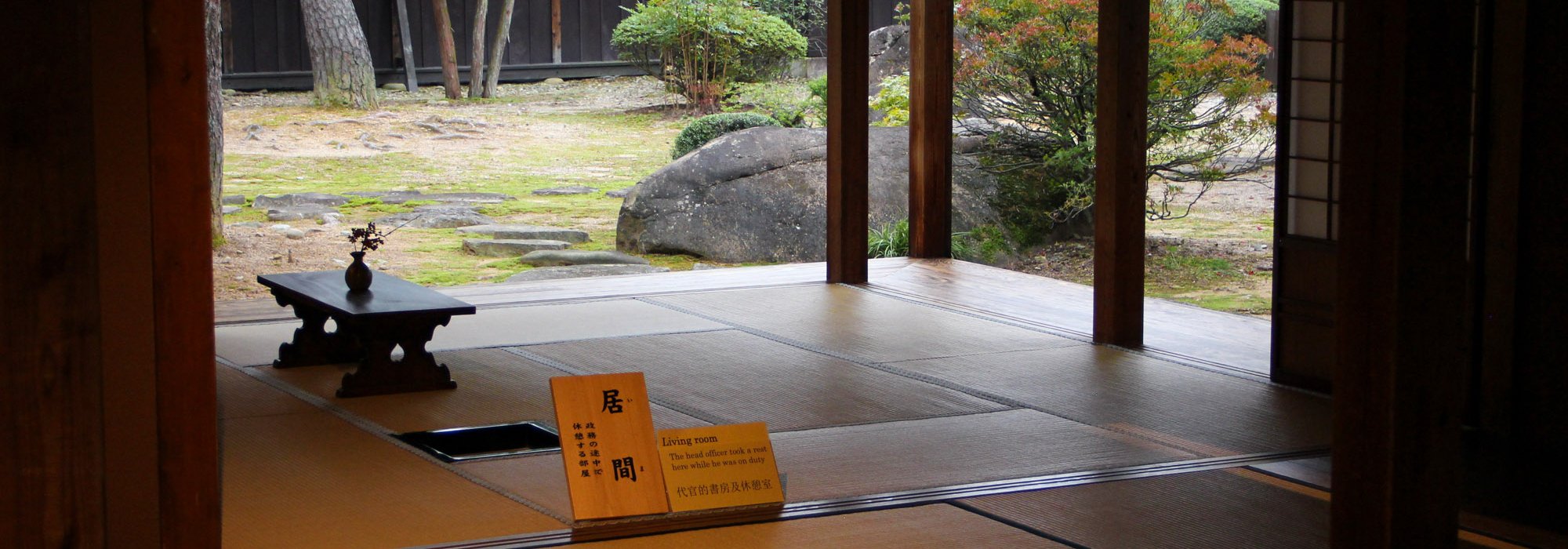
- Ohiroma, a large reception hall in the shoin-zukuri style, with a view on the garden.
The back of the complex was dedicated to the lodging of the magistrate and their family, with the main room Arashiyama no ma connected to a tea room.

Lastly, the long Onkura warehouse is one of the oldest and largest rice granaries of the Edo period to still exist. It is characterized by a cypress shingle roof hold by stone and wood cross beams. It was used to store the rice collected as a tax, and nowadays is a museum displaying historical documents about Hida province.
Inside the buildings, the floor is covered with tatami mats, so it is required to take shoes off and carry them in a bag. Takayama Jinya offers a simple visit for a glimpse on the daily life of government officials and constituents of a remote province in the feudal times. The Asaichi morning market taking place every day on the esplanade in front of the gate adds a nice authentic touch.