
Arashiyama
The Nature Side of Kyoto in Sagano
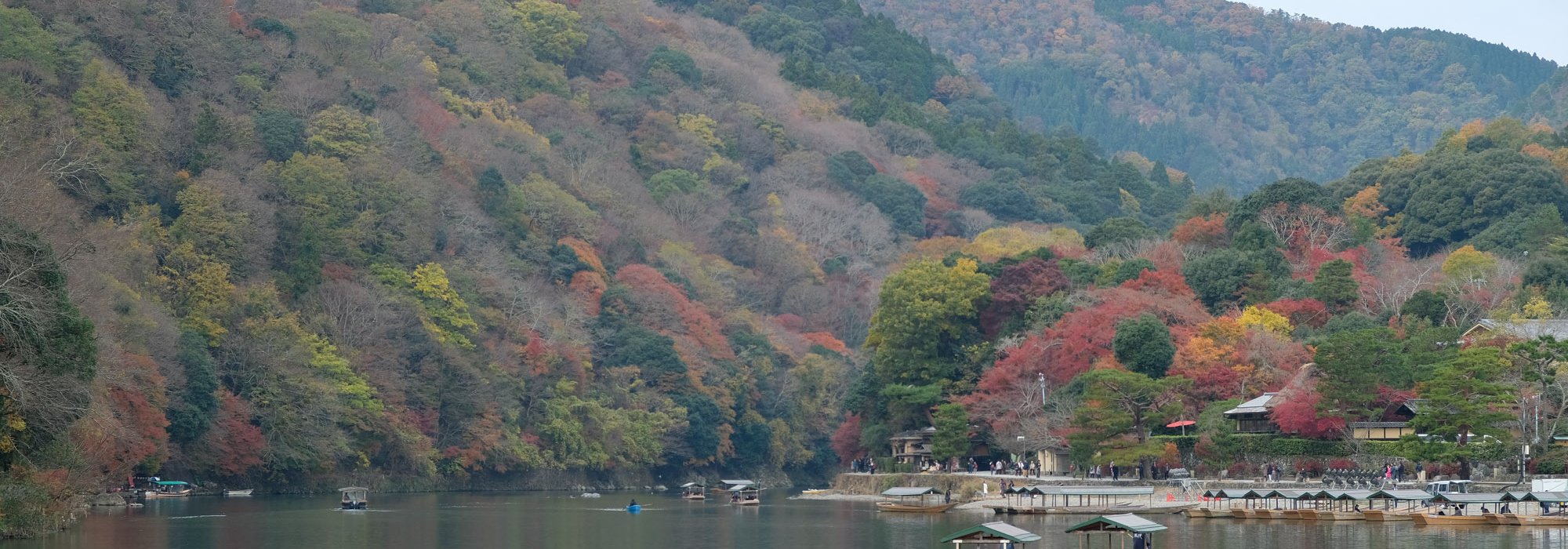
Arashiyama is a scenic district located in the western suburb of Kyoto. In the past, members of the Japanese imperial court enjoyed the area for leisure and now tourists are attracted to its spectacular natural landscapes, its Buddhist temples, Togetsukyo bridge and the famous Sagano Bamboo Forest. We recommend visiting Arashiyama over 1 to 2 days, as it is a must-see of Kyoto, particularly popular in spring for the sakura and in autumn for the koyo foliage.
Slightly off the north-west of Kyoto in Ukyo ward, Arashiyama is part of the much larger Sagano area. The very touristic area is located around and in the south of the Hozu (or Katsura-gawa) river, whereas Sagano district extends to the remote Kiyotaki (Sagakiyotakicho) village at the foot of the sacred Mount Atago.
Arashiyama’s popularity began as early as Japan’s classical age, when its was the favorite leisure hangout of aristocrats and imperial court members where they used to admire the spectacular aesthetics of its natural landscapes, made of rivers and forested mountains. The area became a place of choice for relaxing and contemplating nature and the passing of seasons, and also an inspiration for visual arts and poetry. Several Buddhist grounds were also established, as it offered ideal conditions for spiritual retreating and zen meditation.
Arashiyama and Sagano successfully maintained a beautiful harmony between nature and human architecture, which is overall of traditional wood buildings. With its air of old-time Japan’s postcard, Arashiyama is truly worth the trip: the landscapes barely changed since the nobility of the Heian period (794 -1185) used to admire them.
Nowadays, the area is easily accessible by train 🚅 from the center of Kyoto, thanks to the 3 stations that are located in the same vicinity:
- Saga-Arashiyama Station on the Sagano JR line;
- Arashiyama Station on the Keifuku Randen tramway line; and,
- The 2nd Arashiyama station on the Hankyu-Arashiyama Line.
Arashiyama is one of the must-sees of Kyoto, especially when staying several days in the former imperial city. Here, international tourists and Japanese vacationists mingle which can lead to situations of over-tourism on the time of the year, particularly on weekends and Japanese holidays and depending on the places visited.

Best times to visit and over-tourism
Arashiyama is a place to visit all year round, with 2 peak seasons when the mountains are the most beautiful:
- In spring, for the sakura 🌸 blossoms that usually bloom in early April (Nakanoshima and Kemayama Parks); and, especially,
- In autumn, for the red maple tree leaves koyo 🍁, from mid-November to early December.
Bamboos stay green regardless of the season and snow occasionally covers Arashiyama at the coldest of winter, namely in January and February. The forested landscape is the main character and there is no additional flower spot.
Flat boat cruises on the river are available from March to November. In the background, the mountains form a wall protecting the north-west of Kyoto. Rickshaw rides are available all year round to enjoy Arashiyama on the land-side.
To avoid a disappointing experience due to overcrowding, we recommend visiting Arashiyama:
- In the lowest seasons, that is to say in winter, in June and September;
- Early in the morning, for sunrise (5:30 a.m. in April and 6:30 a.m. in November) and even earlier to enjoy the free natural sites;
- In early evening, at nightfall as most of the visitors prefer going on the daytime.
A nice tip is to stay overnight to better enjoy the less busy hours of the morning and the evening. Accommodations in this area include traditional ryokan inns with onsen ♨️ hot springs and 3 to 5-stars hotels 🏨.
However, this location is only suitable when limiting travels to Arashiyama and its surroundings, and is a lot less convenient as an excursion base than the city-center or the vicinity of Kyoto’s main station. Moreover, evenings are fairly quiet and it is advisable to book a restaurant in advance for a dinner around 6:30 or 7 p.m., or to eat at your accommodation.

The must-sees of Arashiyama over 1 day
Togetsukyo, the famous bridge that crosses the Katsura river just before the train stations is certainly Arashiyama’s landmark. A "moon crossing bridge" (in a literal translation) according to the legend, the Japanese love to cross it on a date or on a family trip and watch the blooming cherry trees or the red maple trees, and also the sunset.
It connects to 2 very busy yet unavoidable areas of Arashiyama. First in the north:
- Tenryu-ji, a large temple and the heart of Arashiyama, listed in the UNESCO World Heritage, with a landscaped garden considered as one of the most beautiful of Kyoto;
- Arashiyama Bamboo Grove, one of the idealized landscapes of Kyoto, that is a victim of its own success but whose walkway lined with giant bamboo stems, while short offer a wonderful walk;
- Okochi Sanso, the former residence of actor Denjiro Okochi offering beautiful views on the surrounding mountains.
This side of the river is also home to a long shopping street, lined with:
- Souvenir shops, on the expensive side as they sell handcrafted goods (such as bamboo items); and,
- Traditional Japanese cuisine restaurants (especially yudofu) or cafés open on the daytime for tourists.
Then, Mount Iwatayama is standing to the south of the Katsura-gawa and topped by a monkey 🐒 park where hundreds of macaques roam freely. Visitors can observe them from afar with the additional bonus of an unobstructed view on Kyoto.

Temples of Sagano to step away from the crowd
The river banks area near Togetsukyo bridge and the bamboo grove gathers most of the tourists. The further you walk in Sagano district, the less you will feel Arashiyama’s over-tourism. On the contrary, it provides a more authentic walk heightened by Buddhist temples that are particularly beautiful in autumn during the koyo season.
The atmosphere becomes quieter, filled with spirituality and the presence of the trees at the foot of the forested mountains. We recommend the following places from south to north:
- Jojakko-ji, a temple of the Nichiren school of Buddhism located on the side of a hill at the foot of Mount Ogura. Its thatched roof gate, its Tahoto pagoda and its 2,000 maple trees that turn red and yellow in mid-November have made its reputation.
- Nison-in is known for a stone stairway framed with maple trees and several standing Buddha statues.
- Gio-ji has a beautiful moss garden thriving in the shade of the trees.
- The preserved Saga-Toriimoto road is lined with beautiful machiya townhouses maintained since the feudal period and some of which have been converted into restaurants or craft shops. It is a section of the former Atago Kaido road connecting to Atago-jinja shrine, located nearby on the eponymous mount.
- Adashino Nenbutsu-ji is renowned for its very old cemetery sheltering about 8,000 Buddhist statues and stupa erected for the souls of the deceased since Antiquity. The grounds has its own bamboo grove that is a lot less famous and frequented than Arashiyama’s.
- Otagi Nenbutsu-ji is a temple of the Tendai Buddhism famous for its 1,200 Rakan statues (disciples of Buddha) each with their own quirky facial expression.
- Daikaku-ji is a former imperial residence converted into a temple of the Shingon school and home to the last Japanese garden of the Heian period in the archipelago.
We recommend beginning Sagano temples’ visit as soon as they open from 9 a.m. as they often close quite early, between 4 and 4:30 p.m.

Arashiyama and Sagano over 2 to 3 days
The Sagano area is rich with alternative visits, that while not being must-sees can nonetheless appeal to curious travelers who would like to unveil another side of the destination, or for those who stay in Arashiyama for several days or are repeaters. Our non-exhaustive selection comes as follow:
- The Kimono 👘 forest, a modern artwork by Yasumichi Morita, is a walkway lined with 600 cylindrical pole wrapped in Japanese kimono fabric in the terminus station of the Randen line in Arashiyama.
- Fukuda Art Museum, and its collection of about 2,000 Japanese paintings in a stunning building of contemporary architecture inspired by Kyoto’ traditional houses.
- Saga Arashiyama Museum of Arts & Culture is a literary and artistic museum dedicated to Japanese poetry. Its cafe has a view on a beautiful modern garden.
- Torokko Sagano is a touristic but tedious ride on a train crossing the gorges of Hozu river. A better alternative is to board the Hozugawa kudari cruise on a traditional boat from Kameoka.
- Daihikaku Senko-ji is a peculiar temple whose pavilion is hanging on the side of the mountain and that is visible from the heart of Arashiyama.
- Seiryo-ji is a peaceful temple displaying a remarkable classical architecture, home to a Shaka Nyorai Buddha statue originating from the Song dynasty China and designated National Treasure.
A little bit further south from Arashiyama, the area of Matsuo doesn’t know mass tourism and is home, among other places, to :
- Katsura Imperial Villa;
- The famous Kokedera Moss Temple; and,
- The Matsunoo Taisha great shrine dedicated to the god of sake, within a 25 minutes’ walk from Togetsukyo bridge.
The West of Kyoto is hiding many other gems and we recommend taking the time to admire the wonderful views of Arashiyama and Sagano over several days.