
Nagaokakyo
The Former Capital in the South of Kyoto
Nagaokakyo is a small city located in the south-west of Kyoto that was shortly home to an imperial capital at the end of the 8th century. It is now less than a 15 minutes’ ride from Kyoto Station and providing a nice excursion away from over-crowded touristic spots. With bits of Japan's history highlighted by seasonal colors, Nagaokakyo can be visited over a day all year round, ideally in spring or in autumn.
The antique city of Nagaoka-kyo has been overridden by current days Nagaokakyo, Muko in the north and Oyamazaki in the south. It was bordered on its eastern side by Kyoto’s Nishikyo ward and was leaning on the Nishiyama mountains, known as the home of Yoshimine-dera temple, on its western side.

Imperial capital for 10 years
In 784, emperor Kanmu choose to settle his new capital city in a village called Nagaoka, about 40km to the north of Heijo-kyo (Nara). The location was ideal to move away from the Buddhist clergy’s influence and to benefit from a more convenient geographical situation. The new capital was thus built at the confluence of 3 rivers (Katsura, Uji et Kitsu) allowing for easier trading with the ports of Yamazaki-tsu (Oyamazaki), Naniwa (Osaka) and the Seto Inland Sea. Natural springs provided water for both drinking supply and sanitation of the city.
However, Nagaoka-kyo was abandoned in 794 for Heian-kyo (Kyoto) after a string of events that were deemed nefarious, such as the murder of Fujiwara no Tanetsugu, a close counselor of the emperor, and the death in exile of prince Sawara, whose wrathful spirit is said to have caused disease outbreaks and floodings that impacted the city, as well as the successive deaths of several of the emperor’s relatives. After the capital was moved to Heian, Nagaoka-kyo was placed under the supervision of Sugawara no Michizane (845 – 903), another historical figure of Japan, deified under the name Tenjin after his death.
Nowadays, very few traces remain of the former capital, even if archaeological excavations allowed to understand its size and to find the locations of important buildings. Most of the sites are indicated by simple stela, pillars or information panels. The contemporary city is nonetheless allowing for a glimpse on the history of Japan, off the touristic beaten tracks, thanks to beautiful places highlighted by stunning seasonal colors.

Best things to do in Nagaokakyo in 1 day
Nagaokakyo is of a very easy access from Kyoto and Osaka thanks to 2 train 🚅 lines: JR and Hankyu, through the Nagaokakyo (JR) and Nagaokatenjin (Hankyu) stations. Located in the same area, they conveniently serve Nagaokakyo and its surroundings. 3 sites are within walking distance from Nagaokakyo JR station:
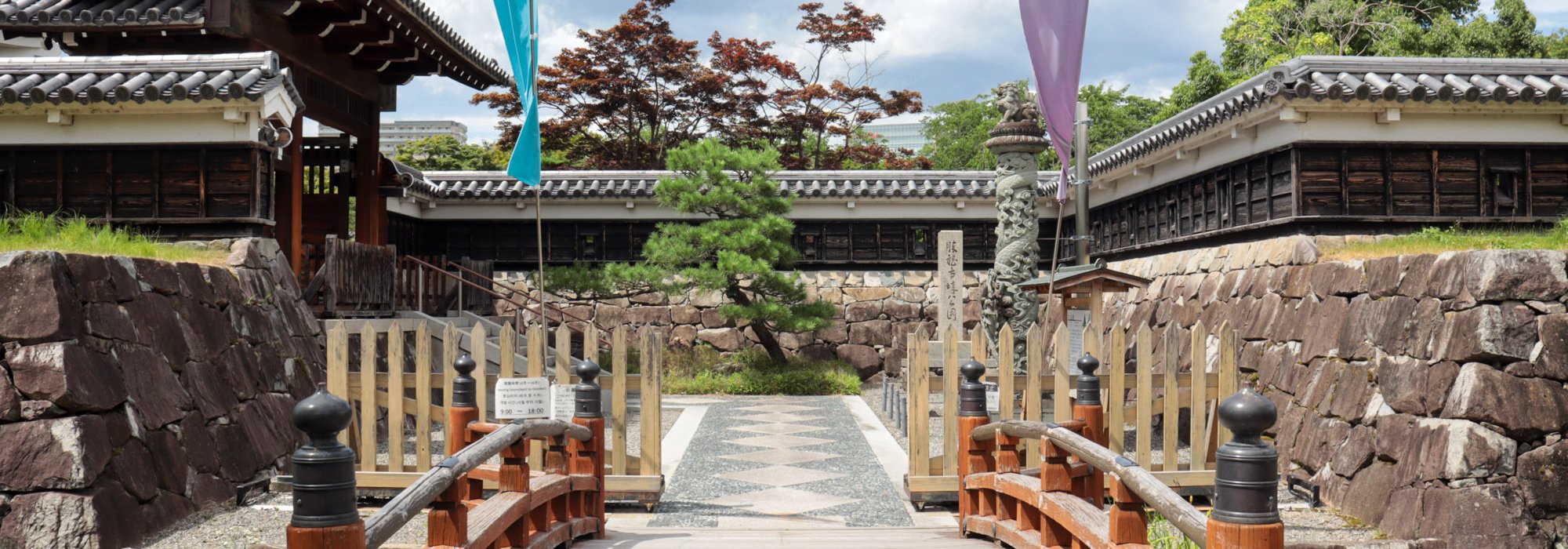
- Shoryuji Castle, an ancient fortress defending Kyoto, is now a small historical park homing the reconstitution of its keep of the Azuchi-Momoyama period. The tower hosts a free small museum with very few explanations in English, but quite useful to shelter on a very hot day. The site is dedicated to Akechi Mitsuhide, a former retainer of Oda Nobunaga and responsible for his demise, and mostly to his daughter Gracia Hosokawa (or Tama, 1563 -1600), who is said to be the inspiration for Mariko, the character of the novel Shogun. On the 2nd Sunday of November, the Nagaoka Garasha Festival pays a tribute to Gracia with a great historical parade.
- Igenoyama Kofun, a little bit further south, is a keyhole-shaped burial mound, built in the 1rst half of the 5th century. Several excavations have confirmed the site’s importance and it was included in an historical park in 2014 for its preservation. Walking around and on the tumulus is possible. Copies of Haniwa, the fired clay statuettes specific to this type of monuments, have been placed to try recreate its original aspect. English explanation panels allow to better understand the site, that is free to access.
The tomb is located about 20 minutes’ walk from the castle 🏯, following Igenoyama-dori street in a Japanese rural landscape.
- Nagaoka Tenmangu shrine is located a little bit further to the north-west of the city. Founded in 901 to honor Sugawara no Michizane, while not as colorful as its more famous and touristic counterparts, it remains charming nonetheless thanks to its Kirishima azalea tunnel (Kirishima Tsutsuji) blooming with dark red flowers at the end of April. Amateurs of botanical pictures will enjoy its pond Hachijogaoka-ike covered with lotus flowers in summer. Gourmets can discover the take no ko bamboo shoots cuisine, a spring specialty of Kinsui-tei its luxury kaiseki restaurant.
The shrine is located about 15 minutes’ walk from Nagaokakyo JR station, or 5 minutes from Hankyu Nagaokatenjin station.

In addition, 3 Nagaokakyo temples are renowned among the locals for their colors in spring 🌸 and in autumn:
- Otokuni-dera, about 25 minute’s walk from Nagaokatenjin station, is said to date back to the times of Shotoku Taishi (574 - 622) and to have been visited by Kukai (Kobo Daishi). It is home to several cultural treasures, including an 11-faces Kannon statue, but is also know for its 2,000 peonies blooming in spring at the end of April, protected by white umbrellas.
- Komyo-ji temple, a little bit further up in the north-west, about 20 minutes by bus from the Hankyu Nagaokatenjin station, is renowned for its Momiji 🍁 Sando alley: about 250 Japanese maple trees lining a 200 meters long pathway and turning in a beautiful red in autumn. It was established in 1198 by a disciple of Honen, the founder of Pure Land Buddhism.
Lastly, again in a more secluded location in the mountain at the south-western limit of Nagaokakyo, the Yokokuji Yanagidani Kannon-ji temple, founded in the 9th century, is famous for its hydrangea festival (ajisai) in June and its momiji in autumn. While not easy to reach, it is served by a special shuttle service connecting the Hankyu Nishiyama Tennozan and JR Nagaokakyo stations, only on the 17th each month or during a matsuri period. Otherwise, the easiest way to visit is to take a taxi from one of these train stations.

The surroundings of Nagaokakyo
The surrounding cities and formerly home to the ephemeral antique capital also have a few highlights, to discover over 1 to 2 days with Nagaokakyo.
Muko
Located between Kyoto’s Nishikyo-ku ward and Nagaokakyo, Muko has its own bamboo grove, less crowded than Arashiyama’s; the nearest station is Hankyu Rakusaiguchi, about 15 minutes’ walk away. This bamboo path, logically called Take no Michi in Japanese, is 1,8km long and includes 8 different species of bamboo growing naturally. While its first part might not be very impressive, the bamboo walk is getting more and more beautiful as one is nearing the bamboo park.
The Kyoto Bamboo Park (or Chikurin Koen) is a botanical garden solely dedicated to this plant, opened in 1981 to preserve the natural bamboo grove typical of this area of Kyoto. Admission is free and there are about 110 bamboo species dispatched over 5,000m², in Japanese gardens and little forests, as well as a museum dedicated to the plant.
Note that in October, part of Take no Michi (in the south of the bamboo park) is lit-up for 2 evenings for an event called Kaguya no yube.
Other visits in relation with the ancient capital Nagaoka-kyo are also possible:
- Daigoku-den Park near the Hankyu Nishi-Muko station, only for archaeology aficionados, exposing the foundations of an antique building;
- The former residence of the Ueda family (Kyu-Uedake Jutaku), a farm house built in 1910 over a part of the former capital; or,
- Muko City Cultural Museum (Mukoshi Bunka shiryokan) to learn more about the old Nagaoka-kyo.
Oyamazaki
In the south of Nagaokakyo, at the limit between Kyoto and Osaka prefectures, Oyamazaki harbored the former port of the imperial capital. However, the places to discover near the Hankyu Ooyamazaki and JR Yamazaki stations are in fact related to contemporary Japan:
- Ooyamazaki Villa Museum of Art, property of the Asahi group, displays artworks of the early 20th century, of western and Japanese artists, including movements from impressionism to Mingei. The museum is spanning several buildings of varied architectures, from the Tudor style to Tadao Ando’s contemporary touch, and dispatched into a beautiful garden of about 5.500m².
- Chochikuyo, another luxury villa, dates back to 1928 and is representative of the interpretation of modern architecture in Japan. It is only open on Wednesdays and Sundays, upon online reservation in advance.
Lastly, the Yamazaki Whisky Museum stages a guided tour of its distillery but only in Japanese and tickets are given away through a lottery system. It is also possible to visit during the opening hours of the bar, to see a small exhibition about the brand and take part to a tasting session.
Nagaokakyo and its surroundings are mainly attractive to a Japanese audience or to connoisseurs of art and history, however they are a good alternative to the touristic beaten tracks without going too far away from the center of Kyoto. Beside Muko’s bamboo grove, Nagaokakyo area is not necessarily recommend for a 1rst trip in Japan, especially as the access to some places requires a bit of logistics, but it can be interesting to traveler already used to Kyoto or Osaka or who don’t have much time to explore.