
Nata-dera
The Pearl of Hakusan
Nata-dera is a Buddhist monastery in Ishikawa prefecture’s Komatsu city, in the Japanese Alps. Located at the foot of Mount Hakusan, it is dedicated to this sacred volcano as well as to the Buddhist deity Kannon. Designated Place of Scenic Beauty, its grounds immersed in nature were also awarded 1 star by the Michelin Green Guide.
Founded in 717 by monk Taicho (682 - 767), Nata-dera combines Shingon Buddhism and the cult of nature. Taicho was indeed a follower of Shugendo asceticism and he was the first to climb Mount Hakusan, the great volcano 🌋 at the foot of which is spreading the sacred enclosure. Hakusan is by the way considered one of the 3 most beautiful mountains in Japan, with Mount Fuji 🗻 and Mount Tateyama.
Synthesis of Buddhism and Shinto
The temple received its current name in 986. It is made of 2 kanji characters borrowed to the official names of the 1rst and the last temples of the Kansai Saigoku Kannon pilgrimage:
- Nachisan Seiganto-ji in Wakayama, and,
- Tanigumisan Kegon-ji à Gifu.
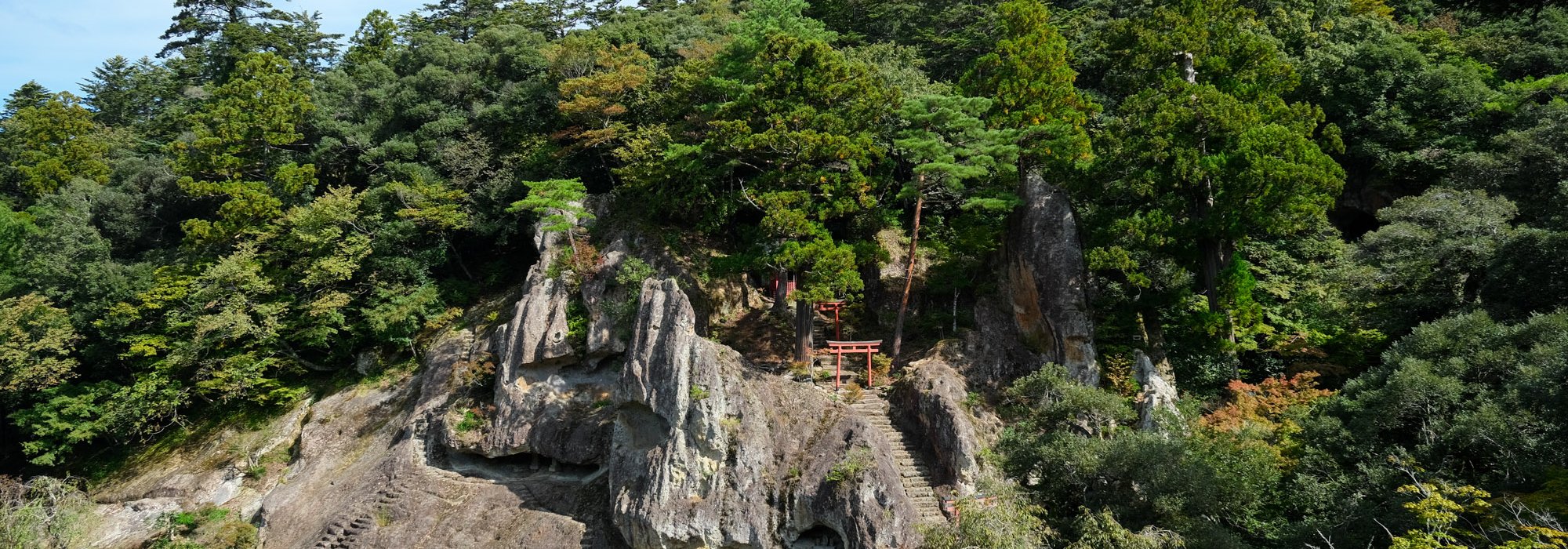
The temple was originally named Iwaya-dera (the "cave temple"), in reference to the natural troglodyte structures on its site. One of them was particularly worshiped as early as prehistoric times, as it was considered a place for purifying the soul.

Mystic walk in the heart of Mount Hakusan forest
The grounds of Nata-dera, sprinkled with remarkable natural rock formations, is spreading in the heart of nature as if to better celebrate it. Its entrance, marked by the main gate Sanmon, opens on an alley lined with cedar trees planted by Maeda Toshitsune (1594 – 1658). Toshitsune was the 3rd lord of the Kaga domain and was particularly involved in the temple’s restoration after it was destroyed several times during the troubles of the early Muromachi period, and later during the Ikko-ikki peasant uprisings of the 15th and 16th centuries.
The left hand side of the gate is home to 2 important areas:
- The "special visit" area, that includes the Sho-in, a reception pavilion dating back to 1637 and a Japanese garden with a pond (the oldest in Ishikawa prefecture). In the latter, you’ll also find Maeda lords’ tea pavilions and a 20th century garden.
- The "golden pavilion" Kondo keo-den, rebuilt in 1990 in a style reminiscent of the late pert of the Kamakura period. Buddhist ceremonies take place here, while preserving the statue of "the 11-headed and 1,000 arms Kannon" (Juichimen senju Kanzeon bosatsu 十一面千手観世音菩薩) behind closed doors. The statue is displayed publicly once every 33 years, the last time dating back to 2017. The treasure hall Fumonkaku Homotsukan is located next to this pavilion.

Then, the carefully paved main alley Sando leads to 2 spectacular places, that are best enjoyed from their special observation platform:
- Kigan Yusenkyo, a rock formation that was shaped by both natural and man-made attrition. It is topped by vermilion torii ⛩️ gates signaling a shrine dedicated to Inari. The beauty of the site inspired poet Matsuo Basho when he visited around 1689.
- Honden, the main pavilion, also named the "hall of mercy" (Daihi-kaku haiden) and designated Important Cultural Property of Japan. Its wood architecture leaning on the rocks reminds of the Kiyomizu-dera’s stilt pavilion. It is home to a natural cave stage to the Iwaya Tainai Kuguri (いわや胎内くぐり, literally "passing through the cave"), a purification ritual using the similarity of the cave to a womb to offer a symbolical rebirth or a new beginning.
Nata-dera’s grounds has other structures to admire, less peculiar but nonetheless designated Important Cultural Property of Japan, such as a 3-story pagoda, a bell tower, an altar dedicated to Fudo Myo and a great lengthy pond limiting the site on its southern side.
With such particularities and being so distant to the touristic beaten paths, Nata-dera is an original and appeasing visit, to combine with its nearby moss garden Hiyo Koke no Sato. On Mount Hakusan, seasoned walkers will find beautiful hiking trails, and they can take a break at Awazu Onsen ♨️ spa village. There, the Kaga Traditional Crafts Village offers a deeper cultural discovery of the local crafts such as Kutani ceramics or Kanazawa’s gold leaf decor.