
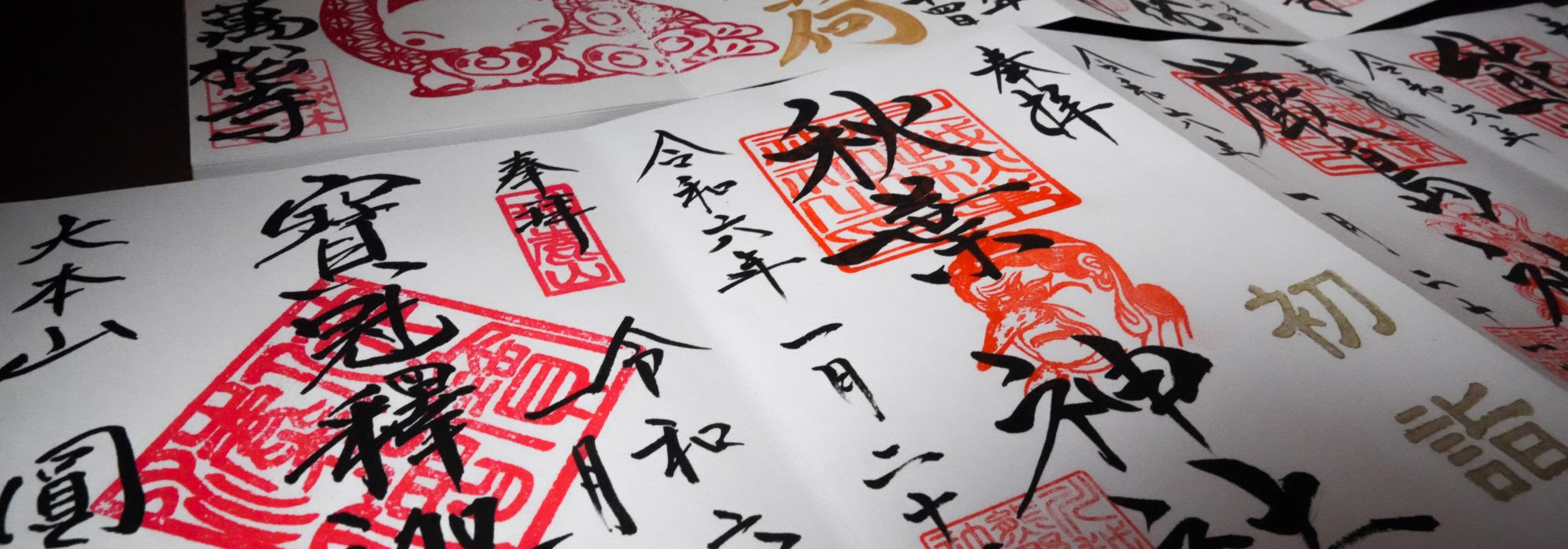
Goshuin
The Sacred Stamp as a Travel Souvenir from Japan
Goshuin refers to a commemorative stamp received when visiting a Buddhist temple or Shinto shrine in Japan. Originally proof of completing a pilgrimage, the goshuin can also become the object of a collection, gathered into special notebooks called goshuincho. Now prized for its artistic qualities, the goshuin makes for an authentic souvenir for travelers in Japan.
A goshuin or shuin (御朱印, "vermilion mark") is a stamp traditionally issued at a Buddhist temple or Shinto shrine in exchange for a monetary offering. Buddhist places of worship in particular began issuing them around the 8th century as proof that a devotee had deposited a sutra, and the practice became established during the 13th century as part of the pilgrimage to the 66 provinces of Japan at the time.
Once tied to the completion of pilgrimages, collecting goshuin has seen a genuine revival since the 2010s and has become very popular with Japanese and foreign tourists alike.

A Miniature, One-of-a-Kind Work of Art
The size of a goshuin can vary, but it's generally about the size of a standard postcard (A6 format, or 105 x 148 mm) and includes several basic elements:
- One or more red stamps applied with an ink seal;
- Calligraphy brushed in black ink, typically indicating the name of the site, the type of prayer, and the date the goshuin was issued.
A goshuin is normally drawn on white paper. However, some are found on colored paper and/or featuring more or less elaborate illustrations, in black and white or in color, depending on the season or a particular feature of the place of worship. Some goshuin are offered as limited-time editions, or, more rarely, in collaboration with pop culture franchises such as Hello Kitty, for example.
Depending on the temple or shrine, 2 types of goshuin may be offered:
- Jikagaki, the traditional way of collecting the commemorative stamp: the goshuin is drawn directly into the goshuincho notebook, presented open to the correct page.
- Kakioki, which has become more common in recent years, is a goshuin prepared in advance on a loose sheet of Japanese washi paper, which is simply picked up at the dedicated counter and later glued into a notebook or framed.
A goshuin costs on average between ¥300 and ¥500 (~US$1.90 and ~US$3.17), though it's not uncommon to find ones priced at ¥1,000 or ¥1,500 (~US$6.34 or ~US$9.51) when produced for a limited period or for special occasions. Payment is always made in cash.

A Goshuincho to Collect Them All
Believers and casual enthusiasts of these small works of art alike are expected to store them properly, which means picking up a goshuin-cho. This is a notebook whose pages, usually made of washi paper, are sturdy and absorbent enough to be painted on with India ink.
The covers often feature rich or original decoration; they may, for instance, be made of brocade or wood. Designs range from an illustration of the temple or shrine where the notebook was purchased to kawaii themes drawn from pop culture. The thick paper of the goshuin-cho is designed so that calligraphy can be drawn directly onto it, but it can also hold kakioki goshuin, which simply need to be glued onto the desired page. Some goshuin-cho are even specifically designed for this, with slots to insert them like a photo album.
Places of worship offer a selection of goshuin-cho for sale on site, but they can also be found in most stationery shops in Japan and even online. Prices start around ¥1,000 to ¥1,500 (~US$6.34 or ~US$9.51), and some of the most elaborately decorated ones can cost around ¥4,000 to ¥5,000 (~US$25.36 or ~US$31.69).
While the goshuin-cho might resemble a watercolor sketchbook, its use follows certain rules; it's generally frowned upon to use it as a notebook for jotting down notes or to collect stamps from stamp rallies. Additionally, it's best to keep a separate one for Shinto shrine stamps and another for Buddhist temple ones, as some places of worship refuse to stamp their mark next to that of another religion.

How to Get a Goshuin
Most temples and shrines offer at least 1 goshuin design. It's worth checking their official websites before visiting to get a preview of the available goshuin design(s), as well as their price and pickup conditions. You can also draw inspiration from suggestions on Instagram accounts or websites dedicated to goshuin.
Note that a few rare temples, particularly those affiliated with the Pure Land school of Buddhism, do not issue goshuin, as they place greater emphasis on the spiritual nature of visits.
If you'd like to obtain a goshuin, the general steps are as follows:
- Purify yourself at the temizuya, then pray in front of the main hall;
- Pick up a goshuincho notebook from the temple or shrine's shop if you haven't brought your own;
- Head to the Shuinjo, the counter dedicated to issuing goshuin (note: its opening hours may be limited);
- Ask for a goshuin: 御朱印をお願いします (Goshuin wo onegai shimasu) or 御朱印を頂きたいのですが (Goshuin wo itadakitai no desuga), and hand over the cash payment, ideally with exact change;
- Wait patiently while the person in charge of goshuin carefully calligraphs and stamps the goshuincho or the loose sheet;
- Receive the goshuin and thank them: ありがとうございます (Arigato gozaimasu).
The people who perform the calligraphy for the goshuin (a kannushi or miko priestess at shrines, a monk at temples) practice a highly respected art form in Japan. The writing style varies depending on the hand of the person holding the brush, resulting in a small, authentic, one-of-a-kind work of art.
It's important not to photograph or film the calligrapher without their permission, and to wait quietly without speaking to them while they work, as the task requires concentration. At some particularly busy temples, it may even be recommended to drop off the goshuincho upon arrival and pick it up at the end of the visit, so the artist has time to focus on the calligraphy without feeling rushed.
If the religious aspect of goshuin is a deterrent, you can turn instead to collecting castle stamps, known as gojoin (御城印), a practice that has been growing since the late 2010s. About 500 Japanese castles 🏯 take part, following the same principle as goshuin, with dedicated gojoin-cho notebooks, though the difference is that gojoin are almost always pre-printed, at a similar cost to goshuin.
All in all, goshuin offer an interesting way to collect lasting, personal souvenirs from Japan, gathered visit after visit, with each piece of calligraphy being entirely unique.