
Kuramae-jinja
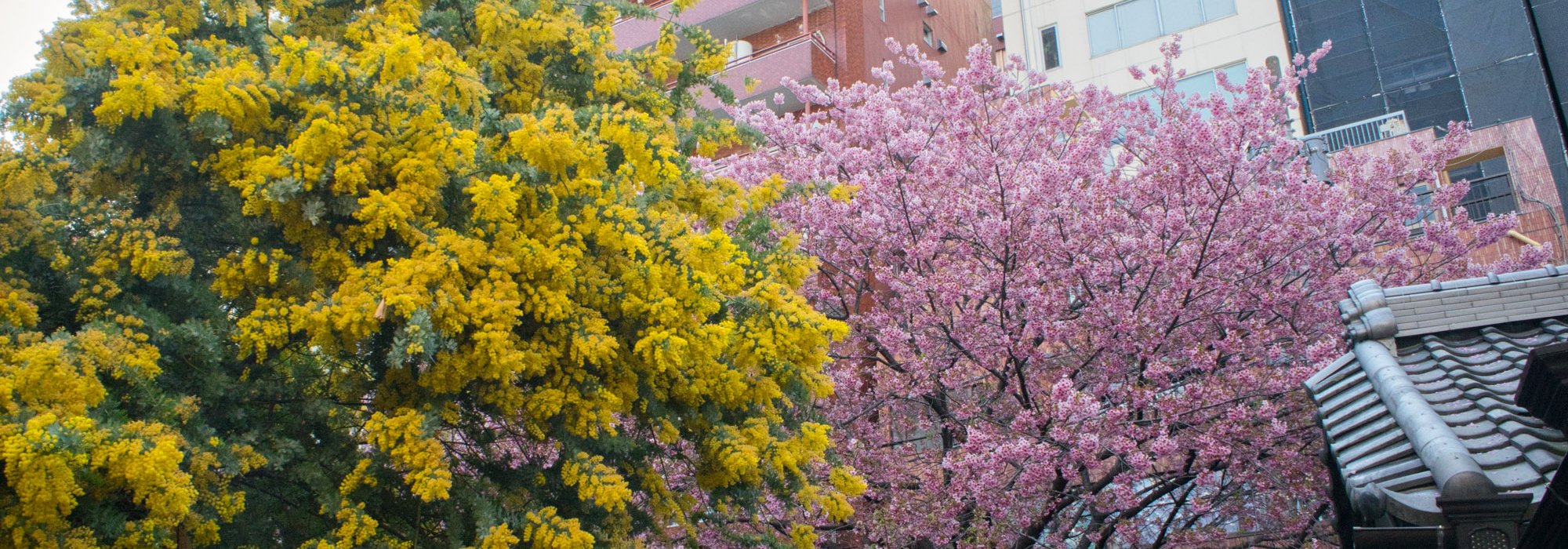
Early Kawazu Blossoms and Mimosa Flowers in Asakusa
Kuramae-jinja is a neighborhood shinto shrine located in the south-west of Asakusa, in Tokyo’s Taito ward in Japan. The small, ordinarily quiet enclosure welcomes its busiest time for the blooming of its Kawazu cherry tree and its mimosa at the end of winter, usually between mid-February and mid-March.
The 1rst beautiful sakura 🌸 blossoms are produced by early cherry trees a few weeks before the Japanese somei yoshino start to bloom. Recently, the reputation of the small Kuramae-jinja shrine near Asakusa in Tokyo has been growing on the social medias. It is indeed home to 2 wonderful trees flowering at the same time, heralding the beginning of spring in the capital:
- 1 kawazu-zakura cherry tree, with bright pink blossoms; and,
- 1 mimosa that turns into a cute vibrant yellow.
They both reach their flowering peak near the end of February and during the 1rst half of March, and therefore attract a lot of sightseers and amateur photographers. We recommend visiting early in the morning (from 8 a.m.) to enjoy some peace. On the daytime, a waiting line can form in front of the main pavilion and at the best picture spots of the 2 blooming trees, looking like a beautiful flowery decor. On a side note, goshuin seals can be purchased from 9 a.m.

Neighborhood shrine of the Edo feudal period
Founded in 1693 by Tokugawa Tsunayoshi (1646 – 1709), the 5th shogun of the Tokugawa dynasty in the beginning of the Edo period (1603 - 1868), the shrine is home to a deity initially enshrined at Kyoto’s Iwashimizu Hachiman-gu. The kami Hachiman-sama was thus entrusted the protection of Edo Castle 🏯 and Kuramae district, whose name derives from its many kura warehouses used to store rice at the times. Located in the south of Senso-ji temple, on the shore of the Sumida River in the lower city Shitamachi, Kuramae’s area was indeed one of the granaries of the former feudal capital. A few wealthy merchants also lived here.
Historically, Kuramae-jinja is known for being one of the first places to organize sumo bouts called kanjin-zumo, in order to collect funding for temples and shrines in Japan, and precursor to the current wrestling tournaments.

The shrine is also associated with rakugo (落語), a kind of traditional Japanese theater relying on humor and minimalism. A rakugo show consists of a single comedian dressed in a kimono 👘 and formally sitting in seiza and telling a story.
Kuramae shrine’ shiba-inu dog statue is a reference to a story from rakugo’s classical repertory, entitled Moto Inu, which could be translated as "the former dog" or the tale of a dog praying Hachiman-sama to become a human being.

Nowadays, the streets of Kuramae’s area are home to small lovely cafés as well as artists' studios immersed in a quiet atmosphere contrasting with the bustling of Asakusa and Ueno, its large touristic neighbors. Kuramae Bridge connects easily to Ryogoku, the sumo district.