
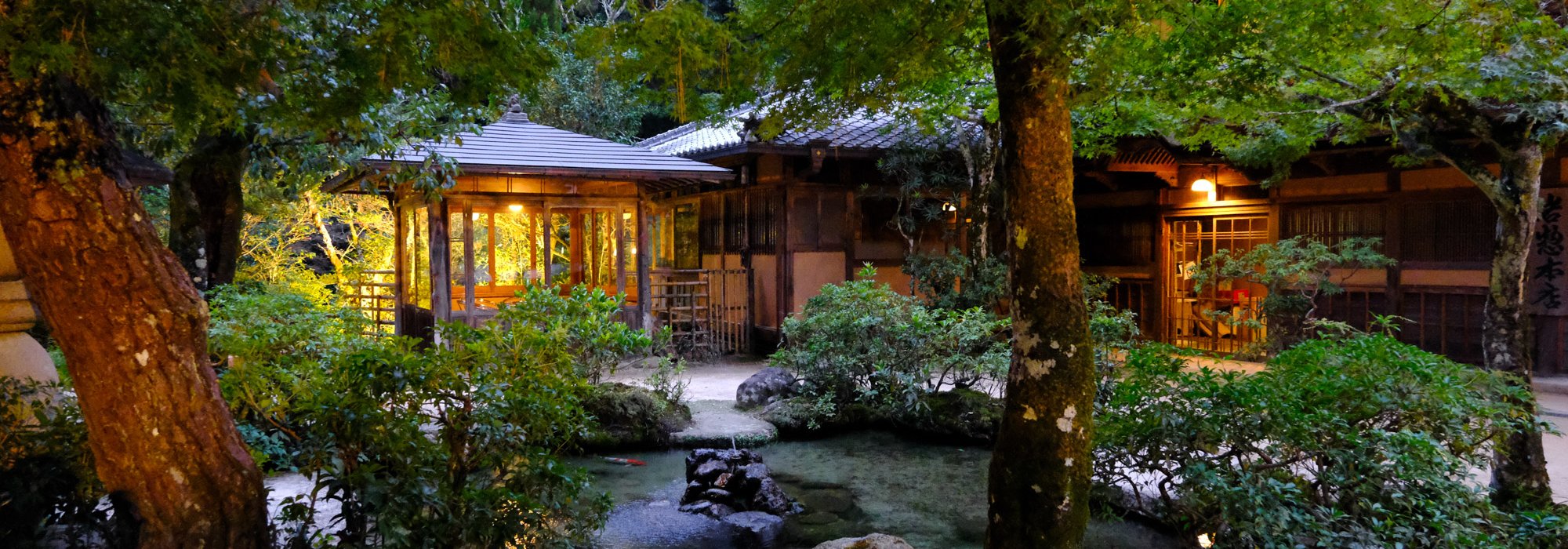
Iwaso (Review)
Historical Ryokan Inn in Miyajima
Iwaso is a 3-star traditional Japanese inn located on Miyajima island, off to Hiroshima. Established in the 19th century near Itsukushima shrine and at the edge of a forest, this ryokan is the ideal place to briefly disconnect from the world without losing touch with it.
Iwaso ryokan is part of a long tradition of hosting pilgrims next to sacred sites. The inn is ideally located a few minutes’ walk away from Itsukushima shrine and at the entrance of Momijidani Park, at the foot of Mount Misen.
Historic inn and prestigious guests
The story of Iwaso begins in 1854 with a simple tea-house founded by Iwakuniya Sobee. In the early days of the Meiji era (1868 – 1912), the house becomes a ryokan inn and takes the name Iwaso, created from the 2 first kanji characters of its founder’s name.
The inn soon received distinguished guests: Japanese statesmen, artists, writers and international personalities of culture. Even Hirohito (Showa emperor) stayed at the inn in 1947. It also hosted several meetings for the G7 and G8 international summits in 2008, 2016 and 2023.

A lodging nestled in the forest
Iwaso is a traditional Japanese style accommodation, with beautiful wooden buildings dating back to the 19th century, the oldest one being its entrance, built in 1892. Its 38 rooms and suites are all arranged in the Japanese style: spacious, with tatami flooring, and futon bedding laid out by the staff for the night. The rooms occupy several areas, that were built along the Momijidani river over time: Honkan, Shinkan and the Hanare "cottages".
Honkan is the main building, constructed in the 1920s and located behind the reception building. It houses five 31sqm rooms on its 1rst floor, that open on the river and the forest.
Shinkan (Annex) is the newest building, constructed in 1981. While its concrete structure is lacking charm, it is however the most convenient. The 5-storey Shinkan is standing behind the Honkan and has:
- About 30 rooms in the Standard and Deluxe categories (from 26 to 58sqm) with a view on the maple forest or on the sea depending on the side of the building, at the 3 uppermost floors;
- A banquet room at the 1rst floor, that can host more than a hundred guests;
- A restaurant called Momiji and the inn’s shop at the ground-floor; and,
- Hinodeyu and Tsukinoyu, 2 shared baths with indoor and outdoor (rotenburo) pools, whose access is at the basement floor.
Lastly, the Hanare are 4 suites in individual pavilions. These wood constructions were built between 1924 and 1951, in various traditional Japanese styles and are all unique. Their layout focuses on views and circulation with the outside, for a better blending with the surrounding nature.
Note however that in the purest tradition of ryokans with onsen ♨️, customers are expected to bath in the shared hot spring 🌸 bathrooms. Therefore, several rooms, including those of the Honkan and 2 of the Hanare cottages, do not have a private bathroom 🛁 or even a shower! Likewise, tattooed guests may be refused access to the inn’s bath; an element to take into account when booking to make sure to have access to a bathroom.
Otherwise, all the rooms do have their own private toilets 🚽 and modern amenities, such as air conditioning and Wi-Fi connection, and are supplied with yukata 👘 robes and bath products.

A full gastronomic experience
An overnight stay at Iwaso usually includes breakfast and dinner. The latest is served in the room or at the restaurant Momiji 🍁 in the Kaiseki style: that is to say a profusion of seasonal dishes cooked by the ryokan’s chefs. Ingredients are fresh and preferably local and include Hiroshima oysters. The inn was even awarded a Michelin star for its cuisine. As it is a traditional ryokan, the evening meal is served quite early and guests are expected to arrive before 7 p.m. (at the latest) to be able to enjoy it.
Incidentally, the Momiji Manju is said to have been invented in Iwaso in 1906. At the time, the inn wanted to impress its hosts with something they wouldn’t find anywhere else and thus a new wagashi pastry was created, consisting of a sponge cake filled with anko sweet red bean paste and shaped into a small maple leave. It was met with such a success that the Momiji Manju is now one of Miyajima’s specialties.
The old Iwaso provides its guests a haven of peace in the heart of one of Japan’s most touristic sites. They can relax in a protecting forest environment, listening to the soothing flow of the Momijidani river, and even spotting a wandering deer from time to time.
The calmest hours on the island are ideal to admire Itsukushima’s floatting torii ⛩️ early in the morning before the crowds flow in; or in the evening to enjoy the night illuminations. The inn’s onsen baths offer a relaxing time after walking one of the hiking trails of Mount Misen.