
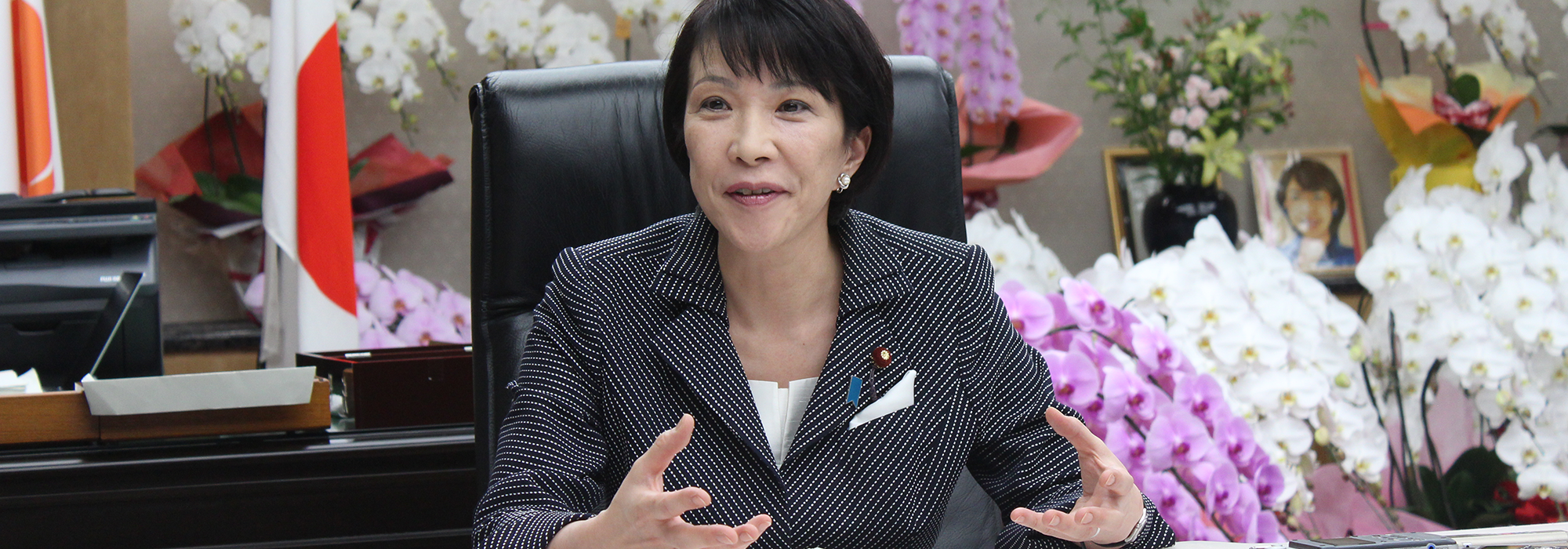
Powerful Women of Japan
Sanae Takaichi, the 1rst Female Prime Minister of Japan and the Others Before Her
On October 21, 2025, the Japanese Parliament elected Takaichi Sanae as the 1rst woman Prime Minister of Japan. The Japanese archipelago is a constitutional monarchy where the monarch is an emperor whose role is mainly symbolic and representative, very much alike to the king’s in Great Britain. The Prime Minister is the chief of the government and actual ruler of the country, within its borders and on the international stage. The Prime Minister is nominated by both the lower house and the upper house of the Japanese Diet, candidates being members of the Parliament, and it is often the leader of the majority party at the lower house who gets to be appointed.
A few weeks before, on October 4, 2025, the fact that Takaichi Sanae was elected at the head of the Liberal Democrat Party, the party that has been actually ruling Japan since 1955, was already a historical moment, all the more as the LDP’s president has almost always been appointed Prime Minister. There was a brief uncertainty when the Komeito, another party that had been in an alliance with the LDP for 26 years, had withdrawn its support to Takaichi. However, the reshuffling of political cards and several negotiation rounds allowed Takaichi Sanae to find new allies for running the election race thanks to a rival party, the Japan Innovation Party (JIP, Nippon Ishin no Kai), whose ideas are closer to hers than the Komeitos’.
In Japan’s political world, Takaichi’s election is a unique accomplishment, even more so as according to the OECD women constitute only 10 % of the archipelago’s parliament and about 8 % of its Cabinet. Takaichi Sanae is the 1rst woman to actually lead the country in contemporary times. As for the imperial throne, it can only be occupied by a man, despite the revival of the inheritance questions surrounding the abdication of emperor Akihito in 2019.
However, female sovereigns and important stateswomen did play a role in the country’s founding myths as well as in its most ancient history. We tried to select a non-exhaustive panel of influential or leading Japanese women who contributed in the archipelago’s history.

The 8 female emperors of Japan
Japan has a reluctance to appoint women to the highest functions or to let them accede to the throne. It may seem contradictory to the country’s founding myths filled with stories about goddess Amaterasu, said to be the ancestor of the still reigning imperial dynasty, and about powerful queens. For example, according to Chinese chronicles, Himiko the legendary queen is said to have ruled over the Yamatai area (located either in the Yamato province in the Kansai area, or in the north of Kyushu) from 188 to 248. About Empress Jingu, who supposedly reigned from 209 (from her husband’s passing) to 269 (succeeded by her son), the Kojiki and the Nihon Shoki tell that she has conquered the 3 kingdoms of Korea; and she is now is integral part of the contemporary nationalist imaginary.
However, despite its more than 2,000 years history, the archipelago was ruled by only 8 empresses, some of them appointed more than one time, and mainly during Japan’s classical age.

Most of the empresses were appointed to act as regents, until the official male heir was able to reign and thus avoiding succession battles. In the same way as their masculine counterparts, the empresses were surrounded by advisers from the imperial household and the nobility, and their governance had the same value, at least during the Classical Age.
- Empress Suiko (born in 554, reign 592 - 628): daughter of emperor Kinmei, she succeeds emperor Sushun and is chosen because she is part of the Soga clan and viewed as a guarantee of political stability. She is the 33rd emperor of Japan and the 1rst Josei tenno, that is to say a female emperor. She is nevertheless assisted by a regent, Shotoku Taishi (574 - 622), also known for the founding of the Shitenno-ji, the Horyu-ji and the promotion of Buddhism in the archipelago.
- Empress Kogyoku (born in 594, reign 642 - 645) / Empress Saimei (655 - 661): she holds the title on 2 occasions, becoming the 35th and 37th ruler of Japan. Her son was the one actually ruling during her 2nd reign. Under Saimei, military expeditions are sent to the north of Kyushu and to the Korean peninsula.
- Empress Jito (born in 645 - 702, reign 686 - 697): she is the 41th emperor, succeeding to her husband Tenmu and becoming the regent for her grandson, the future emperor Monmu. She abdicates in 697, but stays in a power position as the 1rst "retired emperor" (dajo tenno). She is a recognized waka poet and her works are collected in the famous Hyakunin Isshu anthology. She also decided of the construction of Yakushi-ji temple.
- Empress Genmei (661 - 721, reign 707 – 715): the 43th emperor of Japan, she succeeds to her son Monmu and holds the regency for her grandson, the future emperor Shomu. She is the one who settled the capital in Heijo-kyo in 710, opening the Nara period. The compilation of the Kojiki is completed during her reign (712). She also ordered the writing of the Fudoki, the chronicles on history and provinces of Japan and had the 1rst Japanese currency minted. She abdicates in favor of her daughter empress Gensho.
- Empress Gensho (680 - 748, reign 715 - 724): Gensho succeeds her mother as the 44th emperor of Japan, and is also the regent for future emperor Shomu. The writing of the Nihon Shoki is completed under her reign in 720. She abdicates in favor of Shomu in 724.
- Empress Koken (718 - 770, reign 749 - 758) / Empress Shotoku (764 - 770). Emperor Shomu, her father, abdicated in her favor, and she was the 46th and 48th emperor. She abdicated in favor of emperor Junnin and became a nun. With the support of Buddhist monk Dokyo, she overthrew Junnin and reigned again under the name of Shotoku. She ordered the building of Todai-ji’s Daibutsu.

Shotoku remained the last reigning empress for several centuries, and the last 2 have lived during the Edo period (1603 - 1868):
- Empress Meisho (1624 - 1696, reign 1629 - 1643): 109th emperor of Japan, Meisho succeeds her father Go-Mizunoo who abdicated in her favor as he didn’t have a son. She becomes a regent at 5 years old, and because her mother is a Tokugawa she is used as a token of stability. Due to her young age, the actual ruler was in fact her father. She abdicated in 1643 in favor of her half-brother born to emperor Go-Mizunoo, emperor Go-Komei (reign 1643 - 1654).
- Empress Go-Sakuramachi (1740 - 1813, reign 1762 - 1770): 117th emperor and last female emperor of Japan, she was the daughter of emperor Sakuramachi. Once again, the empress is in fact a regent until the designated heir is old enough to reign and she can abdicate in his favor. The heir, Go-Momozono, passed heirless so Go-Sakuramachi, acting as a retired emperor dajo tenno, appointed the next emperor Kokaku, who is the current emperor’s ancestor.
These women, be they retired emperors or empress dowager, often become Buddhist nuns, and can still maintain a very influential role long after their reign is officially over. Other are as influential as men, even if they only have spouse status. Many of them can be mentioned such as:
- Tokugawa Kazuko (also known as Tofukumon-in, 1607 - 1678), wife of Go-Mizunoo (father of empress Meisho) and mother to empress Meisho, continues to influence the Court under the reigns of Go-Mizunoo’s 3 sons: Go-Komyo, Go-Sai and Reigen who reigned between 1643 and 1687.
In the feudal times, women of the aristocracy or the warrior class were granted influence thanks to marriage policies, and they could also act as in-between for various factions, especially:
- Oichi (1547 - 1583), Oda Nobunaga’s younger sister;
- Her daughters Yodo-dono (1569 - 1615), Ohatsu (1570 - 1633) and Oeyo (1573 - 1626) who were wedded to the Toyotomi’s and the Tokugawa’s; or,
- Kodai-in (Nene / Kita no Mandokoro, 1541 - 1624), Toyotomi Hideyoshi’s official spouse who was in charge of the relationships with the Imperial Court among other duties.


Onna-bugeisha: the female samurai
The term onna-bugeisha ("female samurai") is used for many female warrior figures from the 12th to the end of the 19th century, some of which have a semi-legendary status such as Tomoe Gozen (1157 – 1247), who became a character in the Heike Monogatari and was born in the bushi class that rises to power from the 12th century. Many others can be mentioned without exhaustivity:
- Hojo Masako (1156 – 1225), known as the wife of Minamoto no Yoritomo, the 1rst shogun of the Kamakura period (1192 – 1199), and the mother of the 2 next shoguns. She was nicknamed Ama-shogun (the "shogun-nun") for her critical role in the Hojo clan’s seizing of power over the Kamakura shogun lineage.
- Ashikaga Ujihime (1574 - 1620), who ruled the Kaga domain (now Ibaraki prefecture) and played a key role in the control of the Kanto area.
- Ii Naotora (birth unknown - 1582) was a daimyo of the Sengoku period whose territory was located around Hamamatsu in Shizuoka’s area. She was the daughter and only child of Ii Naomori, the 18th head of the Ii clan.
- Ikeda Sen (born circa 1563 ? – 1599), who made sure to keep her daimyo status thanks to her artillery unit of 200 women, after they demonstrated their shooting skills to envoys of the Tokugawa’s. Her family was serving the Oda’s. And,
- Nakano Takeko (1847 - 1868) who fought during the Boshin war, leading an all-female unit.
However, the restoration of emperor Meiji impacted the political roles of women.

Restrictions on women’s status during the Meiji Era
The beginning of the Meiji Era (1868 - 1912), and especially its 1rst decade, is filled with political and social debates at every levels of society. In this context emerges the Freedom and People's Rights Movement, that led to the creation of the first political parties. These parties’ activities forced the Meiji government to act on its institutional framework by promulgating a Constitution on February 11, 1889.
Women naturally took part to the movement: they attended meetings and spoke up (Kishida Toshiko, Fukuda Hideko) to advocate for equal rights between men and women regarding economics, politics and family, as well as the right to an education. However, in 1890, the government forbids any political gathering, and the participation of women specifically to any such events. In 1898, the civil code puts women under the authority of the head of the family, denying them their fundamental rights.

Being forbidden of a political representation, women turned to education and literature as ways of expression, as part of the interests of feminist movements and the government actually aligned:
- The pursuit of emancipation for women; and,
- The government’s will to shape a female population of "good wives, good mothers" able to raise a people in line with the nationalistic ideals of the early 20th century.
While the schooling rate initially lagged behind for girls, it reaches almost 100 % of the population by the end of the Meiji Era, with a 6 years-long compulsory education. Women are still excluded from the general higher education system, but a few women-only universities are opened, such as Tsuda University, founded in 1900 by Tsuda Umeko (1864 - 1929), who was sent in the United States at 6 years old accompanying the Iwakura mission (1871).
Mass medias directly target women with journals and magazines of diametrically opposed subjects: some focus on managing a household like the monthly Shufu no tomo ("The Housewife’s friend," 1917 – 2008) aligning with the government’s guidelines, others advocate for women’s rights. The later category includes Seito ("Blue stocking," 1911 - 1916) a key publication in the debates on women’s status. Created by 6 women (Raicho Hiratsuka, Yoshiko Yasumochi, Kazuko Mozume, Teiko Kiuchi, Hatsuko Nakano and Fukuda Hideko) who all graduated from Japan’s Women University (Nihon Joshi Daigaku), it covered every topics:
- Men and women equality;
- Voting right;
- Sexuality;
- Contraception;
- Motherhood;
- Prostitution;
- Women’s role in society;
- Etc.
Due to its risky themes, the magazine became the target of censorship and a few issues were pulled out from the shelves.
Broadly speaking, Japanese feminist movements in the early 20th century supported or shared claims with socialist, communist, anarchists and anti-capitalistic movements, and they were consequently quite harshly repressed. The Diet strongly opposed any idea of women’s suffrage in 1925, and by the 1930s, contestants were either completely silenced or adhered to the nationalistic and expansionist views of the imperial government.

New rights for Japanese women after World War II
After the surrender of Japan leading to the American occupation, women are finally allowed a political representation: they gain the right to vote and to be elected. They vote for the 1rst time at the 1946 Japanese general elections, in which 39 women are elected as representative and make a little bit more of 8 % of the House of Representatives.
A new constitution is implemented starting 1947 and is known for its article 9 about Japan’s renunciation of war, but it is also key for women’s rights. It notably establishes the principle of equality of men and women before the law, bans any discrimination based on genre or social class, prohibits slavery, introduces the notion of workers’ rights and guarantees freedom of speech, meeting and opinion, out of the many claims made since the beginning of the 20th century.
However, progress remains slow as it is only in the 1960s that the first women are appointed to a Cabinet role with:
- Nakayama Masa (1891 - 1976), as the Minister of Health, Labor and Social affairs in the first government of Hayato Ikeda in 1960;
- Kondo Tsuruyo (1901 - 1970), president of the Atomic Energy Commission of Japan and director of the Japan Science and Technology Agency, in Ikeda Hayato’s 1962 government; and,
- Ishimoto Shigeru (1913 - 2007), Minister of the Environment in 1984 (!) in Nakasone Yasuhiro’s cabinet.
The situation takes a more positive turn in the 1990s: Doi Takako (1928 – 2014) becomes the 1rst women president of her party, Japan Socialist Party in 1986, and president of the House of the Representatives between 1993 and 1996, the highest leading role reached by a woman at the time.
It was only in the 2000s that key-ministries, such as Justice (Mayumi Moriyama, 2001), Foreign Affairs (Tanaka Makiko, 2001) or Defense (Koike Yuriko, 2007) were distributed to women.
The first Koizumi Cabinet (2001 - 2003) is the 1rst to have a record number of 5 women out of 18 members:
- Mayumi Moriyama, Minister of Justice (2001 - 2003);
- Makiko Tanaka, Minister of Foreign Affairs (2001 - 2002); followed by Yoriko Kawaguchi (2002 - 2004);
- Atsuko Toyama, Minister of Education, Culture, Sports, Sciences and Technologies (2001 - 2003);
- Chikage Ogi, Minister of Land, Infrastructure, Transport and Tourism (2001 - 2003);
- Yoriko Kawaguchi, Minister of the Environment (2001 - 2002).

A glass-ceiling that is hard to break
However, of all the cabinets constituted thereafter, it was only the Abe governments from 2012 to 2020 that hired an equivalent number of women, often selected in the same panel of stateswomen, in the same way as men. The short tenure of the Democratic Party of Japan between 2009 and 2012 allowed for a larger number of women at the Diet (40 of the 44 women elected at the House of Representatives), but only 4 were part of the various cabinets formed during this period.
While Japanese women are increasingly interested in a career in politics, very concrete hurdles persist, starting by the needs for funding and notoriety. For men and women alike, politics at the national level is a milieu monopolized by personalities from wealthy backgrounds and / or of political dynasties (Abe, Koizumi, Tanaka), or who gained recognition after working or appearing in the medias, either as an actress, an athlete or a journalist.
Another hurdle is social and lies in the idea that women should primarily take care of the household and that politics is a man’s career. Regardless, women engage at the local level and their representation in local assemblies has doubled between 2001 and 2021 to reach 14,5%.
If Japan still remains at the bottom of international rankings regarding gender equality and women in politics, the big parties are starting to take interest in women for 2 reasons:
- Women tend to vote more than men;
- Women tend to prefer "non-party" candidates or to run election as independent candidates, who make about 30 to 50 % of the electorate and consequently votes to capture.
Progress is slow: in 2018 the government passed a law to "promote the shared participation of men and women in politics", but it doesn’t have any binding value. At the 2021 legislative elections, only 45 women were elected (out of 465 seats), but in 2024, the Parliament welcomed 73 women.

Japan’s trending women leaders
Several female politicians have gained recognition in Japan through their appointment to prestigious positions, their longevity or their political stance. We put up below a non-exhaustive selection of Japanese women with leading roles in politics:
Yuriko Koike
Born in 1952, she was a long time affiliate of the Liberal Democratic Party, a right-wing and conservative political party. She was an Arabic interpreter, then entered a TV journalist career during which she interviewed Middle-East political personalities, such as Yasser Arafat and Muammar Gaddafi in 1978 for Nippon TV. She thereafter hosted various programs for 13 years, dabbling in political debates, newscasting and economics.
She entered politics in the meantime in the 1990s, when she joined the governing body of the Japan New Party, and was elected at the Diet’s House of Councilors in 1992. Her political beginnings were mainly in parties opposing the LDP and more on the reformist side.
She finally joined the LDP in 2002 and supported Prime Minister Junichiro Koizumi, who appointed her Minister of the Environment from 2003 to 2006. between 2004 and 2006, she was also in charge of the very sensitive position of Minister of State for Okinawa and Northern Territories Affairs. Shinzo Abe appointed her Minister of Defense in 2007, making her the 1rst woman to reach this position in Japan. She then ran the LDP presidential elections without much success and continued to work with Shinzo Abe.
In 2016, she becomes the 1rst woman elected governor of Tokyo, after running againts a LDP candidate as a non-party candidate. She was reelected in 2020 and 2024.
Yuriko Koike is media savvy and a great communicator. She is not shy of using her womanly status when running for an election and had passed several measures favoring women, and especially mothers, such as free toddler daycare. Interested in environmental issues, she established in 2005 the Cool Biz campaign to adapt to climate change, and postponed the transfer of Tsukiji market to Toyosu over health and safety concerns.
Renho
Born in 1967, member of the Constitutional Democratic Party of Japan, a center-left party on the Japanese political arena. Her full name is Renho Saito, by she always went by her first name only. She was born into a wealthy family, her father being a Taiwanese businessman and her Japanese mother being a model.
Renho also started a model and actress career in the middle of the 1980s, then shifted to hosting TV entertainment programs, especially with Takeshi Kitano. Then she moved on to hosting news broadcasts.
She was elected for the 1rst time at the House of Councilors in 2004 and participated in the Kan and Noda Cabinets between 2009 and 2012, especially as Minister of State for Government Revitalization. She was elected president of the Democratic Party (民進党, Minshintō) in 2016 and 2017, making her the 1rst woman leading a parliamentary opposition party. In 2024, she ran for Tokyo gubernatorial elections against Yuriko Koike but was not elected.
Renho is highly involved in parenthood issues. Her Taiwanese origins make her a big critic of the Japanese diplomatic attitude towards China and its refusal to recognize Taiwan as an independent country, that she considers too lenient.

Seiko Noda
Born in 1960, she is affiliated to the Liberal Democratic Party. She is the granddaughter of a former minister, and entered politics in 1987 when she became the youngest member elected of Gifu prefecture’s assembly. She was elected for the 1rst time at the House of Representatives in 1993 and nominated Minister of Posts and Telecommunications in 1998, a role to which she was the youngest appointed again.
In 2006, she joins Shinzo Abe’s faction and is appointed to various ministries until 2022. In 2017-2018, she is Minister of State for Gender Equality and Measures for Declining Birthrate, and is appointed to a similar charge in 2022 in the Kishida Cabinet.
In 2021, she runs for the LDP’s presidential election against Fumio Kishida, Taro Kono and (already) Sanae Takaichi, with the goal of bringing more visibility on women in the government and in the society, but also to represent another side of her party, in which she is standing for a more progressive faction.
Seiko Noda is committed to promoting the participation of women in Japanese political life, especially by establishing a quota system. She is also interested in the more fragile populations (the elderly or handicapped) and is favorable to the recognition of same-sex marriage in Japan.
Sanae Takaichi
Born in 1961, Sanae Takaichi is the 1rst woman president of the Liberal Democratic Party since October 4, 2025 and became the 1rst female Prime Minister in Japan on October 21, 2025.
After studying politics and management, at the end of the 1980s she briefly hosted informational and entertainment programs on TV, before shifting to a university teaching career, that she will lead together with her political endeavors.
She was elected for the 1rst time in the 1993 legislative election as an independent candidate. She was briefly affiliated with the Shishinto party (New Frontier Party) before joining the LDP. She was appointed Parliamentary Secretary in charge of Economy, Trade and Industry in 1998, then in 2002, she became Vice-Minister of Economy, Trade and Industry, a position she would hold again in 2007 and 2008.
She simultaneously climbed the LDP hierarchy ladder and was appointed to several Minister roles in the various Abe cabinets, and following cabinets until 2024. She notably held the position of:
- Minister of State for Okinawa and Northern Territories Affairs;
- Minister of State for Science and Technology Policy;
- Minister of State for Innovation;
- Minister of State for Gender Equality and Measures for Declining Birthrate, and,
- Minister of State for Food Security.
In 2014, she was the 1rst woman to be Minister for Internal Affairs and Communications. In 2021 and 2024, she runs in the LDP’s presidential election, and is finally elected in 2025.
Her rebellious youth of a biker and drummer in a heavy metal band offers a stark contrast with her political stances, that are very conservative, even for her party. It is particularly the case regarding social issues in which she opposes to same-sex marriage and to immigration. Moreover, she has a revisionist view on World War II and supports governmental visits to Yasukuni-jinja shrine, that are a source of tensions with many Asian countries.
Japanese women are increasingly showing up in politics, representing various sides of the country, but they are not necessarily championing for feminism, of which they all have a different definition. There is still a lot to do for a greater number of women in politics, especially as they face harassment or threats from their colleagues and simple voters alike. In a society that is still deeply misogynistic, they are also more scrutinized than their male counterparts and every opportunity is good to attack them, as the case of the female Japanese representative who dared take a fun picture in front of the Eiffel Tower on an official trip in Paris.

Women of the civil society also work in their fields to change mentalities, as can be seen in the MeToo movement partly carried by the case of Shiori Ito’s rape, or the anti-racist activism and advocacy for mental health by tennis-woman Naomi Osaka.
Fun fact, July 19 is the "day of the female-minister" (女性大臣の日 Josei Daijin no Hi) that commemorates the appointment of Nakayama Masa in 1960, the very 1rst woman to access a Minister role in Japan.