
Chishaku-in
The Azalea Hill of Kyoto
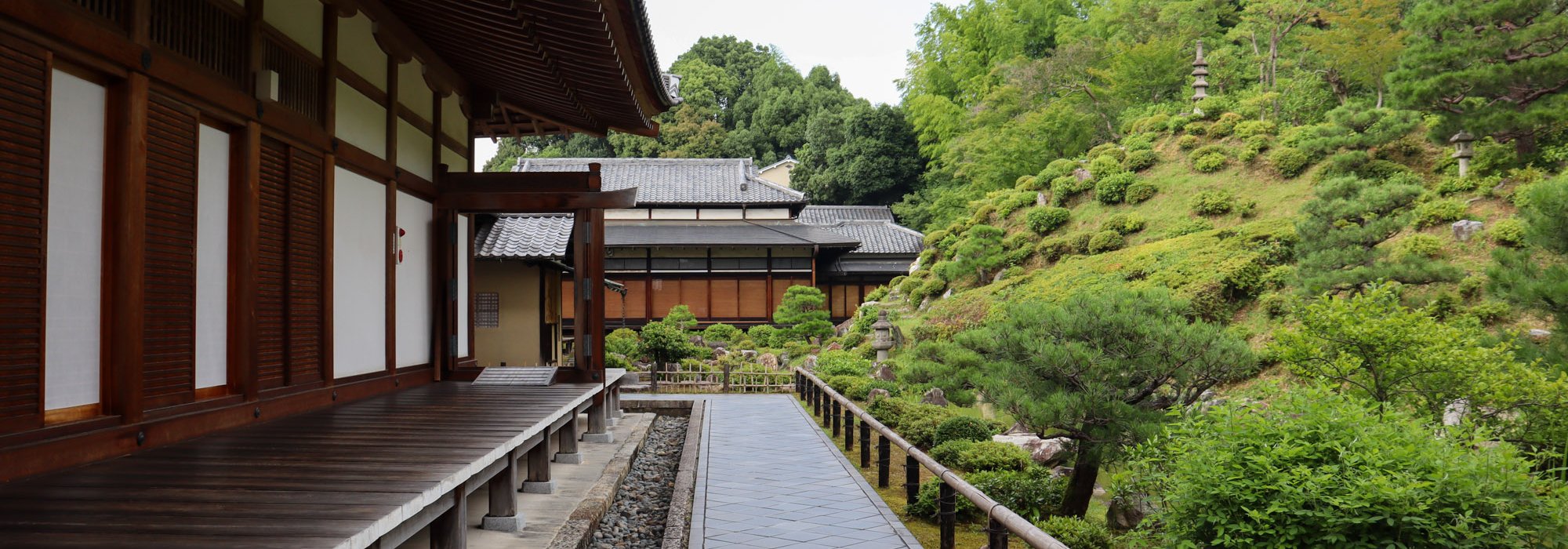
Chishaku-in is a Shingon Buddhist temple located south of Gion and Higashiyama in Kyoto, Japan. Largely overlooked by Western tourists, it combines interior halls adorned with magnificent traditional paintings and several gardens, including one scenic garden that's especially stunning when its azaleas bloom in late April and early May.
Chishaku-in is a large Shingon Buddhist complex that has stood on the small Mount Amidagamine, in the southern part of the Higashiyama range in Kyoto, since 1601. It is ideally located next to Sanjusangen-do and the Kyoto National Museum.
Its turbulent history begins in the early 8th century, when it was first founded on Mount Koya. In the 12th century, Kakuban (Kogyo Daishi, 1095–1143), a reformer of the Shingon school, moved it to the Negoro-ji monastery (now Wakayama Prefecture), a major spiritual center that housed around 6,000 monks in the early 13th century. Later on, it also became home to warrior monks and skilled gunners who took part in the power struggles of the Sengoku period. In 1585, Negoro-ji was besieged and burned down by Hideyoshi Toyotomi.
It was Toyotomi's rival, Ieyasu Tokugawa, who authorized Chishaku-in's reconstruction at its current location, on the grounds of the then newly established Toyokuni-jinja shrine, which was tasked with protecting this new temple. Chishaku-in later absorbed the neighboring Shoun-ji temple along with its treasures, establishing itself as a center for Buddhist training.

A Peaceful Place to Contemplate Paintings
Chishaku-in is thus a fairly young temple by Kyoto's historical standards, yet it hasn't escaped accidental or deliberate destruction, such as the fire 🔥 that consumed the main Kondo hall during the anti-Buddhist movement of the late 19th century. Even so, its meticulously maintained paved paths give no hint of this troubled past, and the temple has managed to preserve some remarkable pictorial treasures, including:
- Large paintings by Tohaku Hasegawa (1539–1610), particularly the fusuma sliding doors decorated with a great maple tree in autumn against a gold background, displayed in the Homotsukan treasure hall;
- Works by Insho Domoto (1891–1975): sliding-door paintings in a modern style depicting two women having tea, one in a kimono and the other dressed in Western clothing, created in 1958.

A Designated Place of Scenic Beauty: The Azalea Garden
These latter works are displayed inside the Daisho-in pavilion, from which visitors can also admire a 17th-century garden designated a Place of Scenic Beauty. It draws inspiration from the famous landscape of Mount Lushan in China, considered the birthplace of Pure Land Buddhism, a major influence on the Shingon school. This symbolic Buddhist paradise is represented by a small pond at the foot of a hill covered in azalea bushes, which bloom in late April and early May and evoke the contours of the Chinese mountain.
In June, visitors can also admire a hydrangea garden in bloom, located behind the main Kondo hall.

An Important Center of Shingon Buddhism
Chishaku-in remains an important spiritual center and serves as the head temple of the Chizan branch of the Shingon school, which oversees around 3,000 temples across the country, including Naritasan Shinsho-ji and Yakuo-in on Mount Takao (Tokyo).
The temple venerates the Buddha Dainichi Nyorai, as well as Kukai (Kobo Daishi, 774–835), who introduced Shingon Buddhism to Japan, and Kakuban. Visitors can also attend certain rites and ceremonies, such as Hana Matsuri on April 8, and a celebration honoring Kukai and Kakuban on June 15.
The temple also offers introductory sessions in sutra copying and meditation, as well as short spiritual retreats at a modern, upscale shukubo lodging, which allows guests to enjoy the grounds and gardens outside regular visiting hours.
Chishaku-in is truly one of Kyoto's hidden gems, even though it sits right in the middle of a heavily visited tourist area. Its fairly comprehensive visit will delight lovers of traditional Japanese gardens, as well as those interested in architecture and painting, all set within a deeply serene atmosphere.