
Toyokuni-jinja
Kyoto Shrine Dedicated to Toyotomi Hideyoshi
Toyokuni-jinja is a small Shinto shrine located in the touristic Higashiyama area of Kyoto. Dedicated to Hideyoshi Toyotomi, the 2nd pacificator of 16th century Japan, it also serves as his mausoleum and a place to pray for professional success and luck.
Toyokuni-jinja is an inconspicuous small Shinto site located right next to Kyoto National Museum in Kyoto’s Higashiyama area. First built in 1599, it honors Hideyoshi Toyotomi (1537 – 1598), one of the 3 hegemons of Japan, and is his mausoleum. His spouse Kita no Mandokoro (Nene or Kodai-in) and his descendants are also honored here.

However, in 1615, shogun Ieyasu Tokugawa (1543 – 1616), his rival and successor who opposed the perpetuation of the Toyotomi lineage, orders its abandonment.
Toyokuni-jinja is reinstated in the early Meiji era and its Honden pavilion rebuilt in 1880. The shrine’s superficies is then slightly enlarged to overlap part of the former grounds of Hoko-ji temple. The later was founded in 1588 by Hideyoshi in view of erecting a great Buddha statue bigger than Nara’s Daibutsu. An earthquake destroyed the temple shortly after its completion and the reconstruction was halted by its patron’s passing. Later in 1610, his son Hideyori donated a bronze bell that Ieyasu used as a pretext to wipe out the last remaining Toyotomi’s.

Cultural Properties and National Treasures
Beside its historical significance, Toyokuni-jinja displays several assets that are worth a detour:
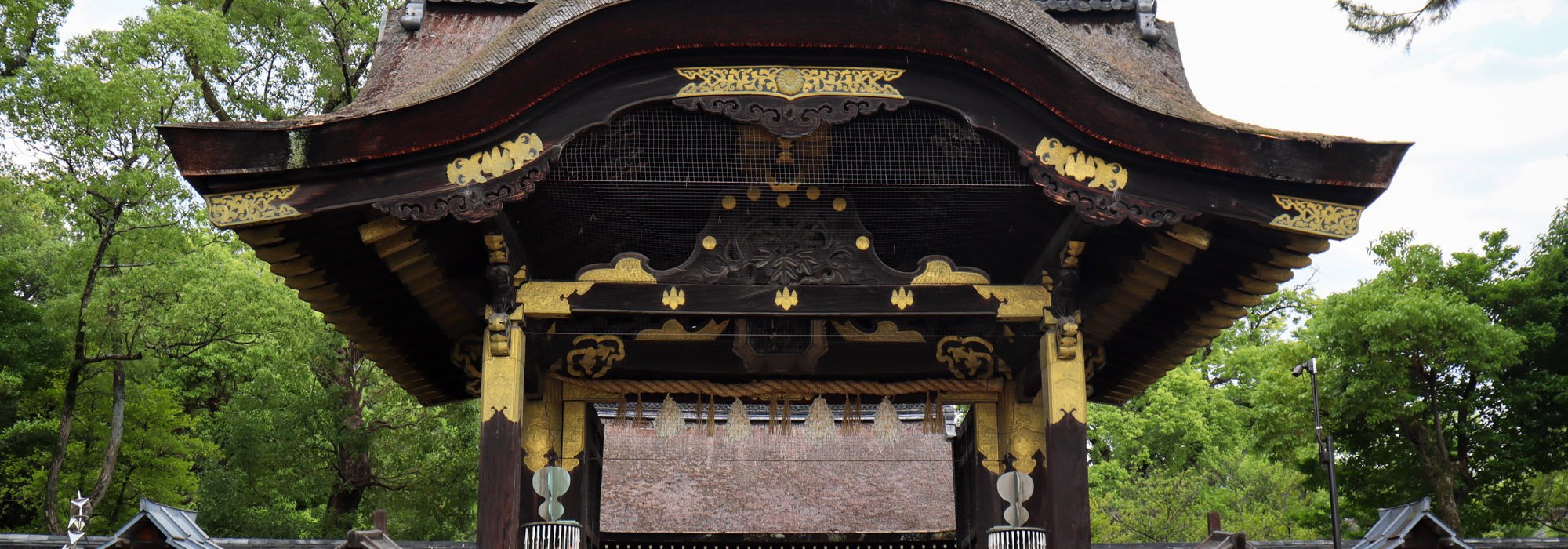
- Its large karamon gate, in the Azuchi-Momoyama style. It was retrieved from Fushimi Castle, one of Hideyoshi’s fortresses in the south of Kyoto that was destroyed in 1623. It is ornamented with refined carps and cranes sculptures and designated National Treasure;
- A gilded screen illustrated with the ritual festivals of Toyokuni-jinja, named Toyokuni Festival Screen (豊国祭礼図屏風 Hokoku saireizu byobu). The Kano school style painting is designated Important Cultural Property and exposed in the Homotsukan treasure hall;
- The sitting statue of Hideyoshi that welcomes visitors, was first erected during World War II, damaged in the 1995 Great Hanshin earthquake, then restored and placed in front of the Karamon gate on May 1rst, 2019.
The shrine’s lanterns 🏮 are decorated with paulownia flowers, the kirimon emblem of the Toyotomi house and now used by the Prime Minister of Japan. Additionally, a few discreet contemporary artworks are also displayed on the shrine’s grounds.

The Hokoku and Toyokuni-jinja line
Hideyoshi Toyotomi’s official tomb is located at Kyoto’s Toyokuni-jinja shrine, but he is also honored in other places of Japan: the Hokoku-jinja shrines. Hokoku and Toyokuni are written with the same kanji characters, in a play on the various pronunciations possible:
- 豊 can read toyo / ho and means "abundance";
- 国 can read kuni / koku and means "country".
Toyo is the first character of the name Toyotomi, and the combination of Toyo and Kuni is a reference to one of the names of Japan mentioned in the Nihon shoki.
Thus, in addition to Kyoto, Hideyoshi is also worshiped at:
- Miyajima’s Hokoku-jinja;
- Nagahama’s Hokoku-jinja;
- Osaka Caastle Park’s Hokoku-jinja; and,
- Nagoya and Kanazawa’s Toyokuni-jinja.
The shrine in Higashiyama is a place to pray for professional success and luck, mirroring Hideyoshi’s career who started as a foot soldier and eventually became the most powerful man of Japan, transcending his social origins to be elevated to a nobleman by the emperor.
The ema votive plates are shaped into gourds, the symbol of Ebisu, 1 of the 7 Lucky Gods, and especially symbol of wealth, also connected to Hideyoshi.
While it is ideally located right next to Kyoto National Museum, Toyokuni-jinja is low-key enough to not attract too many tourists. It will appeal to visitors passionate about the history of Japan, of which Hideyoshi is a major figure and whose presence can be felt throughout Kyoto. The mystical Sanjusangendo temple and the charming Chishaku-in in the vicinity provide additional spiritual visits.