
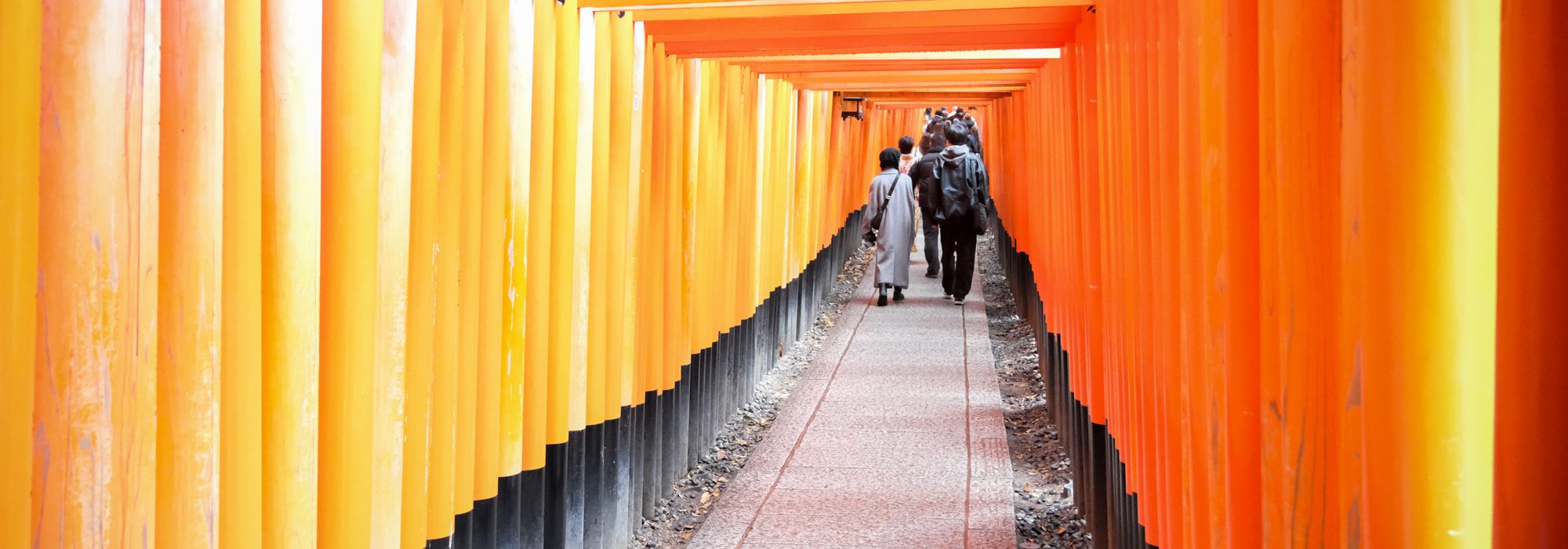
Fushimi Inari Taisha
⛩️ Kyoto’s 10,000 Torii Gates Shrine
Fushimi Inari Taisha is the largest Shinto shrine in Japan, located in the south of Kyoto. The beauty of this key religious complex is unveiled through a walking trail winding on the forested mountain, marked by thousands of vermilion gates called torii. We recommend visiting the shrine over half a day, starting early in the morning (at sunrise) or later in the afternoon (close to sunset) to avoid the crowds.
Fushimi Inari Taisha is the main and largest shrine dedicated to the deity Inari; it is the head shrine of about ~30.000 places worshiping Inari in the archipelago. Located on Mount Inari in the south of the Higashiyama mountain range, it is easily accessible from the center of Kyoto thanks to buses and JR and Keihan trains. It is, incidentally, one of the most visited sites of the former imperial capital, welcoming several millions visitors a year, including about 3 millions just for the first prayer of the year called Hatsumode.

In 2011, the shrine celebrated its 1,300th anniversary but its priests think its site may have been a place of worship for a lot longer.
🦊 A must-see millennium-old shrine in Kyoto
Fushimi Inari Taisha’s official foundation is said to date back to 711. The powerful Hata clan established its tutelary deity Inari, then protector of agriculture, as an act of faith and atonement after a year of bad rice harvest.
At the beginning of the Heian period (794 – 1185), the shrine is transferred under the imperial tutelage and Kukai (Kobo Daishi), a major religious figure of Japan, places his To-ji temple under the protection of Inari, helping to popularize this kami and fostering construction of its shrines throughout the country.
The cult of Inari becomes more complex over time as its importance is growing. Thus, the god’s action gradually extends to trade, craftsmanship and industry, and overall to the pursuit of prosperity. Nowadays, it is also prayed for fertility and love relationships.

⛩️ Senbon torii, the 10,000 vermilion gates tunnel
The entrance to the grounds opens at the monumental Romon gate, a gift from Hideyoshi Toyotomi in 1589, and extends over about 215 acres at the foot and up to the top of Mount Inari. Despite the antiquity of the place, most of its buildings are relatively new, dating back from the 15th century at the earliest.
It is also true for Fushimi Inari Taisha’s main attraction: Senbon torii ⛩️, the thousands vermilion gates tunnel, whose tradition dates back to the Edo period (1603 - 1868).
The torii gates are actually votive offerings to Inari, as a gift of gratitude for granted wishes or to support a prayer. Due to the association of Inari to prosperity and successful business, the number of torii offered by merchants and companies multiplied and now constitute the greatest part of the tunnel. The back of the gates are inscribed with ideograms that feel mysterious for those who don’t read Japanese, but that actually state the names of the donors and the date of the donation. Winning the favors of Inari does indeed come at a price: allow from ¥175,000 (~US$1,102) and up to ¥1,3 million (~US$8,190) depending on the torii’s location!
While being a collection of ads, the tunnel has become the stereotypical image of Kyoto with an aesthetics that is appealing to the crowds.

👣 Mount Inari walking trail
Fushimi Inari Taisha’s trail climbs Mount Inari, that culminates at about 233 meters high, and passes by several vermilion torii tunnels and various stone stairways. The walk under the trees on the side of the hill is characterized by:
- An about 4 to 5 kilometers-long path;
- Approximately 12.000 steps to climb and to go down;
- An elevated viewpoint on the south of Kyoto city at the Yotsutsuji intersection;
- A total duration of about 2 to 3 hours, including about 30 minutes to walk the loop at the top of the mountain.
From the main entrance, the sacred ground is marked by a 1rst giant torii next to the Romon gate. After a short break at the Go Honden main hall, designated National Treasure and displaying a richly ornamented Azuchi-Momoyama style architecture, one can proceed to the start of the walk and to the first torii of the Senbon torii tunnel.
Most of the visitors gather here and up to a first fork in the path to snap the most instagrammable picture. This section is the most crowded and certainly the most unpleasant to cross, however after the first fork, the quiet and spiritual ambiance slowly reclaims its rights.
The higher we climb, the less there are hikers and the more the torii are varied, made of stone or wood, and of all sizes. The side paths are also nice to explore as they lead to small secondary altars. There are a few occasional shops selling torii (from ¥2,500 / ~US$15.75) or fox head-shaped ema as a tribute to Inari’s messenger animal, of which numerous statues are dispersed everywhere.

Getting ready for the ascension
Fushimi Inari Taisha is not an isolated place; you’ll find yatai food stalls and drinks vending machines at the foot of the mountain, however a few tips can help make the most of the hiking trip:
- Allow half a day for the hike and start early in the morning (the place is busy from 7 a.m. in summer) or in the afternoon to watch sunset from the top and go back down the mountain under the light of the lanterns.
- Make sure your clothes are suitable for the day’s weather conditions, and to wear adequate shoes (sneakers or hiking shoes).
- Bring enough water to avoid dehydration. You’ll find vending machines and small shops along the way, but prices are more expensive than in the city and their opening hours are limited to a few hours on the daytime only.
There also a few toilets 🚽 on the way, but very few benches, that are mainly placed near the top, at the Yotsutsuji intersection and in front of the stalls. Moreover, it is not recommended to hike during the night, as the path is not well lit-up and it is not unusual to encounter wild animals, like boars, especially in the depths of the shrine. As a reminder, the grounds is open 24/7 and admission is free.
Lastly, make sure to behave properly towards the worshipers who are praying and respect the offerings placed in front of the altars (usually a cheap sake 🍶 cup and a few coins), but also to be patient with the other tourists. At the end of the hike, make sure to discover the regional cuisine at the sake brewery district in Fushimi, a few minutes away by JR train 🚅 toward south.
Fun fact, the site of Fushimi Inari Taisha is featured in the movie Memoirs of a Geisha.
The shrine also inspired video game designer Shigeru Miyamoto for the creation of the Star Fox series. By the way, Nintendo’s headquarters are located in the same area in the southern suburb of Kyoto.