
Yasui Konpiragu
The Unconventional Hidden Shrine in Kyoto
Yasui Kompiragu is an old shrine located in the south of the touristy Gion district in the heart of Kyoto in Japan. Nicknamed the "shrine to break off relationships", it is famous for its mysterious pierced rock to which people pray for a happy love. It is also home to a small museum dedicated to ema votive plates and is the last receptacle of the geiko’s damaged hair ornaments.
Yasui Kompiragu is a small shrine among Gion – Yasaka’s dozens of places of worships in the east of Kyoto and is located in the vicinity of Gion, the Geiko district and near the great Kennin-ji temple.
Reminiscence of the Heian period
The place was initially home to a small Fuji 🗻-dera temple founded in the 2nd half of the 7th century by the Fujiwara clan. Emperor Sutoku (1119 - 1164) loved the temple’s purple wisterias and even provided funding for repairs in 1146. A few years later, after he died in exile in Sanuki province (nowadays Kagawa prefecture in Shikoku), his wrathful spirit appeared at the temple. To appease it, emperor Go-Shirakawa ordered the construction of Kômyôin Kanshôji temple, that would later be destroyed in the Onin war (1467 - 1477).
In the 17th century, the sacred place was used for transferring Rengekôin temple from Uzumasa Yasui district in the west of Kyoto. On this occasion, 3 spirits and kami were officially enshrined here:
- Emperor Sutoku;
- Ômononushi no kami, the deity of Shikoku’s Kotohiragu Kompira-san shrine; and,
- Yorimasa Minamoto (1106 - 1180), a protagonist of the Gempei war at the end of the Heian period.
After the Meiji restoration (1868), the name of Rengekôin was abandoned and the sacred grounds became Yasui Jinja, then Yasui Konpiragu.

Enkiri jinja: the shrine that ends bad relationships
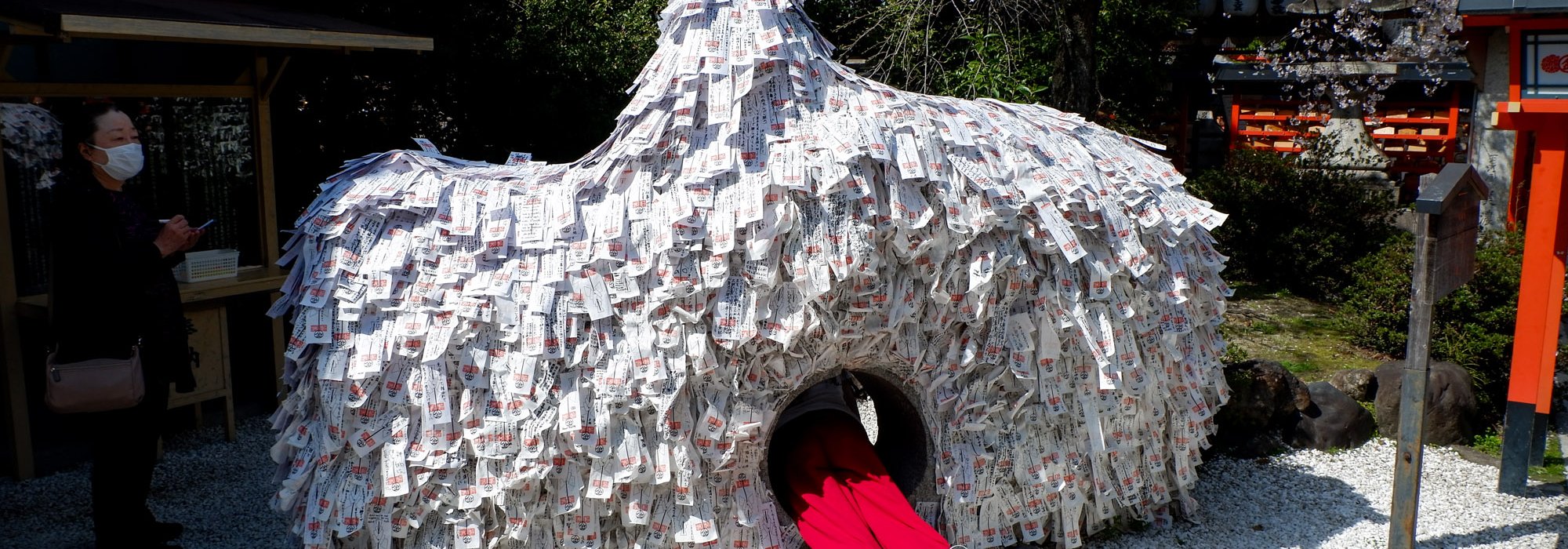
The popular name of Yasui Konpiragu is "enkiri jinja" (縁切り神社), that is to say the "shrine to break off bad relationships." Its centerpiece is a big 1,5m high and 3 meters wide rock whose shape recalls of an ema, with its bottom part pierced by a hole just big enough for an adult to crawl in. The stone in named enkiri enmusubi ishi (縁切り縁結び碑, rock to end or begin relationships) in Japanese, or power stone monument in English, and is situated near the main pavilion Honden. Its name implies that it has the power to cut ties with a former lover or on the opposite to help the bonding of a new couple.
For this to happen, a ritual must be performed at the rock:
- First purchase a katashiro talisman from the shrine, it is quite similar to the one used for Nagoshi no Harae;
- Then crawl 2 times in the hole in the rock while thinking to your wish; and,
- Lastly glue the talisman on the rock on top of the others.
The true shape of the stone is hidden by the thousands of katashiro covering it. Visitors are indeed many to come and pray for their love life, all the more as the ritual can be performed H24, and the talismans are purchasable from a self-service box (donation required) placed near the stone.

Ema Konpira Museum
Additionally, Yasui Konpiragu’s grounds is also home to a small exhibition hall located in front of the Haiden and the sacred stone: the Konpira Emakan Museum. Opened since 1976, it displays a wide range of ema votive plates, with an approach of preserving samples of these Japanese ex-votos that are normally ritually cremated.
The admission to Emakan includes Garasu heya, an original exhibition of glass artworks, in the Art Nouveau and contemporary styles. However, the whole museum is temporarily closed for renovations until at least 2027.

Kushi Matsuri comb festival
Like all Japanese places of worship, the grounds of Yasui Konpiragu is enlivened several times a year by specific celebrations. Besides the classical Ganjitsu and Setsubun, one can mention:
- The great Konpira spring 🌸 festival (Shunki Konpira Taisai), on May 10, the wishes placed on the stone are cremated during a purification ritual;
- Nagoshi no harae, the great mid-year purification around June 30;
- Kushi matsuri, the "comb festival," is a ceremony taking place on the 4th Monday of September. The kushi combs and kanzashi hair pins that are used or damaged are placed on the small Kushizuka (櫛塚) mound located in the north of the enclosure for purification. Geiko and maiko bring here their hair ornaments that are no longer usable as way to showing them their gratitude before discarding them.
Yasui Konpiragu is an unpretentious shrine but the place is constantly filled with Japanese or international visitors eager to pray for a happy love and try passing through the stone. It makes for a nice romantic halt while discovering the geisha’s traditional Kyoto and solemn temples like Kennin-ji or Kodai-ji.