
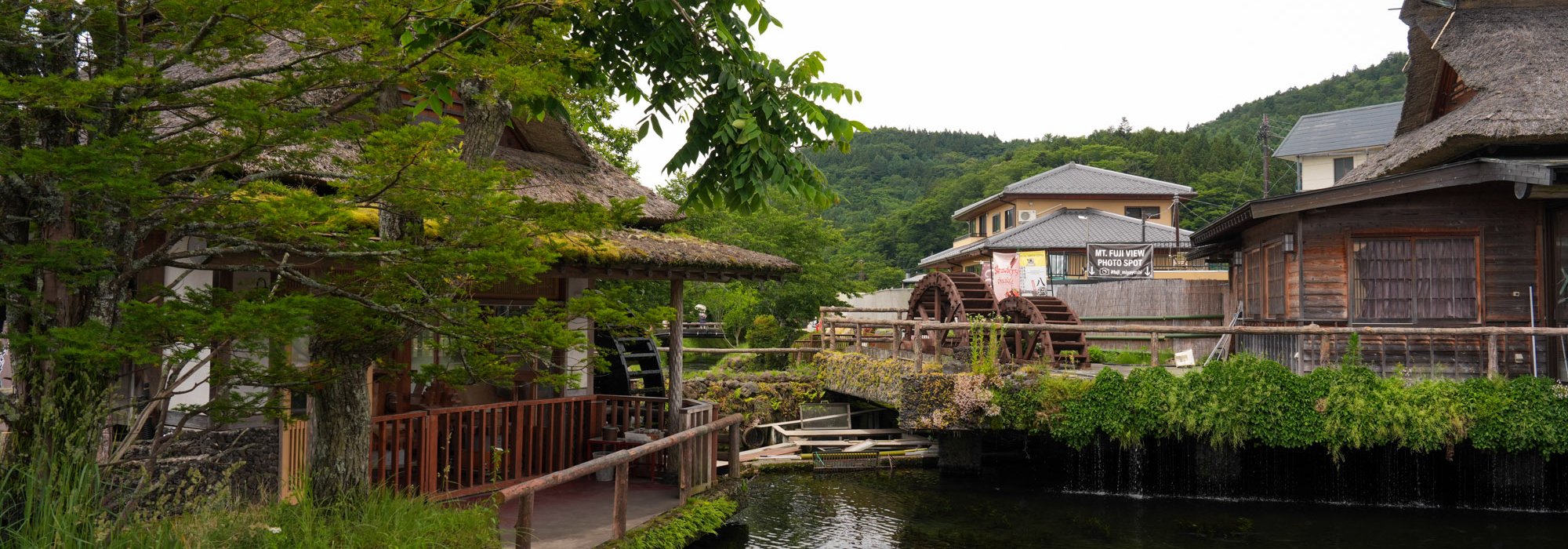
Oshino Hakkai
The Thatched-Roof Village at the Foot of Mount Fuji
Oshino Hakkai is a small village of traditional thatched-roof houses located southeast of Fujiyoshida, in Japan's Yamanashi Prefecture. At the heart of the Fuji Five Lakes region and at the foot of Mount Fuji, its 8 springs, fed by snowmelt from the sacred volcano, are renowned for their crystal-clear purity. Listed as a UNESCO World Heritage site, Oshino Hakkai is especially popular in spring and fall, and can be visited year-round in about 1 to 2 hours.
Oshino Hakkai is a small rural village located halfway between Lake Kawaguchiko and Lake Yamanakako in the Mount Fuji 🗻 5 Lakes Area. Its name comes from the 8 ponds (Hakkai meaning "8 seas") around which it grew up—themselves the remnants of a 6th lake that dried up naturally centuries ago.
It's the village's remarkably pure spring water that made Oshino Hakkai famous: originating from Mount Fuji's melting snow, it has been filtered through volcanic rock for decades. Its quality was such that pilgrims would come here to purify themselves before beginning their climb up the sacred volcano 🌋.
This recognition still holds true today:
- In 1985, Japan's Ministry of the Environment ranked the spring at Waku Pond among the 100 best water sources in the country;
- In 2013, Oshino Hakkai was designated a UNESCO World Heritage Site together with Mount Fuji.

Edo-Era Countryside Charm
Set deep in the Japanese countryside, this small village recreates the traditional wooden architecture of the Edo period (1603-1868). Paths wind between buildings housing souvenir shops, restaurants, and small cafés, connecting the 8 water sources to one another.
In the heart of the village, on the shore of Waku Pond, the small Hannoki Bayashi Shiryokan museum showcases a traditional farmhouse topped with a thatched roof typical of Japan's mountainous regions. Through a display of antique tools, it immerses visitors in the daily life of farmers during the feudal era.
The 8 ponds (Okama, Sokonashi, Choshi, Nigori, Waku, Naka, Kagami, Shobu, and Deguchi) each receive special care. The tradition of making a wish by tossing a coin into a fountain has indeed made its way to Oshino Hakkai, but the practice is banned by local authorities, since it risks polluting these pristine waters and harming the local ecosystem. Visitors wishing to make a wish should instead drop their coin into the saisen-bako offering boxes provided on site.

Yamanashi's Regional Cuisine
Enjoying Oshino Hakkai mainly means strolling through its lanes and sampling local specialties:
- Kusa mochi: a soft rice cake flavored with mugwort, which gives it its characteristic green color, filled with red bean paste and grilled;
- Tofu, made with Oshino Hakkai's spring water. It's served cold, like a savory custard-style dish, topped with soy sauce, grated ginger, and green onion;
- River fish such as ayu (sweetfish) and iwana (char), salted and charcoal-grilled, served whole on a skewer.
In winter, locals enjoy the hearty hoto soup, whose miso broth features Yamanashi's seasonal vegetables along with thick egg noodles. The region also raises its own Wagyu, the Koshu wine beef: the cattle are fed local grape pomace, which gives their meat a rich umami flavor, delicious in stews.
All while admiring Mount Fuji towering over the idyllic landscape on clear days.

A Postcard-Perfect Japan: Sakura and Mount Fuji
The village indeed offers many Instagram-worthy views of the sacred volcano, such as:
- The banks of the Shinnasho River, lined with cherry trees that bloom around mid-April;
- Kagami Pond, where the mountain is reflected on the water's surface.
Rarer, more specific phenomena can also be spotted here:
- Diamond Fuji, which occurs in winter when the rising or setting sun aligns perfectly with the volcano's summit, appearing to rest right on its caldera;
- Kasagumo, a lenticular cloud that can sometimes be seen crowning the mountain. This striking phenomenon mostly occurs in spring and fall, during periods of unstable weather.
Its easy access by bus helps make Oshino Hakkai a highly popular destination, especially in spring for the sakura 🌸 and in fall for the fiery colors of the koyo 🍁. Despite the crowds, the village remains charming and pleasant, and can be explored in about 1 to 2 hours. For those wanting to spend a full day there, the visit can be rounded out with the small garden at the Hikobee residence (八海庭園彦兵衛屋敷, Hakkai Teien Hikobee Yashiki) or, just outside the village, the small Shinobi no Sato theme park 🎡, which combines ninja folklore, red torii ⛩️ tunnels, and views of Mount Fuji—a fun option for families.