
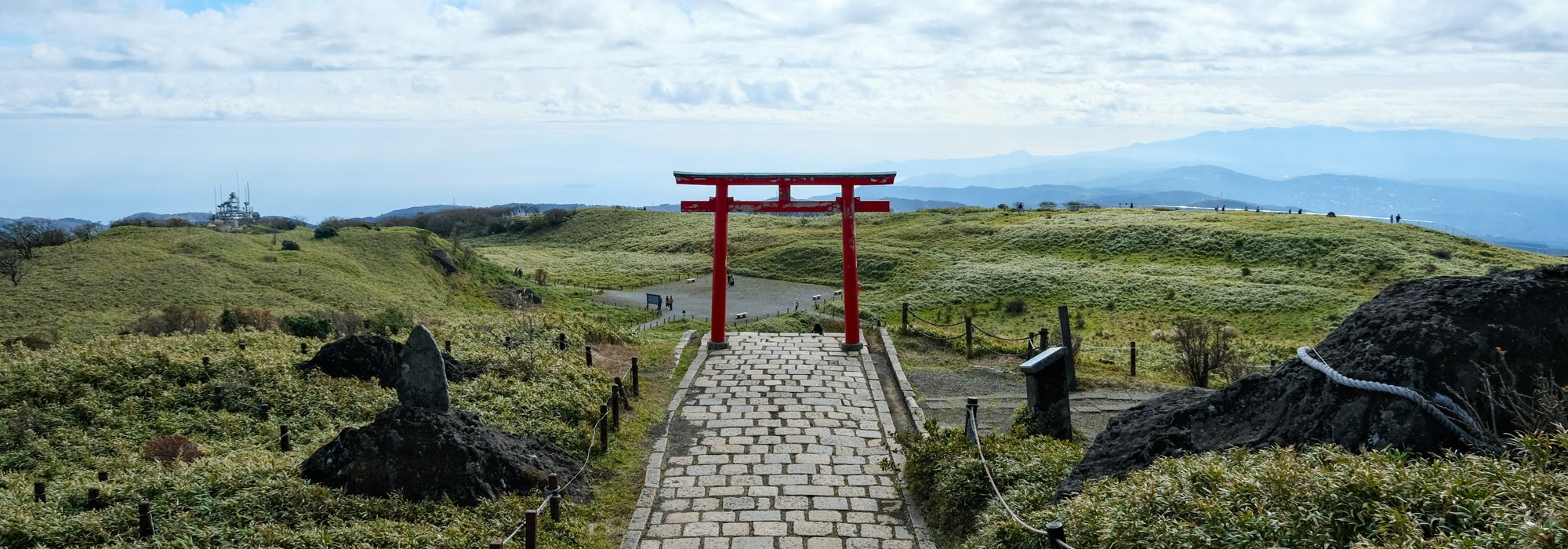
Mototsumiya-jinja
Altitude Shrine With a View on Hakone
Hakone Mototsumiya-jinja is an ancient Shinto shrine, located at the top of Mount Komagatake in the touristic resort of Hakone in Kanagawa prefecture in Japan. Overlooking the eastern side of Lake Ashi, it offers a wonderful panoramic view on the area and Mount Fuji on a beautiful day. Mototsumiya-jinja is a nice place for straying off the touristic beaten paths of Hakone.
Hakone Mototsumiya-jinja’s solitary verdigris and vermilion pavilion is standing at 1,356 meters high, at the top of Mount Komagatake, on the eastern side of Lake Ashi.
Millennia-old place of worship in Hakone
Founded about 2,400 years ago by monk Shozen Shonin during the reign of legendary emperor Kosho, it is deemed the oldest shrine of the area. The deities enshrined are those of the Kamiyama mountain, the Hakone Okami triad (the "great gods of Hakone"):
- Ninigi-no-Mikoto, grandson of Amaterasu and ancestor of the legendary 1rst emperor Jinmu;
- Konohana Sakuya-hime, female deity of volcanoes, that is also worshiped on Mount Fuji;
- Hoori-no-Mikoto (or Hikohodemi-no-Mikoto), the 3rd son of the 2 previous gods, grandfather of Jinmu and protector of harvests.
Mototsumiya-jinja is actually the initial location of Hakone-jinja, before the main shrine was moved down to the shore of Lake Ashi in 757. Nowadays, it is the Oku Miya, that is to say the inner shrine. Therefore, to explore Hakone-jinja in its entirety, on must go on the "3 shrines pilgrimage" that consists in visiting Hakone-jinja and Kuzuryu Jinja on the lakeside, and Mototsumiya at the top of the mountain.

Power spot with a view on Mount Fuji
In the past, emperors and shoguns all sought the protection of Mototsumiya’s deities by developing Hakone-jinja. As for Mototsumiya itself, it used to attract followers of Shugendo asceticism, due to its relative isolation and its spiritual influence.
However, it was only in 1964 that Mototsumiya’s pavilion was renovated, thanks to the businessman founder of the Seibu group (real estate and railway), Yasujiro Tsutsumi (1889 – 1964), who also participated in the touristic growth of Hakone.
The Seibu group continues to sponsor the shrine, with among other things, the construction of a modern observation platform called Ashi no Sora, that offers a unique panoramic view, and a photo spot marked by a giant picture frame. Thus, a spectacular view unfolds from the top of Komagatake on Lake Ashi, Mount Fuji 🗻 and as far as the Sagami and Suruga bays, and it is even possible to discern Tokyo’s skyline. However, such view is only possible on a clear weather and beautiful day.

Staying abreast of the times, Mototsumiya-jinja has been holding every year since 1964 a fire 🔥 festival that takes place on October 24. A sacred fire is lit up and transported to Hakone-jinja, where its flames are dispatched between several shrines of the area. The ceremony is both a tribute to the mountain deities and a symbolic way to spread peace, inspired by 1964 Tokyo Olympics 🏅’ flame.
Mototsumiya-jinja is a small weathered shrine in the clouds. It is kept off the touristic beaten tracks by its relative seclusion from Lake Ashi’s touristic bubble, at about 2 or 3 hours’ walk, and by the substantial cost of the ropeway (not included in the Hakone Free Pass).
Mototsumiya-jinja is worth the detour when looking for a visit in Hakone without the crowd and/or if looking for beautiful vistas or mystical ambiances, in the high-altitude fresh air.