
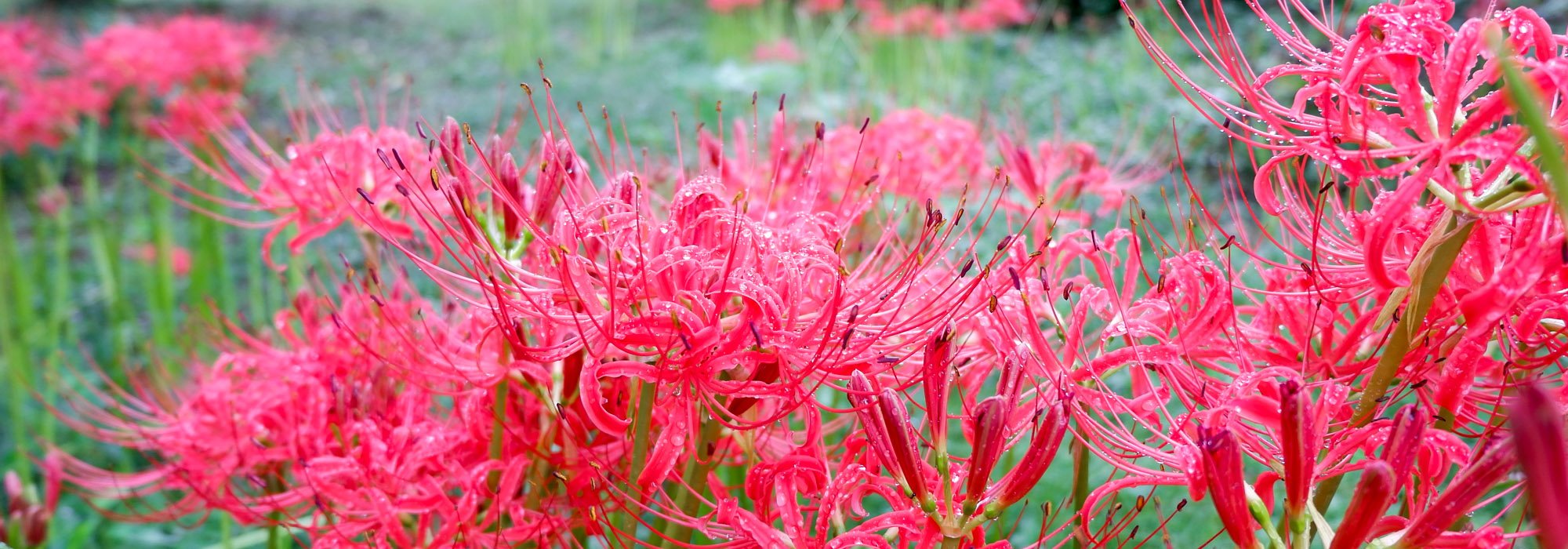
Higanbana
The Red Spider Lilies of the Autumn Equinox
Higanbana, or red spider lily (Lycoris radiata), is a spider-shaped lily flower that blooms in September in Japan, around the time of the Autumn Equinox. It marks the arrival of the fall season and can be admired in parks, gardens, and rice paddies. According to Japanese mythology, it also symbolizes death and the notion of eternal separation.
In September in Japan, public parks and temple gardens turn red as higanbana come into bloom. These lily flowers, with their striking red color and distinctive spider-like shape, mark the Autumn 🍁 Equinox, a national holiday in Japan known as Shubun no Hi, which falls on either September 22 or 23 depending on the year. Various legends from Japanese mythology also give these flowers a darker meaning.
Known by its Latin scientific name Lycoris radiata, the higanbana also goes by the names Japanese amaryllis, red spider lily, or hurricane lily —so many names, in fact, that it has earned a reputation as the "flower with 600 names." This bulbous perennial blooms atop a long stem before its leaves have fully appeared. Best known for its scarlet color, it also exists in a white variety.
Traditionally found along rice paddies, waterways, and in cemeteries, higanbana don't grow entirely on their own; the fact that they're so widespread shows just how much the Japanese value them. Their toxic bulbs help repel unwanted animals such as rats, mice, moles, and other crop pests.

A Flower Steeped in Mythology
Lycoris radiata is a flower surrounded by several legends, all stemming from one peculiar trait: its leaves and flowers never appear at the same time. So why do these 2 parts of the plant grow at such distinct moments?
The 1rst explanation holds that this separation was decreed by the sun goddess Amaterasu, according to Japanese mythology. Two elves were said to have once been tasked with watching over the higanbana in turn—one over the leaves, the other over the flowers. One day, they supposedly met and fell in love. So consumed by their romance, they neglected their duty to care for the higanbana. As punishment, the goddess Amaterasu is said to have separated the leaves from the flowers forever, so the two would never see each other again.
This story bears a resemblance to that of Tanabata 🎋, the star festival that celebrates the annual reunion of 2 soulmates separated by the Milky Way—except that in this case, Amaterasu never granted the pair even a single day together.
The second legend is rooted in Buddhist belief and tells that these flowers, said to grow in abundance along the path to the underworld, guide the deceased toward reincarnation. In this light, the fact that the red spider lily blooms before its leaves appear symbolizes the notion of eternal separation between the world of the living and that of the dead.
This ominous imagery has been used throughout Japanese popular culture, notably in the short story Gongitsune, (Gon, the Little Fox) by author Nankichi Niimi (1913–1943), and in the horror manga Tokyo Ghoul, where the red spider lily is associated with "ghouls," creatures that feed on humans to survive. Red spider lilies also appear in the horror video game Silent Hill f, released in September 2025.

Symbols of Summer's End and of Mourning
The Japanese word 彼岸花 higanbana literally means "flower of the equinox," referring to the blooming period of the Japanese amaryllis, which coincides with the Autumn Equinox. The higanbana flower thus marks the end of summer and announces the arrival of fall.
For the Japanese, it also serves as a way to remember departed loved ones and to honor deceased family members during Shubun no Hi. Indeed, the autumn equinox originated as a Buddhist observance during which graves are traditionally cleaned and maintained. Red spider lilies are then used as offerings to the deceased and to deities during memorial ceremonies. Because of this strong association with mourning, the higanbana is nicknamed the "flower of the dead" or "flower of the afterlife."

Where and When to See Higanbana in Japan
The best time to see red spider lilies in Japan runs from mid-September (around the 20th) through early October on average. They're most commonly found in Japanese gardens attached to Buddhist temples, in certain public parks, and along rice paddies in the countryside. These bursts of red brighten up Japan's still lush, green September landscape. Seasonal matsuri festivals may also be held to mark the occasion.
To see fields of blooming higanbana, we recommend:
- The parks in Saitama, Kinchakuda Manjushage and Gongendo Koen, where several million spider lilies reach peak bloom in late September;
- The terraced rice paddies of Terasaka Tanada in Chichibu, Tsuzura Tanada in the town of Ukiha on the border between Fukuoka and Oita prefectures, or Bansho no Tanada in Kumamoto Prefecture;
- The temples Kuhon-ji in Gose, Nara Prefecture, Soko-in in Matsudo, Chiba Prefecture, and Josen-ji, known for its white spider lilies, in Kanagawa; and,
- Along the Yakachigawa River in Handa, Aichi Prefecture.
The stunning gardens of Koishikawa, in northern Tokyo, are also a great option for a visit during this period, when the weather tends to be unpredictable and often rainy ☔️.