
Tadasu no Mori
🌳 The Sacred Forest of Shimogamo in Northern Kyoto
Tadasu no Mori is a primeval, sacred forest of about 12 hectares that surrounds Shimogamo Shrine, located beyond the Demachiyanagi Delta in northern Kyoto, Japan. Recognized by UNESCO as a historic natural and spiritual heritage site, it shelters trees up to 600 years old and is known as the "forest of truth," where visitors come to purify themselves before praying.
The only forest still standing within present-day downtown Kyoto, Tadasu no Mori is a sacred natural monument that is included as part of a visit to Shimogamo Shrine, acting as an introduction to it. Indeed, its name meaning "forest of truth" or "of amend" in English, the place allows visitors to fully purify both body and soul before going to pray to the Shinto deities.

The mystical atmosphere of the place can be felt as soon as you begin strolling along its straight paths. Visitors take advantage of the surrounding calm to reflect on their conscience and emotions. Sheltered by the trees, lies are revealed, and once confessed, they can be corrected; the mind then regains a certain clarity.
The natural site is also crossed by the Semi no Ogawa and Nara no Ogawa streams, whose clear water serves as a source of purification in Shinto worship. In summer, visitors can dip their feet in the water, which is said to regenerate and protect the body. A mitarashi (or chozuya) purification fountain, used for cleansing hands and mouth, is also set up near the end of the forest path, in front of the shrine's second large torii ⛩️ gate, before the compound of pavilions.

The sacred nature of Tadasu no Mori also comes from its age and the fact that it has remained a primeval forest, meaning it has never been altered or exploited by humans. Its deciduous trees, mainly Japanese zelkova and Chinese hackberry, are for the most part centuries old, ranging from 200 to 600 years.
Although its surface area has shrunk due to urbanization, Tadasu no Mori has always been protected by Shimogamo Shrine and the Japanese imperial family; today it covers about 12 hectares. It is the last remnant of the primeval forest that originally existed across the Yamashiro plain, before the founding of the imperial city of Heian. As such, it is listed as a UNESCO World Heritage site as a historic natural and spiritual monument of old Kyoto.

A transitional path from the modern city to the sacred world
The main trail through Tadasu no Mori stretches 650 meters, between the 2 large vermilion torii gates marking the presence of Shimogamo Shrine. The transition between the human world and that of the kami deities begins beyond the Demachiyanagi Delta and station, after passing the site of the Old Mitsui Family Shimogamo Villa.

Although the path itself is short and can be walked in just a few minutes, it's worth taking your time (about an hour) to discover the various secondary shrines and historical remains scattered throughout the forest, as well as the natural springs that surface in certain spots. Here is a selection of sites to see within Tadasu no Mori, from south to north, before reaching Shimogamo:
- Kawai-jinja is without a doubt the largest of the forest's shrines to visit. It's especially popular among women for its mirror-shaped votive plaques (ema), whose faces are left blank for visitors to draw and paint in order to pray for beauty and love. The shrine is dedicated to the deity Tamayori-hime no Mikoto, mother of Emperor Jinmu, the mythical founder of Japan.
- Not far away stands the entrance to a replica of the hermitage hut of Kamo no Chomei (1155-1216), a Japanese monk and poet who spent part of his childhood at Tadasu no Mori, as his father was a Shinto priest at Kawai-jinja.
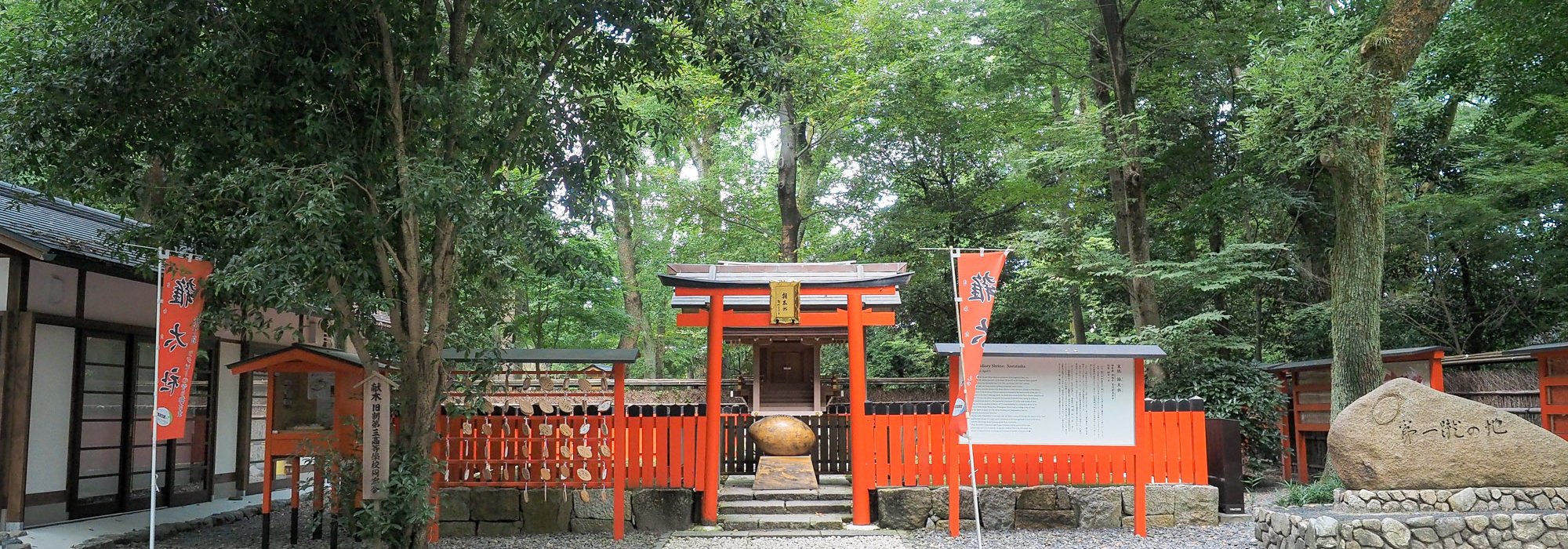
- Sawata-sha is a cute, tiny vermilion shrine dedicated to Kantama no Mikoto, the deity of skill in ball games. It's also considered the site of the first rugby match ever played in the Kansai region. Its votive plaques and main statue take the unusual shape of a rugby ball.
- Also worth mentioning for their simple beauty are the small pavilions Nijuni-sho-sha, Kawasaki-sha, and Saio Shinrei-sha.

The paths of this sacred primeval forest tend to be very quiet year-round, encouraging a certain sense of introspection. They come alive during the warmer months for a handful of annual events, such as the yabusame ritual (mounted archery), held every year on May 3 ahead of the Aoi Matsuri. Yatai food stalls and games for children can also be found there, typical of the Japanese summer, on the occasion of the Mitarashi-sai purification festival.