
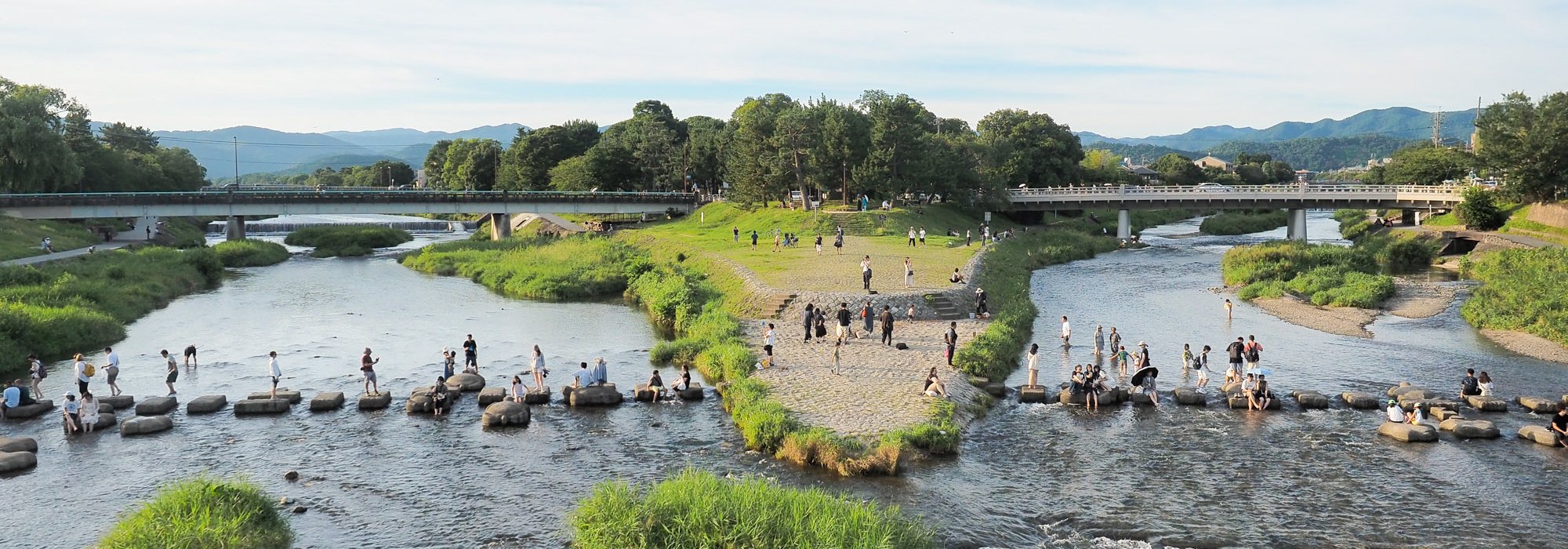
Demachiyanagi Delta
Kyoto's Casual Local Meeting Spot
The Demachiyanagi Delta is an open-air gathering spot for Kyoto locals, located in the Sakyo ward in the northern part of Kyoto, Japan. It marks the confluence of the Takano-gawa and Kamo-gawa rivers, taking shape as a series of stepping stones that visitors can cross on foot or sit on for a break by the water. It's best visited early in the morning or at sunset, especially in summer and from spring through fall.
North of Kyoto, the area around Demachiyanagi Station is one of those under-the-radar, low-key spots for experiencing the city from the inside, away from its more touristy face. Here, for a brief, suspended moment, you get to share in the everyday life of Kyoto locals, who love gathering along the Demachiyanagi Delta to unwind. This triangular strip of land, whose shape recalls the Greek letter Δ, rises from the water where the Kamo (鴨川) and Takano (高野川) rivers meet. From this confluence point, the Kamo-gawa continues on its own, flowing south through the city.
This spot was once known as "Tadasu-gawara," named for its proximity to the sacred Tadasu no Mori forest linked to the Shimogamo Shinto shrine. It used to host traditional events, such as sumo matches and theatrical performances (Noh and Sarugaku), mainly from Classical times through the Muromachi period (1336-1573). During the Edo period (1603-1868), the clear, pure river water was used in various crafts, including painting.
More recently, the Demachiyanagi Delta has served as a backdrop for numerous works of literature, manga, and anime, as well as a filming location for Japanese movies and TV series; notable examples include Pacchigi!, Kamogawa Horumo, My Tomorrow, Your Yesterday, and The Tatami Galaxy. With Kyoto University nearby, students often meet up here after class along the river to hang out with friends, spend time as couples, have a picnic, and enjoy the refreshing presence of the water. Local families love watching their kids hop across the stones, treating it like a natural playground for jumping with both feet or hopping on one. The atmosphere gets particularly lively and friendly in the late afternoon and on weekends.

The River's Iconic Stepping Stones
The delta's current layout dates back to 1993, when the Kyoto prefecture installed 83 stepping stones across the water to:
- Protect the shallow riverbeds in this area; and,
- Create a riverside space that's both functional and pleasant.
These stepping stones let people cross the rivers on foot while also adding character to the delta thanks to their varied, decorative shapes: rectangular ones, as well as turtle-shaped stones and ones shaped like the chidori plover, one of the symbols of the Pontocho geisha district.
Stones arranged in a straight line are meant for crossing, while those set in parallel rows along the sides invite you to sit for a while. In summer, it's a great spot to dip your feet in the water while taking in unobstructed views of:
- The mountains to the north and east of Kyoto, including Mount Hiei and Mount Daimonji; and,
- The river itself, where ducks, wagtails, and the occasional heron venture close by in search of food.
The Demachiyanagi Delta offers a welcome break in a natural, historic setting right in the heart of Kyoto. It's worth visiting year-round, but especially at sunrise and sunset, when the light reflects beautifully on the water. It's also a popular spot for watching the nighttime bonfires of Gozan no Okuribi, held every year on August 16 starting at 8 p.m.
While the stone path is open to the public 24/7, since the river here tends to be calm and shallow, it may occasionally become inaccessible or flooded during periods of heavy rain ☔️, high water levels, or after a typhoon 🌀 passes through.

A Gateway to Kyoto's Less Touristy North
Beyond crossing the stepping stones, the Demachiyanagi Delta makes a great starting point for exploring the more residential northern part of Kyoto, where student and spiritual life thrive, far from the tourist crowds.
From here, you can continue on foot toward:
- The north, to the Shimogamo and Kamigamo shrines, passing through the Tadasu no Mori forest and the Old Mitsui Family Shimogamo Villa;
- The south, along the landscaped greenway on the banks of the Kamo-gawa, back to the lively city center — especially worthwhile during sakura 🌸 cherry blossom season in early April;
- The east, to Hyakumanben, one of Kyoto's main student neighborhoods along with Ichijoji a bit further northeast, known for its cheap, tasty restaurants (ramen 🍜, tonkatsu, and more) and home to the local Hyakumanben Chion-ji temple;
- The west, to the Demachi Masugata shotengai, a shopping street known for its authentic feel, affordable shops, and grocers selling fresh, local products — including the Futaba pastry shop, famous for its delicious mame mochi, made with sweet azuki bean paste.
Lastly, for those looking to venture a bit further, Demachiyanagi Station (the terminus of the Eizan train 🚅 line) makes it easy to reach the hills surrounding Kyoto: notably the pair of Kibune and Kurama, or all the way to Enryaku-ji temple on Mount Hiei.