
Akita (Prefecture)
The Creative and Authentic Region in the North of Japan
Akita Prefecture is a Japanese prefecture of the Tohoku area, located on the western coast in the north of Honshu the main island. Its main touristic cities, such as its capital Akita and feudal city Kakunodate, are accessible by Shinkansen train or by plane from Tokyo. The area also has a delicious local cuisine, as well as beautiful natural landscapes where popular arts and traditions are still flourishing.
Akita is a prefecture of the Tohoku area hugging the coast of the Sea of Japan, and constitutes along with Iwate and Aomori the northern end of Honshu island. Its capital, Akita City, is directly connected to Tokyo by plane ✈️ and by Shinkansen 🚅 in a less than 4 hours train-trip included in the national JRP or regional JRP.
With an easy access for travelers, Akita is an authentic region of rural Japan, that is pleasant to visit all year round, with clearly identified seasons, such as warm summers and very snowy winters. Contrary to many popular destinations on the Golden Route between Tokyo and Kyoto, it is not burdened by overtourism.
The prefecture benefits from extensive natural landscapes, both mountainous and coastal, and attracs amateurs of Japanese terroir thanks to:
- Preserved historical sites;
- An original folk culture renowned throughout the archipelago; and,
- A remarkable local gastronomy supported by its prosperous agriculture.
The prefecture is also known as the birthplace of the cute and famous Akita-inu dogs.

Delicious and generous local cuisine
Akita prefecture’s most attractive trait is its food culture. The area is indeed blessed with a rich and varied agriculture that provides local quality ingredients that used to be served to noble feudal lords and samurai warriors.
The craftsmanship regarding traditional Japanese gastronomy is without a doubt worth a trip to the north of Japan. Several delicious and mouth-watering specialties are to be discovered in the area’s restaurants, the most popular being:
- Akita Komachi, a rice of superior quality, and the "Sakihokore" a new rice variety grown since 2022;
- Nihonshu 🍶 and especially the Hideyoshi sake made by the Suzuki Sake Brewery in Daisen (the prefecture is the 5th sake producer in Japan);
- Hinai Jidori chicken, that is usually served in an okayodon with eggs;
- Kiritanpo grilled rice sticks, that can be eaten as skewers or cut in smaller bits in a nabe hot pot with seasonal vegetables;
- Akita tsukemono, that are smoked and pickled vegetables, especially daikon radish prepared in iburigakko;
- Yokote yakisoba and Inaniwa udon noodles;
- Regional wagyu beef; and,
- Hatahata, the Japanese sandfish whose fermented meat is served as a sushi (nare-zushi).

Akita, the urban and cultural capital
A convenient gateway to the prefecture, Akita is a large city doubling as a cultural window on the region. Its city-center is located withing walking distance from the JR station and gathers most of the sites of interest, from the remains of its feudal past in Senshu Park to cultural and art museums, such as:
- Akita Art Museum, dedicated to Léonard Foujita, a painter that was naturalized French, hosted in a building designed by architect Tadao Ando;
- Neburi Nagashi Kan (Akita City Folk Performing Arts Heritage Center), a well-thought cultural center documenting the main festivals that enliven the city.
The prefecture is indeed renowned for its festival that are very popular every year. 3 great matsuri are to be enjoyed day and night in Akita:
- Yokote Kamakura Matsuri, a snow festival that takes place on February 15 and 16, displaying traditional igloos that are lit-up by candles in Yokote’s city-center, in the south-east of the prefecture;
- Akita Kanto Matsuri, a summer festival taking place from August 3 to 6, with an impressive contest of carrying kanto poles adorned with lanterns in the streets of Akita city;
- Omagari hanabi in Daisen, fireworks that are fired along the Omono-gawa river on the last Saturday of August, and are among the 3 biggest pyrotechnic shows of Japan.

Kakunodate, the samurais' feudal city
Kakunodate, a feudal town in Semboku City, makes for a nice stopover on the Shinkansen line. Being a must-see destination in Akita prefecture, Kakunodate is famous for its old preserved feudal district of dark wood architecture, and its weeping cherry trees 🌸 that abundantly blossom every spring in April.
The visit involves bukeyashiki samurai houses, kura warehouses used by merchants at the times. The small town offers several accommodations for travelers who can use it as a base for excursions in the surrounding area, such as:
- Tazawa-ko, the deepest lake of Japan, with a particular mystical aura;
- Dakigaeri Valley, offering beautiful hikes from spring to autumn; and,
- The wonderful 7 hot springs of Nyuto Onsen ♨️, hidden in the mountains of Towada-Hachimantai National Park, and especially Tsuru no yu, the most secluded and magical hot spring town of the lot.

Oga Peninsula, the Namahage ogres’ folklore
Located on the northern side of Akita city, Oga’s quaint area is extending toward the Sea of Japan. Its jagged coastline is particularly beautiful at sunset, with the last rays of sun lighting up the horizon line. Nyudo Cape at the northernmost end of the peninsula and the top of Mount Kanpu are natural observation platforms over Oga.
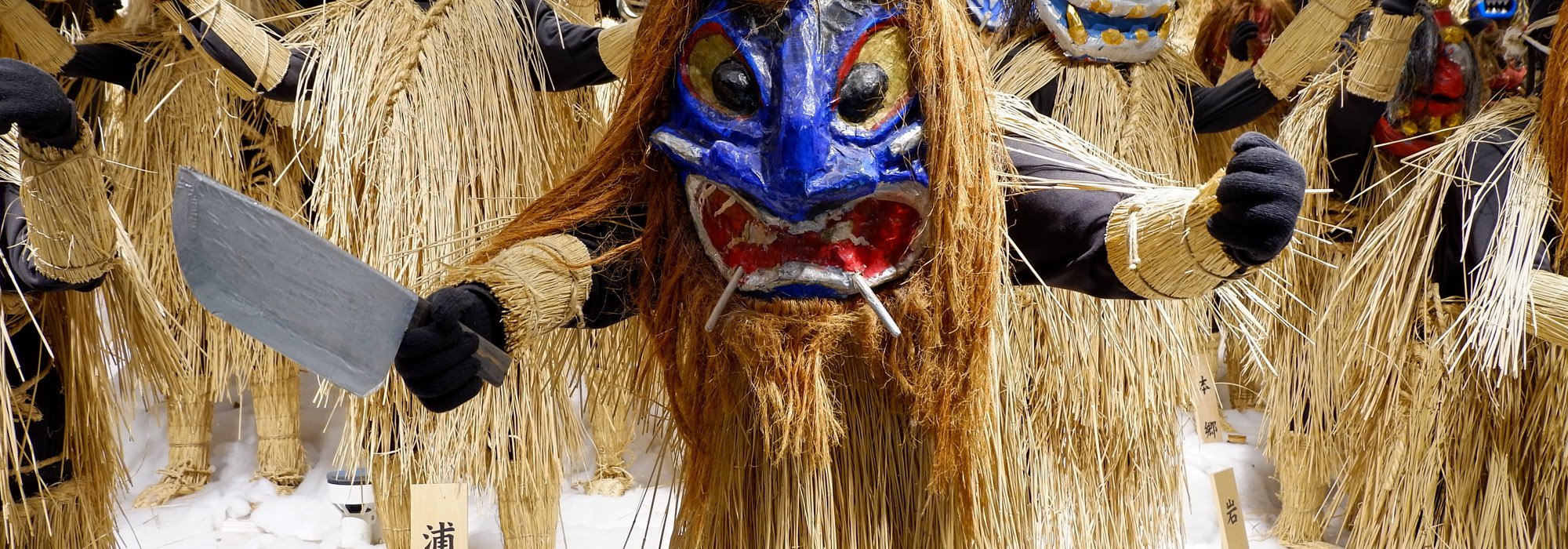
Inland, the Namahage Museum is dedicated to the local folklore enlisted in the UNESCO Intangible Cultural Heritage. Namahage is an ancient ritual that is still taking place for New Year’s Eve in the peninsula: men don straw costumes and scary masks 😷 and proceed to visit every house to "scold" disobedient children and lazy parents.
The museum displays all year round dozens of different costumes, each representing a neighborhood of Oga, and also frequently holds singing and dancing performances typical of the Namahage. Travelers can stay overnight at one of the several traditional ryokan inns with onsen baths in the area.

Odate, the birthplace of Akita dogs and of magewappa craftsmanship
At the border with Aomori prefecture, the small Odate town is attractive for its craftsmanship, and is particularly known to be the birth place of:
- Akita-inu dogs, that became very popular throughout the world thanks to the story of Hachiko, the loyal dog waiting at Shibuya station. The city-center has a small museum dedicated to Akita dogs;
- Magewappa craftsmanship, that uses cedar wood to make mostly bento boxes. We recommend visiting the workshop of Shibata Yoshinobu as well as Hanazen house, that uses magewappa boxes to prepare delicious Akita ekibento to eat-in or to take away.
There are also 2 prehistorical sites of the Jomon period listed in the UNESCO World Heritage since 2021 in the surroundings of the city: the stone circles of Isedotai and Oyu.

While Akita prefecture is mostly rural, its cities gather most of the tourist and cultural activities and are easy to reach by train, by plane or by car 🚙. Due to its slightly remote location in Japan, exploring the area requires taking enough time to adapt to a slower pace and enjoy all its attractions.