
Edo-Tokyo Museum
The Historical Capital’s Reconstitution
Edo-Tokyo Museum is located in Ryogoku area in eastern Tokyo. Opened in 1993, renovated in 2018 and 2026, it offers an immersion in the Japanese capital’s popular culture and way of life from the Edo period (1603 – 1868) to today. Scale models and life-size reconstitution supported by new digital technologies help visitors to better picture the old-time city.
The Edo-Tokyo Museum opened in 1993 as the 1rst museum totally dedicated to the history of Tokyo as a city. Standing out in Ryogoku district, its unusual silhouette was designed by Kiyonori Kikutake (1928 – 2011), one of the founders of the metabolist movement. The architect based the museum’s design on an Edo period grain storage adapted to the modern concrete building methods, with a height similar to the ephemeral Edo castle 🏯’s.

Time traveling through architectural landmarks’ reconstitution
The Edo-Tokyo Museum tackles the capital’s history from a fun and down to earth perspective, with lively exhibition rooms reconstituting neighborhoods of the former Edo (the name of Tokyo until 1868) and of the contemporary city until now. We highly recommend it to tourists visiting Tokyo as it is one of the most important and popular museum's of Japan's capital.
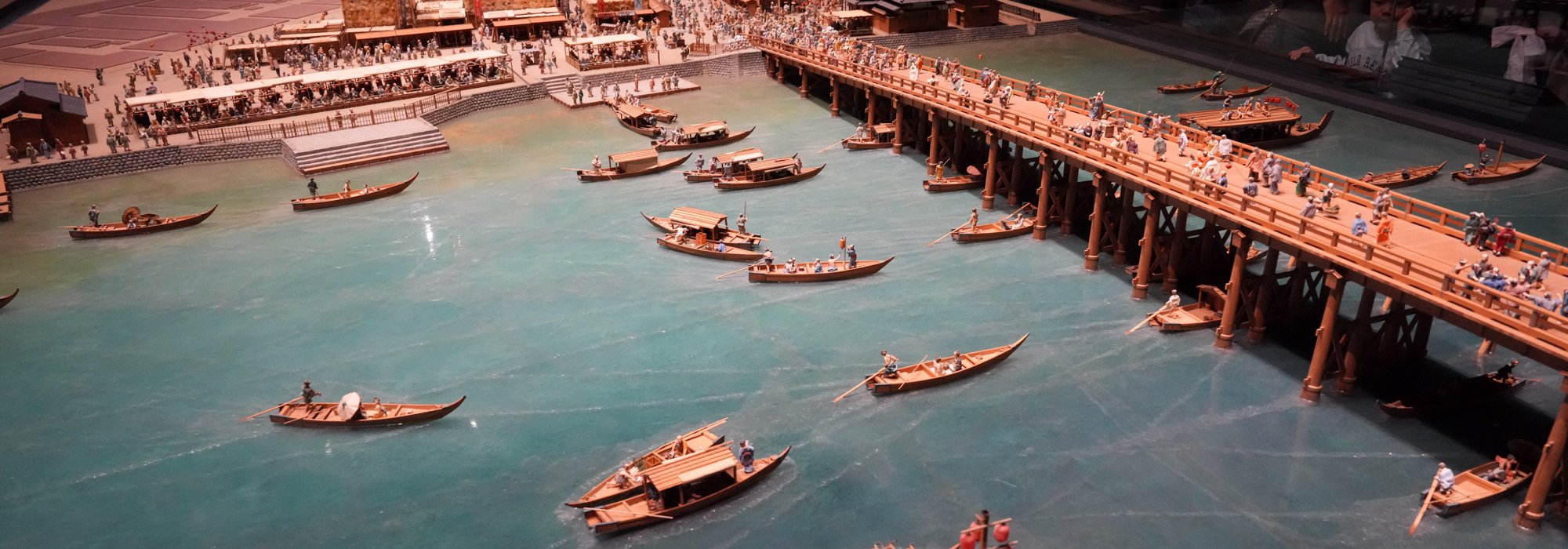
The permanent exhibition is dispatched on the 6F and 5F floors, unfolding typical streets and traditional houses, displays of Edo period objects, dioramas and reconstitution of important buildings such as the iconic Nihonbashi bridge. The visit ends at the 5th floor with the discovery of detailed buildings interiors such as a teahouse, an artisan's workshop, and a Kabuki theater.
The staging of daily life is astoundingly realistic and immerse visitors in the ancient city’s atmosphere. Life-size settings and miniature sceneries marvel visitors who cannot help taking pictures as if they were having a view from an urban observation deck! The museum caters to adults as well as to children tastes, and the opportunity to interact with some animated replica and to try an old tricycle contribute to the appreciation of this travel in the past.
While the museum is a lot of fun, it still manages to give some educational insights, especially on the milestone events that made the history of Tokyo, such as:
- 1923 Great Kanto Earthquake;
- WWII bombings; and,
- 1964 and 2020/2021 Tokyo Olympic Games.

Reopening in 2026 after a 4 years-long renovation
The Edo-Tokyo Museum closed on April 1, 2022 for large scale renovation works and reopened on March 31, 2026. The works mainly consisted in the upgrade of the museum’s equipment and safety to the latest standards, the preservation of the building and an even better accessibility with new escalators.
The exhibition has not radically changed, but it benefits from a freshening up, with new screens for projection or a better and cost-saving lighting. Its content was enlarged to include especially the last 30 years of the city’s life, as well as new installations like:
- The Hattori Clock Shop, of the Meiji Era (1868 - 1912) that replaces the Asano Shinbun newspaper’s building;
- The reconstitution of one of the first examples of Dojunkai collective housing Daikanyama Apartments (1927); or,
- The gate of Asakusa Hanayashiki that opens on a walk-in exhibition.
Additionally, some building replicas are now opened to the visitors, such as the Nakamura-za Kabuki theater for a deeper immersive experience.

A positive digitization of the exhibition
During the time of its temporary closing, the Edo-Tokyo Museum developed several mobile apps called Hyper Edohaku that provide virtual visits and detective games to discover the history of Tokyo since the Edo period. The apps are still available, in Japanese and in English, for the latest versions of iOS and Android and to further enjoy the real life visit.
The exhibition itself is made more dynamic and interactive thank to video projections on screens, that replay for example the changing intensity of daylight. QR codes are dispatched in the rooms to offer explanations in several languages.
The modernization of the Edo-Tokyo Museum is visible from its western entrance decorated with 24 vermilion gates designed by Shohei Shigematsu from OMA design agency. A reminder of the traditional torii ⛩️ gates, they are set up with screens broadcasting scenes of Edo’s daily life and guide visitors to the museum’s entrance.

A museum for everyone
The Edo-Tokyo Museum successfully widens its audience to international visitors, with all the explanations translated in English, and even free audio-guides in several languages to use with a smartphone 📱. History connoisseurs and detail-oriented visitors will also enjoy a visit that doesn’t skip the technical parts.
The museum is adequately equipped to welcome visitors with reduced mobility as well as young children, with toilets 🚽 for all at every floor, and also lockers to store belongings at the 1F and 7F floors. At the 3F floor, The Edo-Tokyo Terrace is a space for enjoying fresh air while having a view on the building and on the area.
Moreover, the museum also has a restaurant and a small coffee shop serving Edo delicacies, as well as a souvenir shop, that are affordable to most budgets.

Note that it is possible to shorten the waiting time at the entrance by purchasing the ticket admission online, which is very convenient especially on busy days. The interior of the museum can be quite dark but pictures without flash are allowed.
The history of Tokyo is in plain sight throughout Ryogoku district starting with the Kokugikan stadium, the Sumida Hokusai Museum and Yokoamicho Park. The Edo-Tokyo Open Air Architectural Museum located in Kodaira in the western side of the prefecture also makes a nice addition, especially in spring 🌸 during the cherry blossoms season.
