
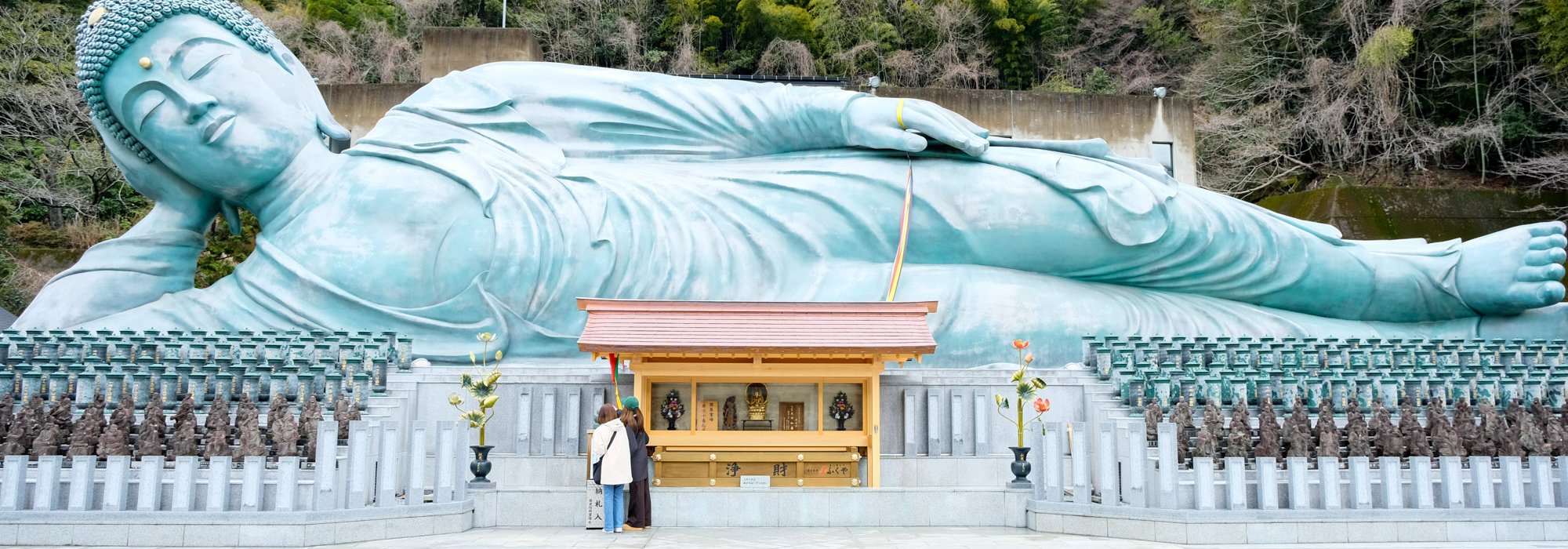
Nanzo-in
The Great Reclining Buddha in Fukuoka
Nanzo-in is a Buddhist temple of the Japanese Shingon school located at the side of a mountain of Sasaguri city, in Kyushu’s Fukuoka prefecture. Its enclosure has been home since 1995 to one of the biggest bronze statues of a reclining Buddha in the world, as well as to many other Buddhist figures dispersed in its forest.
Nanzo-in temple is located in the outskirts of Fukuoka, nestled on the side of the mountain, in the heart of a forest valley formed by the Tatara-gawa river. The spiritual enclosure is thus immersed in nature and its visit is particularly enjoyable from spring 🌸 to autumn 🍁, when its pavilions are surrounded by the vegetation.
Served by a dedicated train 🚅 station, reachable in less than half an hour from Hakata station, by direct trains on the Sasaguri JR Line, the temple is an easy getaway from Fukuoka. Drivers will also find a large parking area. Even though there is really not much more to see in its surroundings, we still recommend visiting Nanzo-in for its important Buddhist iconography, and especially for its monumental Buddha statue.

A recent 1990s Daibutsu statue
Nanzo-in’s Daibutsu is standing out from Japan’s other great Buddhas because of its reclining position that represents the end of the life of Shaka, the original Buddha serenely waiting to enter the Nirvana (Nehan in Japanese). Fukuoka’s Daibutsu is thus officially named Shakanehan-zo (釈迦涅槃像). It is Japan’s only large reclining Buddha.
Its monumental dimensions are by the way quite impressive, making it one of the largest bronze reclining Buddha in the world:
- 41 meters long;
- 11 meters high;
- and weighting about 300 tons.
The entirety of the statue can be admired from afar, but also have a closer look and detail the Buddhist symbols ornamenting its huge naked feet. Worshipers can offer a coin, and even enter the statue.
On Nanzo-in’s grounds, Fukuoka’s great Buddha has its own dedicated plaza, located slightly on the side of the temple, as if it was added at a later stage. Which is actually the case as the reclining Buddha is a modern statue built in 1995.
It was created to home Buddha relics offered by Myanmar and Nepal as an appreciation gift for the years-long financial support of Nanzo-in’s monks to South-east Asian children’s healthcare and schools. Fun fact, just after the statue’s inauguration in May 1995, the temple’s head priest won 130 million Yens (~US$827,973) at the Jumbo lottery, which was then thought as a direct blessing from the Shakanehan-zo statue.
Ever since, Nanzo-in is visited for luck in money matters, so a pavilion homing the two gods of wealth Daikokuten and Ebisu was built at the entrance of the pathway to the great Buddha of Fukuoka.

Sasaguri 88 temples pilgrimage
The temple was originally built on from Mount Koya, a top place of Shingon esoteric Buddhism, introduced in Japan by monk Kukai (Kobo Daishi) in the 8th century. In 1889, its pavilions were all moved from Wakayama prefecture to the little Sasaguri town on Kyushu island.
Nanzo-in’s site thus became the main temple of the Sasaguri 88 temples pilgrimage (篠栗四国八十八箇所) a local iteration of the famous Shikoku pilgrimage created as a tribute to Kukai and his teachings. The 46 kilometers-long route of this local pilgrimage treads the rural landscapes of Sasaguri and can be traveled in 2 to 4 days, by car 🚙 or walking.
We recommend going further than the Daibutsu and take the time to tread the temple’s various paths, making a miniature version of the Sasaguri 88 temples pilgrimage. As a matter of fact, Nanzo-in’s pavilions are quite modern with an architecture that may lack charm, so it is more interesting to stop by the many statues, either Buddhist or inspired by syncretism with Shinto, that populate the grounds.
They are all unique and represent very popular deities in Japan, especially:
- The 7 lucky gods (Shichifukujin), also including Daikokuten and Ebisu;
- Fudo Myoo, one of the 5 kings of wisdom, with an impressive colorful statue, named Dai-Fudomyoo (大不動明王);
- Jizo, the protector of children, travelers, and more specifically of pilgrims, with its characteristic hat and bib; and,
- Hundreds of Rakan statues, the disciples of Buddha.
The main pavilion enshrines the images of Buddha Amida and Shakyamuni.

A spiritual grounds enforcing a strict etiquette
Since 2025, the staff at Nanzo-in has become more rigorous with the visitors’ behavior. Those who won’t comply with the good practices in a Japanese spiritual site may be banned from entering. For example, any adult wearing clothes that are too revealing and / or with a visible tattoo will be barred from entering the temple.
The main rules to know and follow when visiting Nanzo-in are:
- Shoulders, stomach and thighs down to the knees must be covered by clothes (note that tights or yoga pants are considered "skin" and therefore not accepted even when wearing a mini-skirt or a tiny short);
- Tattoos must be concealed by a cloth or a cover seal (preferably of skin color);
- Drinking, eating or smoking are prohibited in the temple’s grounds;
- Respectful and discreet behavior are expected, do not run or speak loud;
- Avoid taking a selfie with the Buddha and follow the no picture signs when they are displayed.
There are many and large prohibition signs everywhere at Nanzo-in, most of them written in English and that seem to specifically target foreign visitors. While the intention of stating the rules of this religious site is perfectly understandable as it is not a touristic attraction, it gives an uncomfortable general impression to international visitors.
Also, since March 2026, foreign tourists must pay a fee while admission is free for Japanese residents.