
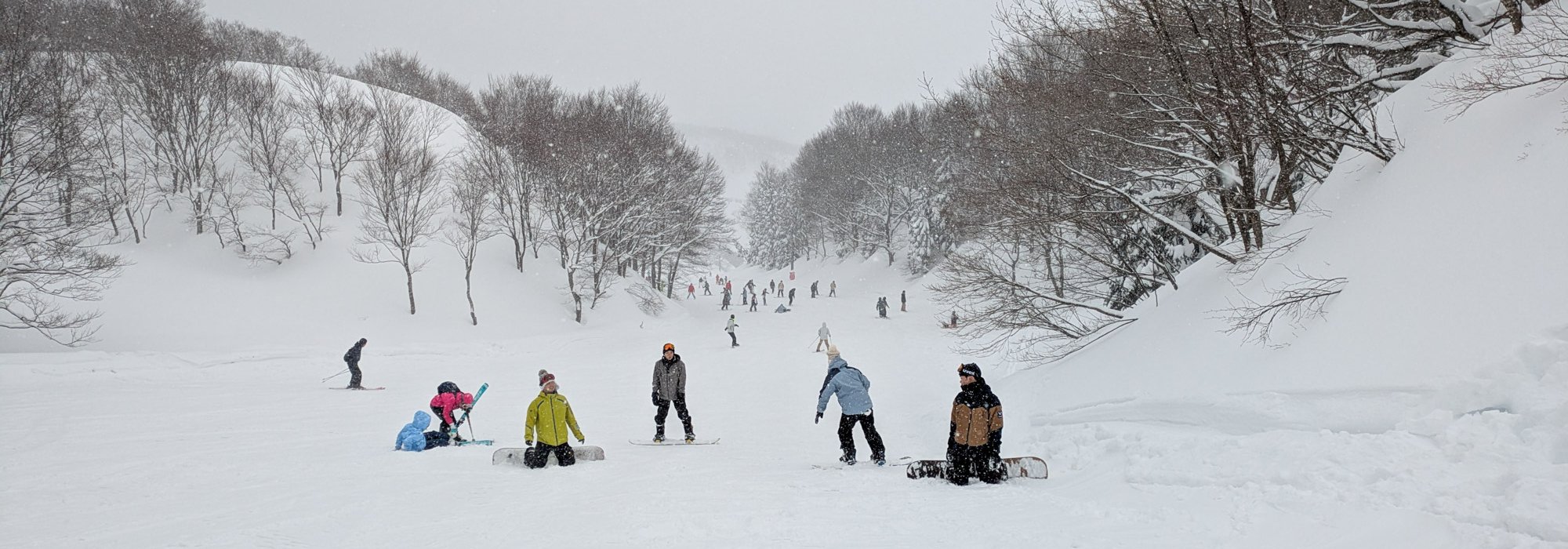
Skiing in Japan
Japan, with 500 ski resorts dispatched throughout its mountains, is a favorite winter destination for skiers and snowboarders. The country is indeed reputed in the world for the quality of its snow, a powdery yet compact snow that falls in huge quantities every year, despite the influence of climate change. The highest ski resorts in Japan peak over 2,000 meters above sea level.
One of the more constant snowfalls in the world
In Japan, 3 large cities are the poster children of the country’s whitest areas in winter as they usually receive a 6 to 8 meters snowfall every season:
- Aomori in the Tohoku, the northernmost region of the main island Honshu;
- Sapporo, the capital of Hokkaido, the winter destination par excellence; and,
- Toyama on the shore of the Sea of Japan, at the foot of the Japanese Alps.
The high mountains surrounding these cities are under the cold winds from the sea, which create many winter storms and heavy snowfalls. The global snow forecast for the archipelago is frequently updated on the Japan Meteorological Agency’s official website.
On the other hand, it rarely snows in Tokyo, Kyoto or Osaka, that are located on the Pacific Ocean side, and more to the center and the south of Japan. To easily reach snowy destinations from the capital, we recommend going to the cultural and historical Nikko, Kusatsu or Karuizawa among others, that are beautiful under the snow even if not interested in skiing.
Japan has by the way already hosted 2 Winter Olympic Games 🏅:
- Sapporo in 1972, that were the 1rst Olympic Games ever to be hosted in Asia and not in a Western country; and,
- Nagano in 1998.

High season from late December to early March
The ski season in Japan starts at the end of autumn and after the koyo 🍁 foliage season, around December, and can extend up to the end of April / early May for the highest ski resorts. The peak months for skiing are January and February all around Japan. In addition to domestic tourism on weekends and holidays, snow-themed inbound travel in the archipelago is also on the rise, thanks to:
- Australian travelers who enjoy their summer vacation in January;
- Asian travelers who take a trip for the Chinese New Year holidays; and,
- American travelers looking for snowy destinations.
Some ski resorts are opening to the international audience and offer packages that include:
- Flights;
- Local transports;
- Ski equipment rental;
- Ski-lift pass, and,
- Accommodation.
Communication at the ski resort can easily be made in English.
Skiing or snowboarding in Japan is accessible regardless the level, to beginners as well as to seasoned skiers. Beginners will be able to ride on the easiest slopes winding into snowy pine tree forests, with beautiful winter sceneries. On the flip-side, speakers are continually blaring music (especially J-pop) over the runs and near the infrastructures. Some resorts prioritize welcoming families with young children, with parks called family snowland in English where they can play with snow, sliding on a sled or an ice toboggan, or ride a hauled buoy. Resorts may also offer activities such as snowshoe hiking, dog-sledding, cross-country skiing or skating on icy lakes depending on the area.
At the end of a skiing day, the Japanese make the most of the mountain’s volcanic activity to warm up and relax in onsen ♨️ natural hotsprings. Pretty much all the accommodations have an area dedicated to shared baths, like, for example, the hotel 🏨 chain Prince Hotels that operates 9 ski resorts throughout Japan.
During the peak ski season, snowy cities and spa resorts enliven as they host snow festivals either called yuki matsuri or kamakura matsuri, characterized by hundreds of small snow huts that are lit-up at night.

There are also fireworks 🎆. Specific to Japan, the natural phenomenon called snow monsters is a unique view of mountaintop conifers covered in icy snow, which particularly occurs at Yamagata Prefecture’s Zao Onsen resort.
As for food, forget about melted cheese delicacies but do try nabe hotpots with vegetables, tofu, fish and tender wagyu beef, as well as oden. Seasonal sushi 🍣 topped with crustaceans and seafood (crab, urchin, scallop) and fat fish such as tuna are also delicious and are ideally paired with a glass of warm or cold nihonshu 🍶.

The main resorts to ski and snowboard
Thanks to the dense and well-maintained Japanese train 🚅 network, many ski resorts are easily accessible by train or Shinkansen from Japan’s big cities. Note however that heavy rainfalls may cause delays in the train circulation. Bus lines are also operating in winter to serve the ski areas from the closest train stations.
If you feel confident to drive with snow tires, you can rent a car 🚙 and directly go to the foot of the slopes or to the accommodation with parking.
Below is a non-exhaustive list of the most popular ski resorts in Japan.
Hokkaido
The large northernmost island of Japan is renowned for its beautiful and extensive natural sites. In winter, Hokkaido attracts skiers and amateurs of snowy landscapes for a couple of days, enjoying spending a few days at:
- Niseko, that encompasses 4 internationally famous ski resorts, with more than 50km of slopes, accessible by train or bus from Sapporo.
- Rusutsu, which has one of the longest ski seasons in the archipelago (from December to early May) and has been elected the "best Japanese ski resort" by the World Ski Awards 2024, with slopes running down 3 different peaks, close to Lake Toya.
- Furano and its family oriented ski-station in the heart of Hokkaido; the Kitanomine area’s slopes are also located nearby.
- Kiroro, located in the south of Otaru, encompasses the Club Med’s infrastructures, that are ideal for families with young children.

Tohoku
The northern area of Honshu island is full of beautiful and winter sports destinations. At the top of its highest mountains, the forests turn into an incredible landscape of snow monsters.
- Appi Kogen is an important and luxurious ski resort of the area, with about 20 slopes arranged around Mount Hachimantai in Iwate prefecture.
- Shizukuishi has beautiful panoramic views on Mount Iwate, located between Morioka and Lake Tazawa.
- Zao Onsen, in Yamagata prefecture, is famous for its snow monsters forest in winter.
The Japanese Alps
Nagano prefecture has among the biggest and popular snow resorts of the Japanese Alps, such as:
- Hakuba, in the northern Alps near Nagano city, is a big resort renowned throughout the world, especially as it hosted several alpine skiing events in the 1998 winter Olympics.
- Shiga Kogen is a large ski resort located at 2,000 meters high in Nagano prefecture and it is recommended to stay several days to better enjoy it. The popular monkey park Jigokudani is located nearby.
- Myoko Kogen is one of the oldest ski resorts in Japan, established in 1911 at the limit of Nagano and Niigata prefectures. The area can be covered with up to 14 meters high of snow and has numerous natural onsen hot springs to relax after a day in the mountain.

Where to ski around Tokyo?
The Tokyoites usually purchase their ski equipment in specialized sports shops gathered in the small Kanda-Ogawamachi district in the heart of the capital. Tokyo’s neighboring prefectures offer several possibilities for a one-day trip getaway, and 2 of them are particularly interesting destinations.
The area of Yuzawa, in the south of Niigata, is one of the easiest ski destination to access by Shinkansen from Tokyo. For example, the Gala Yuzawa Snow Resort is located at one of the terminus station of the Joetsu Line and skiing can begin as soon as exiting the station. A 1-day ski trip to Yuzawa can be booked online in advance (prices are usually more affordable on line than on site) including:
- A ski-lift pass: allow ¥6,300 (~US$39.92) for a day in 2025-2026;
- Ski equipment: ¥6,500 (~US$41.19) for the 3 essentials skis + shoes + sticks; and,
- Other equipment that may be needed, for example: ¥5,500 (~US$34.85) for ski jacket + ski pants.
At the resort, collect the rented equipment, the pass for the gondola and chairlift at the welcome desk, change clothes and go to the top of the slopes. Lastly, chose your sticks and you can now enjoy your 1rst ride. Don’t forget to leave your belongings in a coin locker for about ¥1,000 (~US$6.34) for the day.
Nearby, you will also find Ishiuchi Maruyama, Yuzawa Kogen, Naeba and Kagura Ski Resort.
Other possibilities: the slopes of Mount Fuji 🗻 that home 2 small family-friendly ski resorts:
- Fujiten Snow Resort, located to the north of the volcano in Yamanashi prefecture and is accessible by bus or taxi from Kawaguchiko.
- Fujiyama Snow Resort Yeti, a ski resort in the south of the sacred mountain, accessible in 55 minutes by bus from Gotemba, Susono and Yoshiwara Chuo’s JR stations in Shizuoka prefecture.
Where to ski around Kyoto and Osaka?
A few minutes by train from Kyoto, you’ll reach Biwako Valley on the heights of Lake Biwa in Otsu. In addition to snowy slopes, you’ll get to enjoy beautiful panoramic views on the area and onsen hot baths.
The ski slopes closest to Kobe and Osaka are located on Mount Rokko.
Lastly, the south of the archipelago has smaller ski resorts, especially in Tottori prefecture, famous for its sand dunes covered in snow in winter and down to Kyushu island, with for example, the Kujyu Forest Park Skiing Ground located in Oita prefecture.