
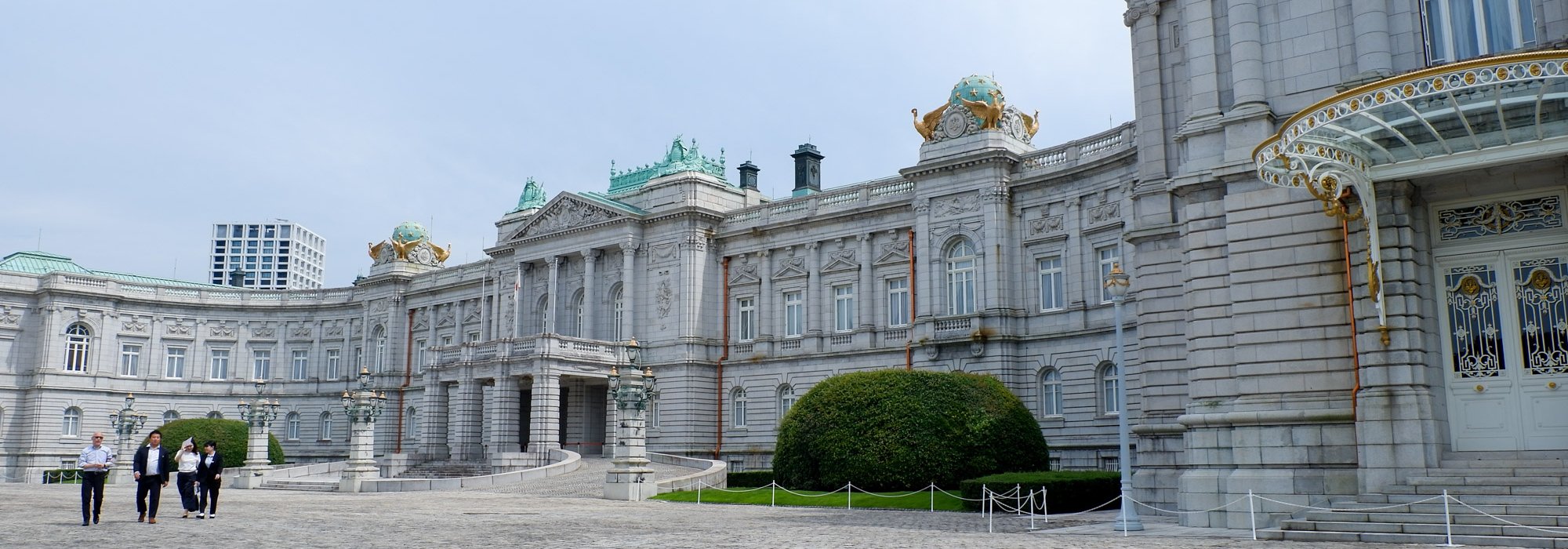
Akasaka Palace
Japanese Hospitality in a Neobaroque Mansion in Tokyo
Akasaka Palace is an official and diplomatic reception complex located in Minato ward in the heart of Tokyo. Also called "State Guest House," its opulent neobaroque building is used to host Japan’s distinguished guests, and its annex Yushintei for negotiations in a more subdued setting, typical of the Japanese-style hospitality omotenashi.
Akasaka Palace, or Akasaka State Guest House, is set in a large wooded park of about 120,000 m² to the west of the Imperial Palace. In the heart of the capital’s upscale neighborhoods, it is part of a green oasis extending toward Meiji Jingu Gaien on Shinjuku’s side. Its southern side is bordered by Toyokawa Inari Betsuin shrine.
The Palace’s grounds is a former estate of the Kishu Tokugawa’s but its main building, dating back to 1909, is not necessarily interesting for a Western tourist. Its central part flanked by 2 curved wings with colonnades in the neobaroque style does indeed seem more related to European palaces like Buckingham or Versailles.
Designed by Tokuma Katayama (1854 - 1917), one of Josiah Conder’s 1rst students, this opulent building of about 15,000 m² superficies is nonetheless representational of the Meiji era taste and a state of the art construction at the times’. It was initially built as the residence of the emperor’s heir Yoshihito (later emperor Taisho), but it was actually inhabited by Hirohito (later emperor Showa) between 1923 and 1928.
After World War II, the supervision of the Palace is transferred to the Japanese state that uses it to home various administrative bodies, including the 1964 Summer Olympics 🏅 Organizing Committee. In the 1960s, a great renovation of Akasaka Palace is undertaken in order to have it become the next state guest house and to host international conferences, in lieu of the residence of Prince Asaka in Meguro (now Tokyo Metropolitan Teien Art Museum) that became insufficient to fulfill diplomatic purposes. The first foreign guest, Gerald Ford, the president of the United States, was thus received in Akasaka Palace in 1974. The 7-years long great refurbishing also allowed for the construction of the Yushintei annex.
Akasaka Palace is renovated again in 2006-2009 after which it is designated National Treasure of Japan. The general public can visit the palace outside of big events since 2016.

Neobaroque pomp of the Honkan building
Arriving from Yotsuya, a large wrought iron gate opens on a wide paved plaza lined up with solemn trees. The alley leads to Honkan, Akasaka Palace’s main building. At the top of its central part, two bronze statues of samurai armors imitate the koma-inu guardian statues usually found at shrines, and are the only elements displaying a Japanese touch.
The Honkan is open to visitors, without reservation, outside of diplomatic reception days. They can wander into several ostentatious rooms, opulently decorated with paintings, sculptures and a lot of gilded ornament, with Empire style furniture. The main rooms are:
- The entrance hall, characterized by symbolic paintings of the rising and the setting sun;
- Asahi no ma, a great reception hall at the first floor, whose painted lions seem to gaze intensely at visitors;
- Sairan no ma, another great reception hall, with gilded phoenixes and samurai armors patterns;
- Hagoromo no ma, a ballroom in the west wing named after a Noh theater play inspired by the Japanese legend of Hagoromo the magical feather mantle;
- Kacho no ma, a banquet room ornamented with patterns of flowers and birds, hence its name.

Japanese hospitality at the Yushintei annex
Yushintei annex is an integral part of the State Guest House, designed by Yoshiro Taniguchi (1904 – 1979) and built in 1974. The architect sought inspiration in the basis of traditional Japanese architecture that he blended to influences of Western-style modernism.
Yushintei’s atmosphere is a lot quieter, both visually and regarding the number of visitors. This exceptional place is indeed only accessible through guided tours in small groups, that must be booked in advance. Moreover, taking picture is forbidden, a rule strictly enforced by the staff. Relieved from the distraction of photos, it is then easier to immerse in the serenity of this building, which is smaller but as interesting as the Honkan, with carefully thought details and elegant and refined lines. Distinguished guests are received for State dinners in a typically Japanese decor or for a tea ceremony, in a more intimate and peaceful setting.
The visit ends at the Japanese garden and its carp pond. A collection of bonsai trees considered as living artworks is also exhibited and occasionally used for indoor decoration during official visits.
Akasaka Palace can’t be considered a must-see in Tokyo, but it can provide a potentially quieter visit in a refined environment, offering a glimpse on early 20th century Japan’s splendor. An audio-guide is available for a fee to further enjoy the tour and understand the intimate blend of Japanese and Western arts that characterizes the place.