
Hakusan-jinja
Thousands of Blooming Hydrangeas in the North of Tokyo
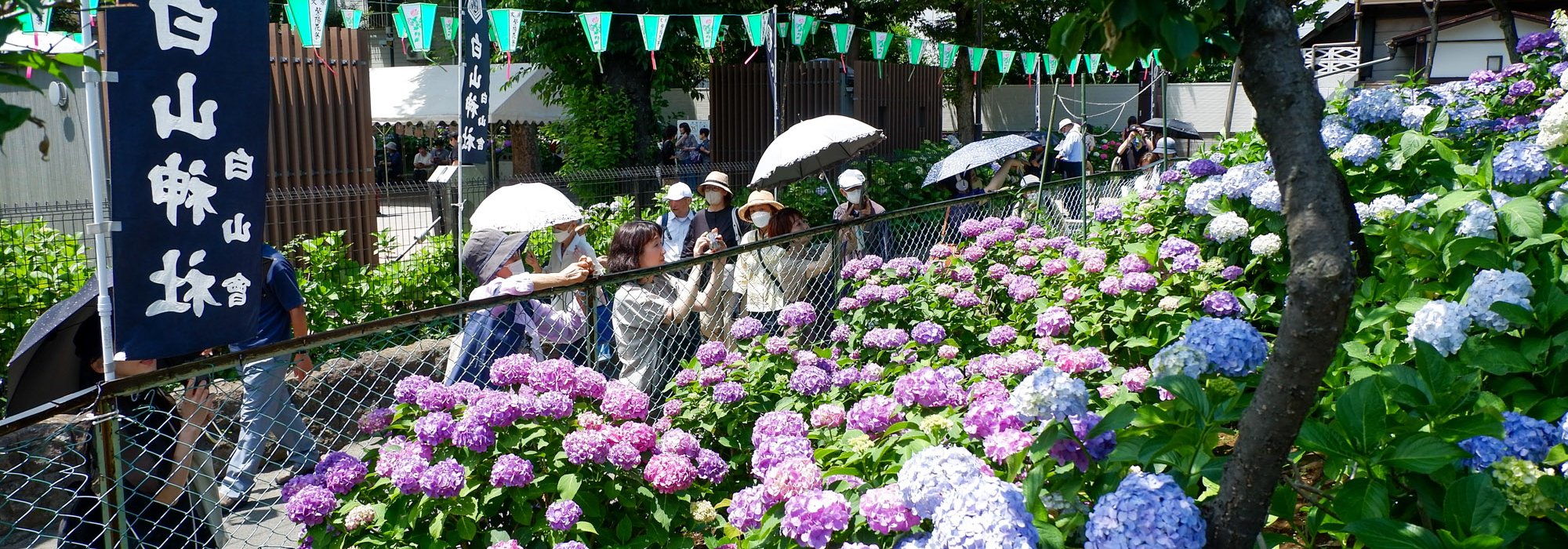
Hakusan-jinja is a Shinto shrine located in Bunkyo ward, in the north of Tokyo in Japan. People come to pray for happy marriages and dental health all year long, but the sacred enclosure is even more busy in June, when its 3,000 ajisai hydrangeas bloom.
Hakusan-jinja shrine in the north of Tokyo is home since 1985 to one of the 5 great flowers festivals of Bunkyo, called Bunkyo Ajisai Matsuri, that is to say "Bunkyo’s hydrangea festival" held every year. The Shinto enclosure and the neighboring park are indeed filled with about 3,000 hydrangeas (ajisai in Japanese) that come in full bloom in June, during tsuyu ☔️, the rainy season of Japan.
This peak seasonal event attracts locals and tourists alike who come to admire the beautiful hydrangeas flowers flourishing in blue, purple, pink and white hues. On the festival’s weekends, animations and events are staged, such as:
- A hydrangea market;
- Hydrangea flower-themed drawing workshops;
- Small live concerts;
- Traditional crafts and yatai food stalls.
In 2025, the Bunkyo Ajisai Matsuri festival held its 40th edition between June 7 and June 15, following the blooming calendar. The shrine’s grounds is usually adorned with garlands of green lanterns 🏮 and the main pavilion remains accessible, guarded by 2 komainu statues also decorated with flowers.

On this occasion, the Fujizuka hill, a small 5-meters high mound, is covered in blooming hydrangeas and is exceptionally opened to the public (from 10 a.m. to 4 p.m. only). People calmly stand in line to be allowed on the hill and make the most of the waiting time to leisurely watch the scenery. The atmosphere remains relaxed as taking pictures of the flowers without rushing is easy.
Leaving the shrine’s grounds, the visit continues to Hakusan Park, one of the oldest green spaces of Bunkyo ward, that opened in 1891 and is also filled with many hydrangeas bushes.
Note that the flowering can also be admired besides the dates of Bunkyo Ajisai Matsuri festival, and with a lot less people. The shrine is also well-known for its feline population, that comes to relax in quieter times.

Tokyo shrine for marital happiness
Founded in 948, the shrine was moved to several times before settling in its current location in 1655. It then became a place of worship favored by Tokugawa Tsunayoshi (1646 - 1709), the 5th shogun of the Edo period (1603 – 1868) and by his mother named Keishoin (or Katsura Shoin).
Initially named Kaga Ichinomiya Hakusan, the shrine’s name refers to Mount Hakusan, one of the 3 most sacred mountains of Japan (Sanreizan) located at the limit of Ishikawa and Gifu prefectures in the Japanese Alps. It enshrines the 3 following Shinto gods:
- Kukurihime no Mikoto (Shirayama-Hime no Okami), the goddess of weddings; and,
- The original couple Izanagi no Mikoto and Izanami no Mikoto.
Therefore, Hakusan-jinja is particularly favored to pray for marital happiness. Dental health is also an important concern, prayers are thus frequently commissioned to Shinto priests to help relieve the worshipers’ toothaches.
At the Meiji Restoration in 1868, the emperor designated Hakusan-jinja as one of the main protective shrines of the new capital, along with Nezu-jinja, Kanda Myojin and Hie-jinja. A pilgrimage called Tokyo-jissha (東京十社) consisting of touring the 10 shrines of Tokyo is still alive today and going on all year long.