
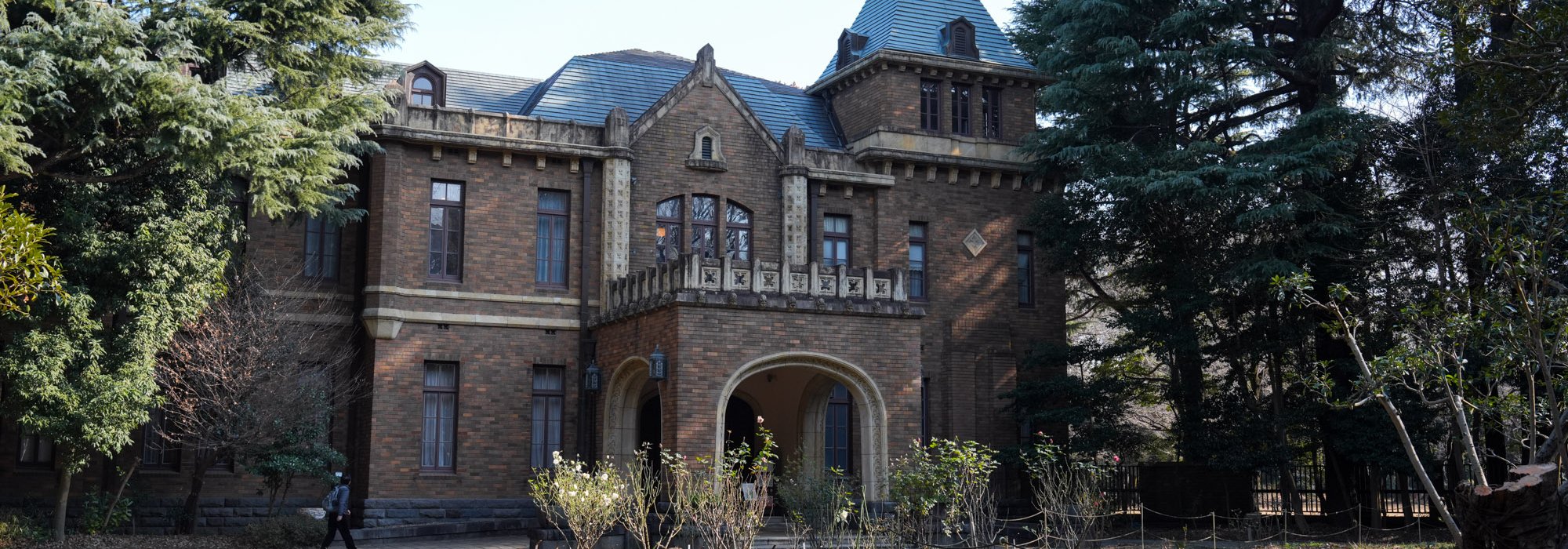
Komaba Park
Former Marquis Maeda Mansion in Tokyo
Komaba Park is a green space located in the north of Meguro ward near Shibuya in the west of Tokyo, home to the former Marquis Maeda’s Mansion. This architectural monument featuring both Western and Japanese styles of building is a designated Important Cultural Property and open to the visit.
Komaba Park is a green area of about 40.000m², opened to the public since 1967 and located in a quiet residential area, between the Komaba Campus of the University of Tokyo and the Japan Folk Crafts Museum Mingeikan.
During the Meiji Era (1868 - 1912), the park sheltered Todai’s faculty of agriculture, that was subsequently transferred closer to the center of Tokyo in 1926, on lands belonging to the former Maeda daimyo lords in the neighborhood of Hongo (Yanesen). Nowadays, the large Akamon gate is still standing on the campus’s grounds as a reminder of the clan’s presence. The Maedas received another land for compensation, that happens to be the future Komaba Park.

A 20th century historical residence
The Maeda clan is known for having ruled over the former Kaga province and developed Kanazawa during the Edo period (1603 – 1868). In the 20th century, marquess Toshinari Maeda (1885 – 1942), who traveled in Europe and served as a military attaché in Great Britain at the end of the 1920s, decides to build his residence in Komaba Park, with the help of the best Japanese architects of the times.
Thus, 2 buildings of radically different styles were erected, and connected by an open corridor. Visitors must take off their shoes to enter both buildings:
- Yôkan, the 1929 Western style pavilion, is a brick manor in the 17th century Tudor architecture, intended for hosting foreign distinguished guests at the ground floor and for housing the family at the upper floor. Inside, the mansion is decorated in the times’ Western style with a profusion of various Damask patterns, marble and precious woods. State-of-the-art anti-seismic techniques were used at the time of building.
- Wakan, the 1930 Japanese style pavilion, also for hosting state receptions, is a 2-stories wooden construction reminiscent of Kyoto’s Ginkaku-ji. The inside is a typical Japanese interior, with tatami flooring and removable partition walls. Its engawa veranda provides a beautiful viewpoint on the mansion’s Japanese stroll garden, that also has a small tea pavilion.
Amateurs of history and architecture will be able to fully enjoy the visit thanks to the many English explanations available, providing the period’s context on panels placed in every room. And what’s more, pictures are allowed throughout the site.
At the end of World War II, the house is requisitioned by the occupying SCAP to home its officers until 1957, after what the estate was transferred to the city of Tokyo. Both Yôkan and Wakan buildings are designated Important Cultural Property in 2013, and the park as a whole as Tokyo Prefecture Place of Scenic Beauty in 2025.

Sophisticated modern Japanese culture
At Komaba Park, visitors will also find The Museum of Japanese Modern Literature (Bungakukan). It was initially homed in the Western aisle of the Maeda mansion at its opening in 1967 and moved to a modern building at the eastern entrance of Komaba Park in 2002. Temporary exhibitions allow Japanese-speaking visitors to deepen their knowledge of the archipelago’s literature in a relaxing environment.
This literature museum has a counterpart in Kamakura, also sheltered in a former villa of the Maedas.
Komaba Park’s gravel alleys are pleasant all year long, but especially in spring. The large central lawn is indeed surrounded by cherry trees that bloom in the end of March and attract among other visitors the neighboring university’s clubs for a festive Ohanami sakura 🌸 blossom viewing.
Komaba Park and the Former Marquis Maeda Mansion make for an original cultural excursion in a quiet atmosphere, while remaining in the vicinity of larger touristic spots like Harajuku and Shibuya. The neighboring Mingeikan museum provides an additional artistic touch.