
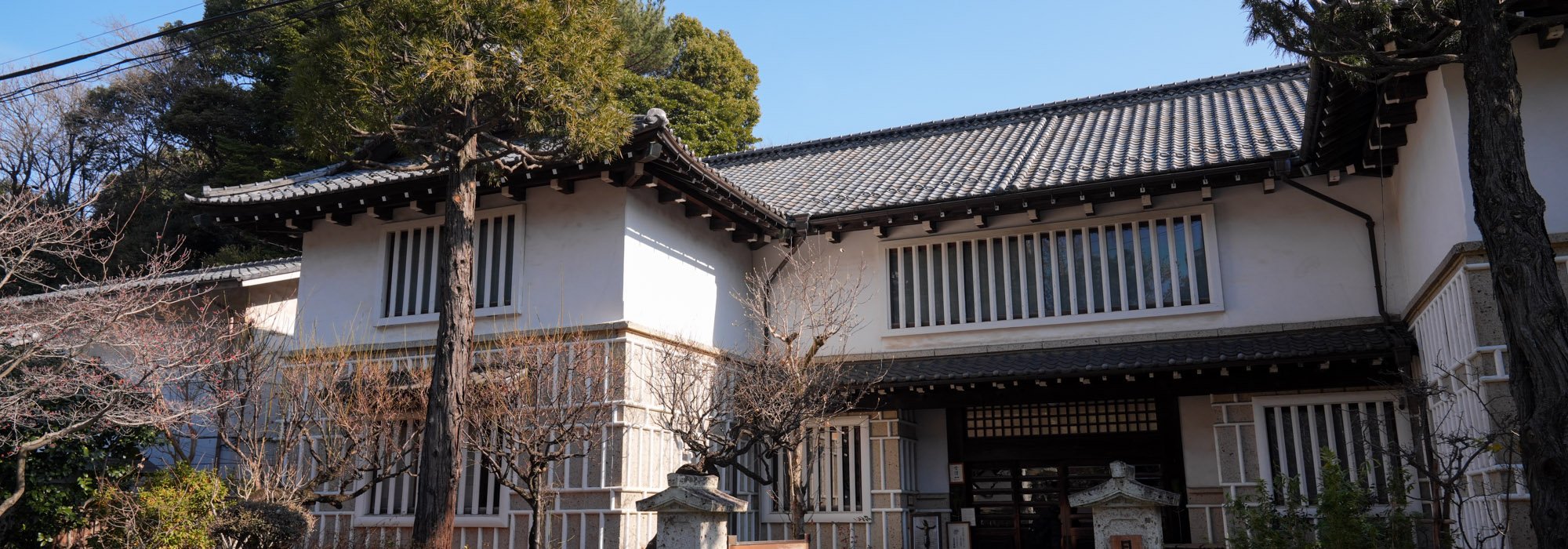
Japan Folk Crafts Museum
The Houses of Mingei in the North of Meguro
The Japan Folk Crafts Museum, also called Mingeikan in Japanese, is located in the north of Meguro ward, at the limit with Shibuya ward in the west of Tokyo. Established in 2 traditional houses, it is dedicated to the popular folk crafts as they were defined by Soetsu Yanagi in the 1930s.
The Japan Folk Crafts Museum, or Mingeikan, is a small museum located between 2 university campuses in a quiet residential area of Meguro, a stone’s throw away from Shimokitazawa the hipster district and 2 stations away from Shibuya on the Keio Inokashira line.
It was opened on October 24, 1936 by Soetsu (or Muneyoshi) Yanagi (1889 – 1961), a Japanese writer, intellectual and aesthete, helped by his benefactor and sponsor Magosaburo Ohara, who also founded the Ohara Museum of Art in Kurashiki.
The Mingei movement
Mingei (民芸) means "folk’s craft" and was theorized by Yanagi, who was passionate about Korean ceramics. Yanagi found that a particular type of beauty characterized the ordinary objects created by anonymous craftsmen for the people. In the same manner as the Arts & Crafts movement (1880s – 1910s) in Great Britain, the Mingei movement, founded in 1926, is aiming at reevaluating manual work and local crafts to resist industrialization, mass production and elitist art.
Yanagi and his artists / craftsmen friends’ field of study encompasses ceramics and popular crafts of Japan, including Okinawa and the Ainu’s, as well as those of a part of Asia, over an area matching the expansion of Imperial Japan in the early 20th century.

Ethnographic museum in Meguro
The current Mingeikan is housed in 2 buildings that have preserved their authentic atmosphere and furnishings of the time:
- Honkan, is the main pavilion hosting the permanent collection. Built in 1935 based on Soetsu Yanagi’s design, it shows a hybrid style blending traditional and western architectures. It has about 10 rooms over 2 floors, and a large wooden stairway. The upper floor was completed by a large exhibition room built in 1982;
- Saikan, is the western building, on the other side of Komaba-dori street, and uses the former residence of the Yanagi family (where they lived from 1935 to 1965). Its peculiar architecture dates back to the Edo period and is a type of housing found in daimyo lords’ residences, called nagayamon, with a stone roof, that was transferred to its current location from Tochigi prefecture. This exhibition hall is open only 4 days a month.
The 2 buildings, as well as the stone gate on the street, have been designated Important Cultural Properties of Tokyo prefecture in 2021.

Anonymous artisans and Mingei artists
Visitors must take off their shoes and use the slippers available at the entrance of the Honkan. Then they can proceed to discover the artisanal objects collected by Yanagi and the followers of the Mingei movement, such as:
- Ceramics;
- Traditional textiles and clothing;
- Lacquer wares;
- Wood or bamboo sculptures.
The collection displays everyday items made by craftsmen who were mostly Japanese and Korean, as well as Buddhist drawings and sculptures, highlighted by a tidy interior, with clear walls delineated by dark wood pillars and beams.
Temporary exhibitions are held in the Saikan and display on a rotation artworks of the museum’s collection, made by artists-craftsmen claiming ties to the Mingei and Yanagi’s entourage: potters Bernard Leach and Kanjiro Kawai, clothing designer Keisuke Serizawa and woodblock print-maker and illustrator Shiko Munakata.
Note that taking pictures is prohibited in the museum, except for a handful of artworks that are clearly identified. Moreover, the admission fee doesn’t take into account the opening days of the western building and is the same regardless the entirety of the museum is available or not.
The Japan Folk Crafts Museum is first and foremost a place for connoisseurs of Japanese art and History amateurs. However, it is also suitable for a simple quiet visit in a more refined neighborhood, while taking a step aside and moving away from the hustle and bustle of the megalopolis. Then, it can be combined with the neighboring Komaba Park, home to the Former Marquis Maeda Mansion and of the Museum of Modern Japanese Literature.