
Ochanomizu
🎵 The Musicians’ District by the Kanda River
Ochanomizu is a small neighborhood in the central Chiyoda ward of Tokyo. It extends from Jimbocho to the east, between the Kanda river and Yasukuni-dori avenue. It is renowned for its view on the railway bridge Hijiri-bashi and its many second-hand music instruments shops.
Ochanomizu is spreading around the eponymous JR station and extends to the north towards Yushima and is closed in the south by Yasukuni-dori avenue. It mainly occupies the southern bank of the Kanda river, including Manseibashi bridge that connects to Akihabara. Meidai-dori, its main avenue, is a major traffic route between both Ochanomizu stations and Jimbocho district.
During the Edo period (1603 - 1868), Ochanomizu was part of the former Kanda ward that also encompassed Jimbocho, the current Kanda district and Akihabara. It was a Bukeyashiki area, that is to say a neighborhood where samurai serving in the capital lived. The area’s name also dates back to this time: it means "water for tea," in reference to the water for the shogun’s tea that was drawn at the former location of Korin-ji temple, near nowadays’ Ochanomizu station.
At the end of the 19th century, several universities and higher education institutions were established in the area and up to Ueno, and many of them have maintained their campuses there such as Meiji University or Tokyo Medical and Dental University.

The central Meidai-dori avenue
Meidai-dori, or Meiji University Street, is the neighborhood’s central road connecting the 2 Ochanomizu stations (JR and Tokyo Metro) to Yasukuni-dori avenue and to Jimbocho district.
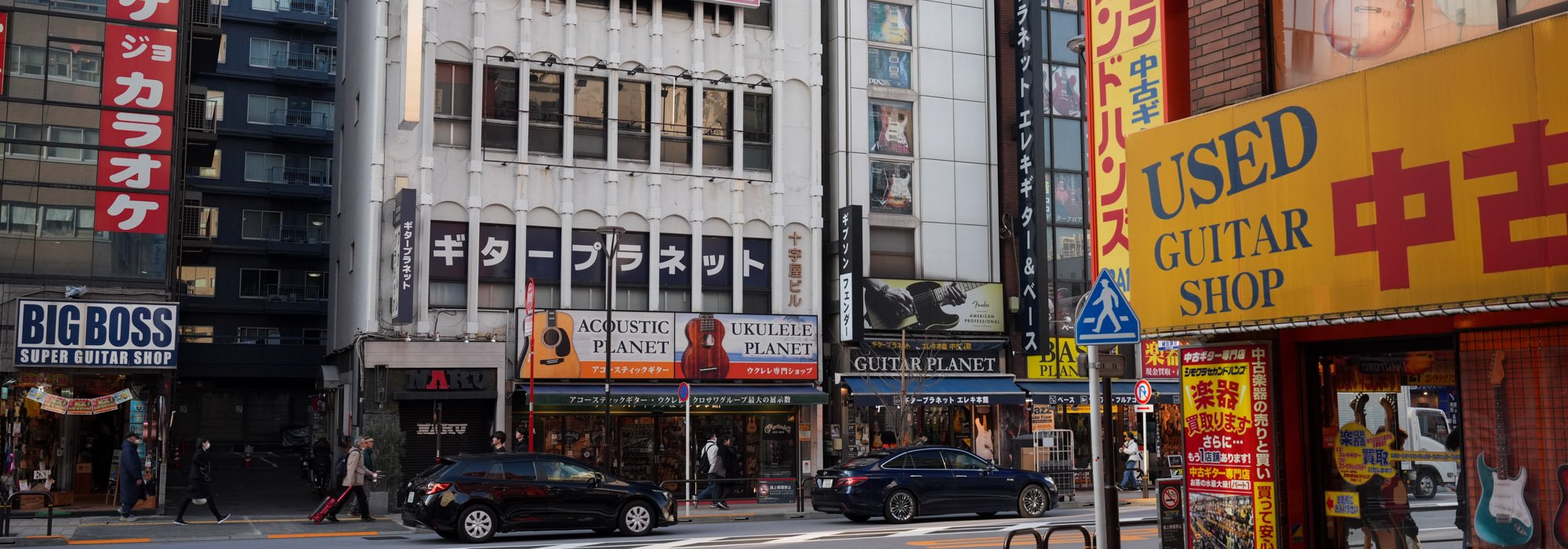
Musicians of all genres particularly like this street for its many second-hand music instruments, that earned it the nickname of Guitar Street. One of the local institutions is Shimokura, whose first store opened in 1937.
Near Jimbocho, 2 low profile places can be worth a visit:
- The small Meiji University Museum (admission free) is home to a rather classical collection of craft works and archaeological items, but also to an original exhibition dedicated to the methods of Japanese police throughout the ages.
- Meiji University Contemporary Manga Library, based on the collection gathered by Naiki Toshio (1937 – 2012), a great Tezuka fan and manga enthusiast who opened the first manga-specialized library in Japan.

Famous view from Hijiri-bashi Bridge
Ochanomizu is served by 2 eponymous stations, located in front of each other and separated by the Kanda river, the JR station being in the south and the Tokyo Metro station in the north. They make a scenery that is famous among sakura 🌸 amateurs, densha otaku train 🚅 enthusiasts and anime fans. The banks of the Kanda are indeed lined with cherry trees that bloom in spring, surrounding the rail-tracks on which there is a beautiful view from Hijiri-bashi Bridge. The exit of the tunnel and the viaduct connecting the 2 banks are featured in Makoto Shinkai’s animated movie Suzume, released in 2022.
Hijiri-bashi Bridge is an arch bridge completed in 1927. Its was named "sacred bridge" because it is connecting 2 places of worship:
- Nikolaï-do, the Holy Resurrection Cathedral of Tokyo, built between 1891 and 1929 (paid admission except for church services); and,
- Yushima Seido, on the north bank, a Confucian temple of the end of the 17th century. The current structure was rebuilt in reinforced concrete after 1923’s Great Kanto Earthquake.
Hijiri-bashi Bridge is often illuminated at night. It is also close to Kanda Myojin and Yushima Tenmangu, the student’s favorite shrine.

To the north of the Kanda river
The northern side of the neighborhood connects to 2 interesting cultural visits:
- Ochanomizu Origami Kaikan, an original museum dedicated to origami. In complement to its exhibition of folded paper artworks and its dedicated shop, the cultural center organizes short introductory sessions to paper folding in English several times a month (paid, reservation not required);
- Tokyo Waterworks Historical Museum (free admission) documents the complex underground water network of Tokyo, that used to be nicknamed "the city of 100 rivers."
Ochanomizu, a neighborhood of small and unpretentious buildings, offers a pleasant walk off the touristic beaten tracks, to combine with Jimbocho and Akihabara. It reignites the atmosphere of the popular Shitamachi town, with university campuses and second-hand shops selling music instruments and winter sport gears. Curry is the local specialty, celebrated every year in early November at the occasion of the Kanda Curry Grand Prix.