
Jimbocho
The Town of Second-hand Books in Tokyo
Jimbocho is the book town of Tokyo, located in Chiyoda ward at the center of the Japanese capital. Considered a Japanese Latin Quarter, it is home to second-hand bookshops, rare or ancient book sellers and famous publishing houses. It preserves a studious atmosphere filled with quietness in the heart of the megalopolis.
Jimbocho district is surrounding the eponymous station, and is spreading between Kudanshita in the west, Ochanomizu in the north and Kanda in the east. It is renowned for its many second-hand and old books shops: the area is indeed home to a third of Japan’s second-hand booksellers, making it the largest used books physical marketplace in the world. The Kanda’s Federation of second-hand bookstores (神田古書店連盟) counted about 130 shops.
The neighborhood is also known to be home to the headquarters of several famous Japanese publishers, such as Iwanami Shoten or Shueisha, some even having their "flagship bookstore" over several levels like Sanseido.

A students neighborhood
The district was named after Nagaharu Jimbo, a samurai of the end of the 17th century who had his residence in the neighborhood. It gained momentum during the Meiji Era (1868 – 1912): its location in the north-east of the Imperial Palace was indeed a founding place for several universities, including Tokyo University (Todai – 1877), Meiji Daigaku (Meidai - 1881) and Tokyo School of Fine Arts in Ueno (1885). Book stores quickly populated the area to cater to the needs of professors and students.
Jimbocho was mostly destroyed by a fire 🔥 in 1913, and partly by the Great Kanto Earthquake in 1923, however it still managed to bounce back into business thanks to its resourcefulness and its commercial networks throughout the country. It also benefited from the boom of the second-hand book market in the 1930s.
The area was mostly spared by World War II bombings and was subsequently chosen by several publishing houses to built their headquarters after the war. Specialist and rare books shops started to flourish in the 1950s. The odor of paper floating in its streets was so characteristic that Jimbocho was included in the list of the "100 smellscapes of cultural importance" by the Japanese Ministry of Environment in 2001.
Unfortunately, the rise of online shopping caused the disappearance of many shops in the 2010s. Jimbocho is now also home to a few office buildings, and since 2007 of the unconventional architecture of Jimbocho Theater.

The bohemian second-hand book shops in Tokyo
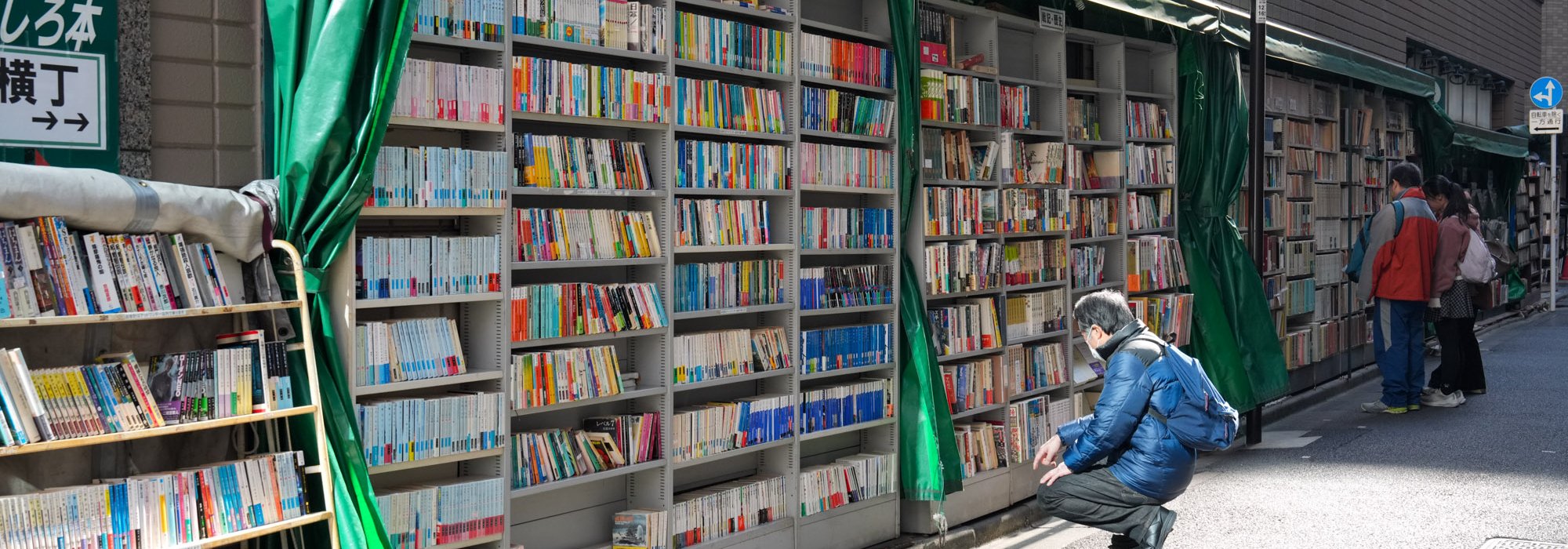
The "second-hand bookstores village" is spreading around Jimbocho station, especially along the Yasukuni-dori and Hakusan-dori avenues. It is full of book stores of all sizes, from the simple shop with overfilled shelves that extend to the street, to several-stories stores. As they are in a highly competitive field, the booksellers have chosen to hyper-specialize:
- Either in the type of books they sell: second-hand, old or rare books, magazines or catalogs;
- Or in the subject: subculture (including manga and anime), entertainment, fine arts or very specialized topics such as Noh theater booklets.
Anegawa Bookstore Nyankodo for example is even only selling books and illustrations related to cats 🐈!
While the "Latin Quarter" spirit remains in the streets of Jimbocho, a few antiquarians have opened a shop and it is possible to find traditional objects such as kokeshi dolls or original prints to bring back as a souvenir. Its eastern side, Kanda-Ogawamachi is now home to several sport equipment shops (ski, mountain climbing, bicycle) and the northern side towards Ochanomizu is known for second-hand music instrument stores.

Celebrating books twice a year
Every year the neighborhood is enlivened by 2 second-hand book festivals taking place at the intersection of Yasukuni-dori avenue and Hakusan-dori avenue:
- Jinbocho sakura michi festival, a few days around March 20 / the spring equinox;
- Kanda furuhon matsuri, since 1960 during 10 days between late October and early November.
For these 2 events, the shops install their shelves in the streets for bibliophiles and old books collectors to browse freely.
Despite the fact that the number of book stores has significantly depleted in the recent years, it is still pleasant to wander in the streets of Jimbocho, all the more as it is easy to find a café to sit and read one’s latest purchases, or to take lunch in one of the many small and affordable restaurants selling soba noodles or curry. The neighborhood is ideally located in the vicinity of Yasukuni-jinja shrine, Tokyo Dome and Koishikawa Korakuen Garden as well as Ueno Park.