
Azabu-Juban
Tokyo’s Discreetly Chic and Internationally Minded Neighborhood
Azabu-Juban is a residential and embassy-filled neighborhood located in Tokyo's Minato ward. This underrated area invites you to wander quiet little streets lined with shops catering to a well-established international clientele. One of the capital's most upscale yet unpretentious districts, it offers a peaceful escape close to major tourist attractions.
Azabu-Juban is a small neighborhood ideally situated between the contemporary art museums of Roppongi Hills and Shiba Park, home to Tokyo Tower 🗼 and Zojo-ji Temple. Its namesake subway 🚇 station is served by two very convenient lines: the Tokyo Metro Nanboku Line and the Toei Oedo Line, whose loop connects the west and east sides of Tokyo, passing through Shinjuku and Ueno along the way.
The gateway to old Edo's hills
The rectangular perimeter of Azabu-Juban sits roughly at the center of an older administrative division that existed between 1878 and 1947, simply called Azabu, which also included Roppongi to the north, up to Azabudai.

Like Shibuya, Azabu-Juban belongs to the Yamanote geographic zone, the "mountain side" of the city (as opposed to Shitamachi), whose Japanese name reflects its original landscape of small hills. These slopes are still visible today in the many "saka" or "zaka" — short, steep streets characteristic of old Azabu — of which Azabu-Juban is now the entry point. Many of these streets still bear the names of the daimyo (feudal lords) whose residences once stood here during the feudal era.
The Azabu area was inhabited as far back as Japan's prehistoric period, but it only really began to grow and urbanize during the Edo period (1603–1868), when it was even home to the city's largest horse market. By the late 19th century, Azabu had developed into an entertainment district, complete with cinemas, red-light quarters, and numerous shops. After World War II and the devastation caused by air raids, reconstruction focused on the area's residential character, welcoming numerous diplomatic missions and embassies, including that of France.
Today, old Azabu retains the atmosphere of a small international village, where you can stroll along streets lined with elegant homes, small shops, and cafés, depending on the district. Although Azabu is one of the capital's wealthiest areas, it remains easy to enjoy for everyone, and you don't need a big budget to appreciate it.

The many faces of Azabu
The former Azabu ward is divided into several "districts," 3 of which are particularly worth exploring.
Azabu-Juban, shopping and relaxation
This is by far the best-known part of the area, with a subway station of the same name. Its streets are perfect for a leisurely stroll and a food break, with plenty of cafés and restaurants, or for enjoying the nightlife at one of its izakaya bars. Thanks to the nearby embassies, you'll find a range of international cuisines close at hand if you're craving a favorite dish from home.
Azabu-Juban's main highlights include:
- Azabu-Juban Shotengai, its large shopping street where long-established local shops sell a wide variety of goods for every budget. You'll find Japanese specialties like senbei crackers and karinto sweets alongside handcrafted goods. It's a great spot for window-shopping in a setting far more authentic than the usual big shopping malls.
- The tiny but thousand-year-old Juban Inari Jinja shrine, whose frog-shaped omamori charms are especially popular. It's also one of the stops on Minato ward's pilgrimage of the Seven Lucky Gods, and in November visitors can pick up a lucky kumade rake here.
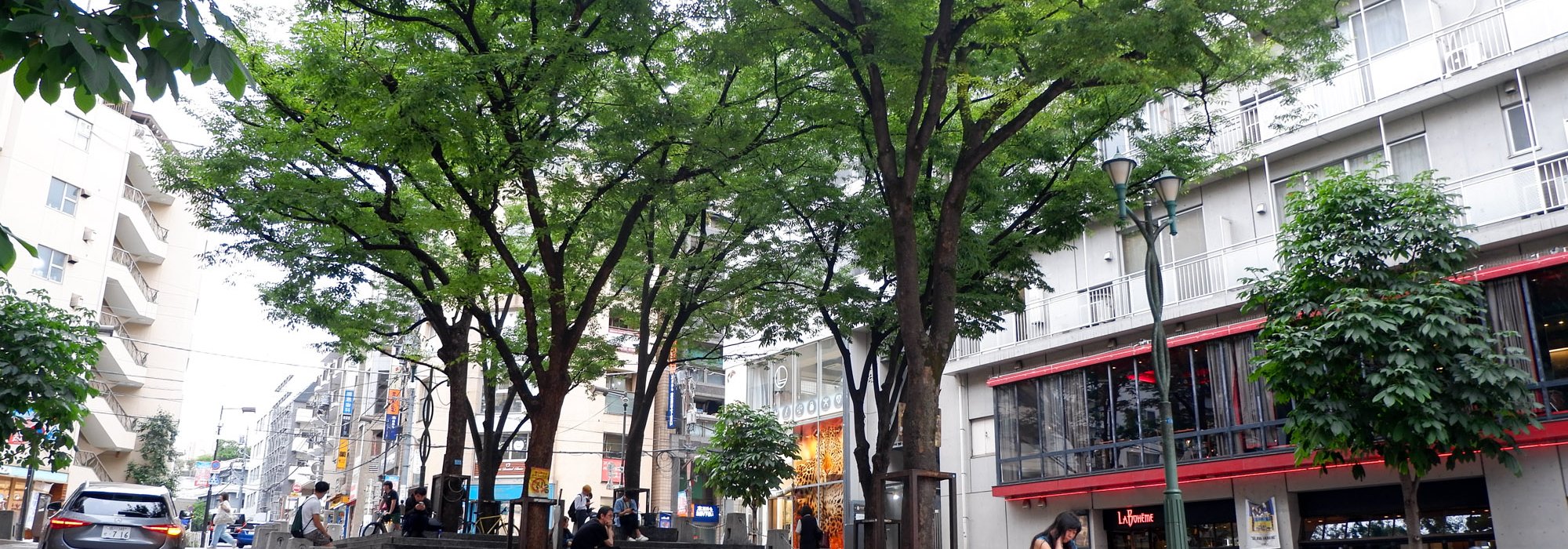
- Patio Juban, a small tree-lined island amid the traffic, notable for hosting a statue of Kimi-chan, the little girl in red shoes who is the tragic heroine of a nursery rhyme well known to the Japanese. Her story is said to be linked to this neighborhood, as well as to Yokohama, where two other statues of her can be found.

Moto-Azabu, a touch of History
Bordering Azabu-Juban to the west, Moto-Azabu juxtaposes different eras. The main sights here are temples and shrines:
- Zenpuku-ji temple, founded in 824 by Kukai (Kobo Daishi), is one of Tokyo's oldest temples. This quiet site isn't a major tourist attraction in itself, but it boasts beautiful architecture enriched over the centuries. It's known for its ginkgo tree, over 750 years old (the oldest in the city), and for having hosted the first U.S. diplomatic mission in Tokyo in 1859. In the background looms Motoazabu Hills Forest Tower, a modern residential building with a distinctive silhouette.
- Yumemido Ossuary: this contemplative space, housed in a very modern building, holds a roughly 400-year-old Buddha statue in its Hondo hall on the 2nd floor, along with beautiful depictions of celestial nymphs known as tennyo.
- Azabu Hikawa Jinja shrine, a small, peaceful sanctuary set on a hill amid the surrounding houses. Founded during the Edo period, its festival is held on the weekend closest to September 17 each year.

Minami-Azabu, the Embassy District
South of Sendai-zaka Avenue lies Minami-Azabu, home to several notable sights:
- The History Museum of Japanese-Koreans, located at the South Korean embassy. The exhibition traces the history of forced and voluntary Korean migration to Japan since the end of Sakoku. Best suited to history enthusiasts.
- The Azabu Kurobisui Onsen Takenoyu bathhouse, whose naturally dark brown-black waters are said to soften the skin.
- Arisugawa-no-miya Memorial Park (free admission), about a 15-minute walk toward Hiroo, offers a green escape spanning more than 60,000m², with playgrounds and quintessentially Japanese scenery. It's here, in particular, that you can really feel the neighborhood's "zaka" topography.
Higashi-Azabu and Nishi-Azabu (to the east and west, respectively) are primarily residential. You'll pass through Higashi-Azabu if walking from Tokyo Tower, while Nishi-Azabu sits close to Omotesando and the Nezu Museum.

Exploring a human-scale Tokyo neighborhood
Azabu doesn't have any single blockbuster attraction, but it's ideal for a leisurely walk. It's a great place to pass through or take a break between 2 tourist hubs, for instance by linking:
- Shiba Park (Tokyo Tower and Zojo-ji) to Roppongi Hills, notably the Mori Art Museum tower for its panoramic views;
- Azabu-Juban to Meguro, via Shirokanedai (Happo-en Garden, Tokyo Metropolitan Teien Art Museum).
Both traditional and contemporary pop culture also offer their own trails through the neighborhood, notably:
- The Minato Seven Lucky Gods Pilgrimage, which connects 8 places of worship across old Azabu, spanning Shiba Park, Azabu-Juban, Moto-Azabu, Roppongi, and Nogizaka. Special goshuin stamps and omamori charms can be collected during the 1rst half of January to ensure good fortune for the year ahead. Juban Inari Jinja represents the Takarabune, the treasure ship carrying the 7 gods.
- The Sailor Moon pilgrimage: heroine Usagi actually lives in Azabu-Juban, and several real-life locations appear in the manga and anime, including Azabu-Juban subway station, Patio-Juban plaza, Hikawa Jinja, and Arisugawa Park. There are also 5 manhole covers featuring the show's characters scattered at key spots tied to the storyline.
Finally, you can also visit Azabu-Juban in late August for its annual Azabu-Juban Noryo Matsuri (麻布十番納涼まつり), a two-day festival that draws around 40,000 visitors.
Azabu-Juban, and old Azabu as a whole, forms a cluster of upscale Tokyo neighborhoods with a hushed, international atmosphere. It's home to a very affluent population, yet its overall mood has kept the simplicity and easygoing spirit of the Edo period. Its hilly terrain adds to the pleasure of wandering its calm, charming streets, between shopping and a leisurely snack break.