
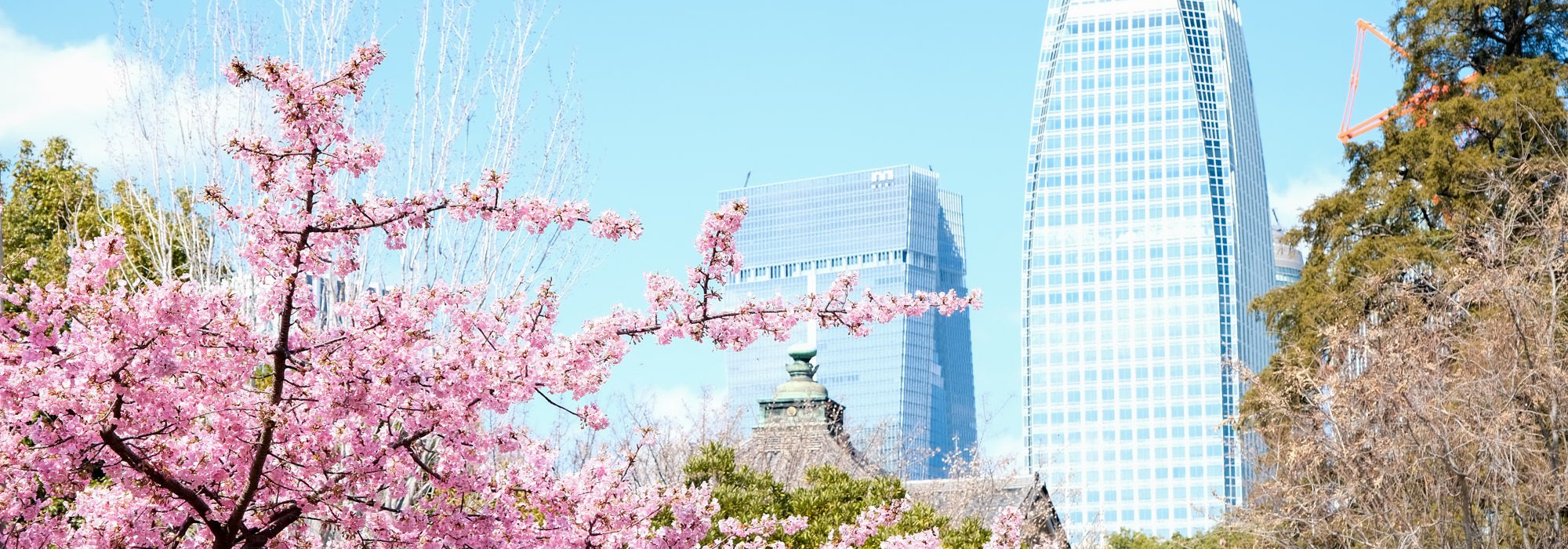
Shiba Park
The Lawns at the Foot of the Tokyo Tower
Shiba Park is one of the oldest public parks in Japan, located at the foot of the Tokyo Tower in Minato ward, in the south of the Japanese capital’s center. A pleasant area for a picnic in spring under the cherry blossoms or in autumn for the koyo foliage, it is also home to Zojo-ji temple grounds, 2 hotels of the Seibu Prince Hotels & Resorts group, as well as open-air leisure facilities.
Inaugurated in 1873, Shiba-koen is one of the oldest public parks of Tokyo, along with Ueno, Asakusa (Sumida Park), Fukagawa and Asukayama’s. Its location ensures its popularity thanks to an unobstructed view on the Tokyo Tower 🗼, located a few meters away, as well as a view on Minato ward’s skyscrapers, such like Toranomon Hills.

The first parks of contemporary Japan
The park’s design was assigned to landscaper Nagaoka Yasuhei (1842 – 1925) who laid down the basis of big Japanese cities’ contemporary urban parks. Divided into several sections with distinct functions, they usually are home to:
- Open-air leisure facilities;
- Coffee shops;
- Cultural or sport facilities; and,
- Areas dedicated to the contemplation of seasonal flowers.
The locals can therefore enjoy a place to gather and meet on the daily basis. This types of parks are first and foremost designed for convenience and congeniality, but not necessary for "beauty" unlike the usual Japanese gardens. However, they tend to have an interesting history, as they were often built on formerly influential sites.

Grounds of ancient mausoleums of the Tokugawas
Shiba-koen was built on lands seized by the the Meiji government from Zojo-ji temple, causing at the times the decline in influence of this former official place of worship of the Tokugawa shogunate that was just toppled down. The park now stretches on a generous superficies of more than 122.500 m², whose center is still occupied by the grounds of Zojo-ji, that we recommend visiting at the same time.

A few testimonies of the temple and the Tokugawa dynasty’s former glory of the Edo period (1603 – 1868) are still visible, such as:
- In the north on Onarimon subway’s side, the vermilion Niten-mon gate that signals the entrance to the former mausoleum dedicated to shogun Tokugawa Ietsugu (1709 - 1716);
- At the center, the gate to the former Taitokuin mausoleum, erected for Hidetada Tokugawa (1579 - 1632) and its picturesque stairway; and,
- The small Shiba Toshogu shrine, dedicated to Tokugawa Ieyasu (1543 - 1616).
The park is also home to a very ancient tomb cluster, the Shiba Maruyama Kofun, a keyhole-shaped burial mound that has been dated to the end of the Jomon period. It remained in its original condition and now looks like a small forested hill on top of which is sitting a small Inari-jinja shrine.

A seasonal spot with a view on the Tokyo Tower
Spring and fall are the 2 best seasons to visit Shiba-koen that then displays beautiful colors allowing for remarkable pictures with the Tokyo Tower as a backdrop.
Note that the park is also home to 2 other towers that are in fact 2 luxury hotels operated by the Seibu Prince Hotels & Resorts group: the Tokyo Prince Hotel 🏨 (with a pool opened to non-customers in summer) and The Prince Park Tower Tokyo.
Shiba Park has a developed green side with:
- A plum tree garden, that bloom at the end of winter, on the Shibakoen subway exit side;
- An early-blooming kawazu cherry tree 🌸 that flowers in the early days of March in the close vicinity of its large lawns;
- A few somei yoshino cherry trees for residents to gather and celebrate hanami at the end of March and early April;
- A wisteria pergola, covered in flowers in April, on the shore of Benten-ike pond;
- Huge sacred camphor trees, providing a nice green touch in summer; and,
- Zelkova, ginkgos and an artificial maple tree valley momiji 🍁-dani, created in 1984 in the area the closest to the Tokyo Tower, whose bright colors appear at the end of November.
Access to the park is free all the time, so it is possible to enjoy the night illumination of the Tokyo Tower every evening.