
Kura Sushi
🍣 One of the Best Kaitenzushi Chains in Japan
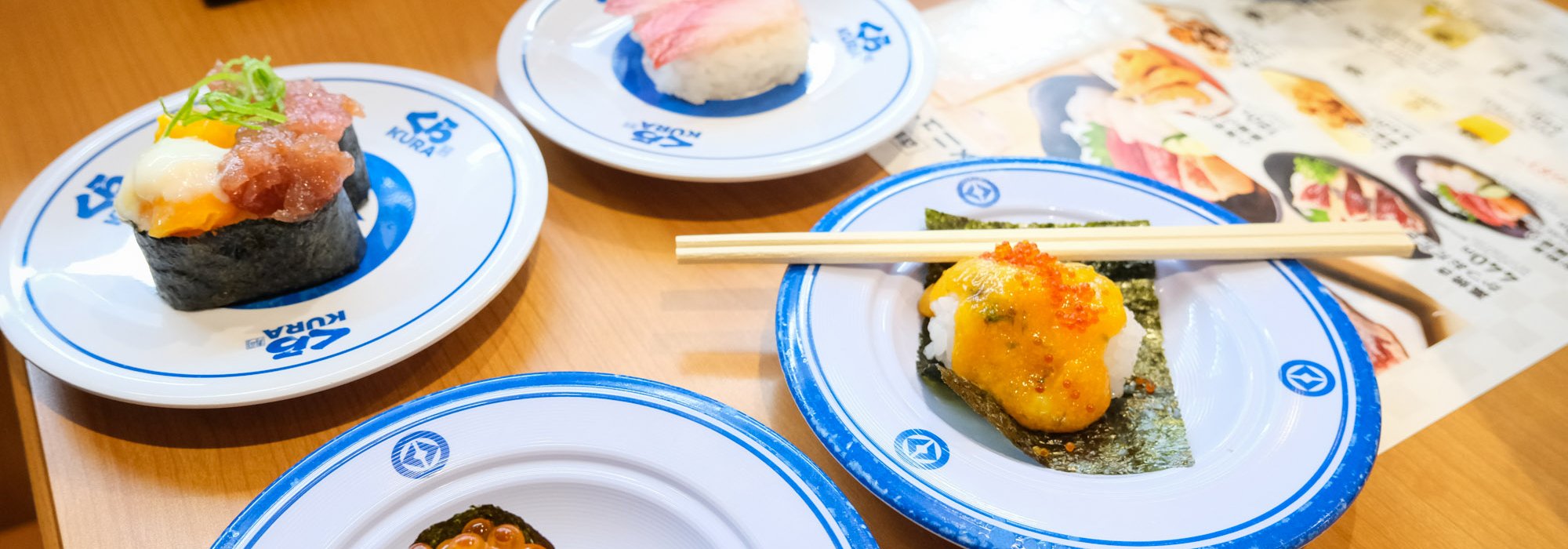
Kura Sushi is a popular kaitenzushi brand, serving sushi plates on a revolving conveyor belt. It operates about 557 sushi fast-food restaurants in Japan, that can be found in main cities and close to large touristic sites, providing a relatively healthy rice and raw fish-based Japanese fast-food.
A refined dish of contemporary Japanese cuisine, sushi 🍣 has popular roots dating back to the Edo period (1603 – 1868). Its then most common version was the nigiri-zushi that used to be sold as a cheap fast-food dish at yatai food stalls. Sushi is therefore one of the oldest type of takeaway in Japan.

This food culture is reclaimed and further developed in the 2nd half of the 20th century by kaiten-zushi (回転寿司) fast-food restaurants that managed to produce sushi with a good price for value. To minimize costs and production time, sushi making is indeed partly automatized and dishes are placed on a conveyor belt winding from table to table. The final bill is based on the number of sushi plates collected while eating.

The Kura Sushi (くら寿司) brand was founded in 1977 in Sakai, in the southern suburb of Osaka, and is one of the Japanese’s favorite kaiten-zushi. In October 2024, about 550 venues were operated in Japan, 64 in the US and 61 in Asia (mainly Taiwan and Shanghai). Its motto is summed up by 3 words: "safe, delicious and affordable." Food safety is one of the brand’s priorities, that manifests into using ingredients that are free of any synthetic additives and artificial preservatives.
Moreover, with the rise of sushi terrorism (or sushi-tero) in 2023, Kura Sushi has been implementing strict hygiene measures in its restaurants, such as:
- Security cameras constantly monitoring the conveyor belts and use of AI to detect potentially suspicious behavior;
- Condiment containers, like the shoyu soy sauce bottle or wasabi and ginger containers are replaced after each customer;
- Plates on the conveyor belt are now protected by an anti-bacterial cover.

Regardless, plates without a cover are to be left on the conveyor belt: the restaurant indeed uses them to display the cheapest sushi or advertise the seasonal ones. The safest choice is to order sushi through the digital tablet available at the table, or with the smartphone 📱 app when a regular.
Tablets display the menu in English, which makes it easy to choose, and the prices per dishes or drinks are also clearly stated. The order is then delivered directly to the table, thanks to the conveyor belt, and the plate is totally safe. So much so that as sushi are prepared upon ordering and the fresh fish was just taken out of its cold storage, its taste sometimes feels less flavorfull.

What to eat in kaiten-zushi chains?
One of the biggest advantages of a sushi chain like Kura is the diversity of the menu able to cater to the largest number of customers, whether they like raw fish or not.
There is of course a varied range of nigiri-zushi, from the classic Western-style topped with salmon, to more traditional white flesh fish such as yellow-tail, or blue flesh like mackerel and sardine, and also shrimp, octopus and squid (one of the cheapest sushi in Japan). There are also maki rolls for nori seaweed amateurs.
There is also a selection of fish-free plates such as:
- Meat sushi with fine slices of pork or beef;
- Patty in a Japanese hamburger style;
- Tamagoyaki omelet; and,
- Cheese tempura.
Hot side dishes include fries, ramen 🍜, udon noodles, miso soup and karaage-style fritters and are also available at Kura Sushi.
We particularly recommend trying:
- The various fat tuna sushi that melt in the mouth;
- The traditional gunkan-maki, topped with natto, seafood salad, urchins or salmon roe;
- The Korean-style spicy gunkan-maki, named in English Seafood Yukhoe, made with salmon, squid and botan shrimp; and,
- Original and tasty combinations like sushi topped with shrimp, avocado and onion.
Sushi are also available in a smaller rice portion size, so as to keep some space for a dessert. It is indeed possible to end a meal on a sweet note at Kura Sushi with: ice cream, chocolate cake, dango 🍡 skewer or fruit salad, the choice varying according to the restaurants and the seasons.
Lastly, there a large range of drinks including the classic self-service hot green tea, Japanese beer 🍺, cooled nihonshu 🍶 and fruit juices. Coffee, hot or cold, is also available.

How much is a sushi plate?
Kura Sushi is historically known for being affordable with a unique price per plate, that used to be ¥100 (~US$0.64). However, with the gradual rise of VAT in Japan, the Covid 🦠 pandemic in 2020 and the inflation that followed the sanitary crisis, the base prices have been raised and usually amount:
- From ¥120 (~US$0.77), to ¥130 (~US$0.83) and even ¥150 (~US$0.96) per plate in restaurants located in city-centers and near touristic sites;
- From ¥115 (~US$0.73) per plate in restaurants located in residential neighborhoods or outside larger cities.
Prices remain very attractive to foreign visitors, especially with a favorable Yen exchange rate since 2022 when buying in Euro or Dollar. Yet Japanese residents find that kaiten-zushi restaurants are not affordable all-you-can-eat places anymore, and they tend to go to independent sushi restaurants where they can have a lunch at a reasonable ¥2,000 (~US$12.76) to ¥3,000 (~US$19.13) price.

A beginner’s guide to Kura Sushi restaurants
Tourists in Japan will easily find a Kura Sushi restaurant as they are usually established in popular areas, like the one near Kinkaku-ji in Kyoto. Its main competitor Sushiro on the other hand has its restaurants less visible as they are located at the upper floors of shopping malls.
When it comes to the most beautiful interior decorations, we recommend trying the new restaurants branded Global Flagship Stores that have been inaugurated since 2020 in touristic districts of large cities like Tokyo and Osaka. The one at the foot of the Tokyo SkyTree, at the exit of Oshiage station, is by the way the largest Kura Sushi restaurant in Japan, with 277 seats spread over 2 floors. The clear wood furniture and the many paper lanterns 🏮 provide a feeling of authenticity and warmth; in a well-thought off way to recreate the atmosphere of a storehouse of the Edo period with nowadays digital technologies.

Staff is scarce in kaiten-zushi restaurants: the experience is about autonomy, from the entrance and stating the number of people in the party, to the exit and the payment of the bill at a self-check-out.
Seating is available in 2 different spaces: at the counter or at a table, and is allotted according to the size of the party. Consequently, single customers can skip most of the waiting time and families are ensured to be seated together in a quasi-private space; each table is indeed placed in semi-enclosed spaces.
Depending on the period and the time of the day (usually between 12 p.m. and 2 p.m., at dinner time, on the weekends and holidays), it is strongly recommended to book in advance as the waiting time can easily reach one hour long. Advance booking is possible thanks to:
- A mobile app with the creation of a customer’s account; or,
- Directly from an Internet search and with a valid e-mail address.
At the restaurant, an automatic check-in device is setting up the virtual waiting line which is displayed on a screen at the entrance.
A reservation number is provided upon booking, that is used to call customers and show them their seat (customer may directly go to their designated seat when booking in advance). Once seated, one can order right away.
At the end of the meal, the plates, the chopsticks and other used tableware are to be disposed through a specific hatch. Depending on the quantity and the price of the plates ordered, a game is then available on the tablet to try winning a collectible gashapon. The types of games vary according to the restaurants. Then, the experience ends at the self-check-out providing easy payment solutions such as bank card 💳 or cash.
Eating in a Kura Sushi is an original and nice experience to do when traveling in Japan. The relaxed and fun atmosphere is particularly suitable for families with young children or friends groups. The value for money is still good for foreign tourists who can enjoy relatively good sushis.
The brand is also developing a range of more upscale sushi restaurants with Muten Kura, with 6 shops available in 2026, of which 2 are located in Tokyo's Nakameguro and Shinjuku. People fond of raw fish looking for a more upscale gastronomic experience in Japan may prefer independent restaurants hosted by seasoned sushi chefs working at the counter.