
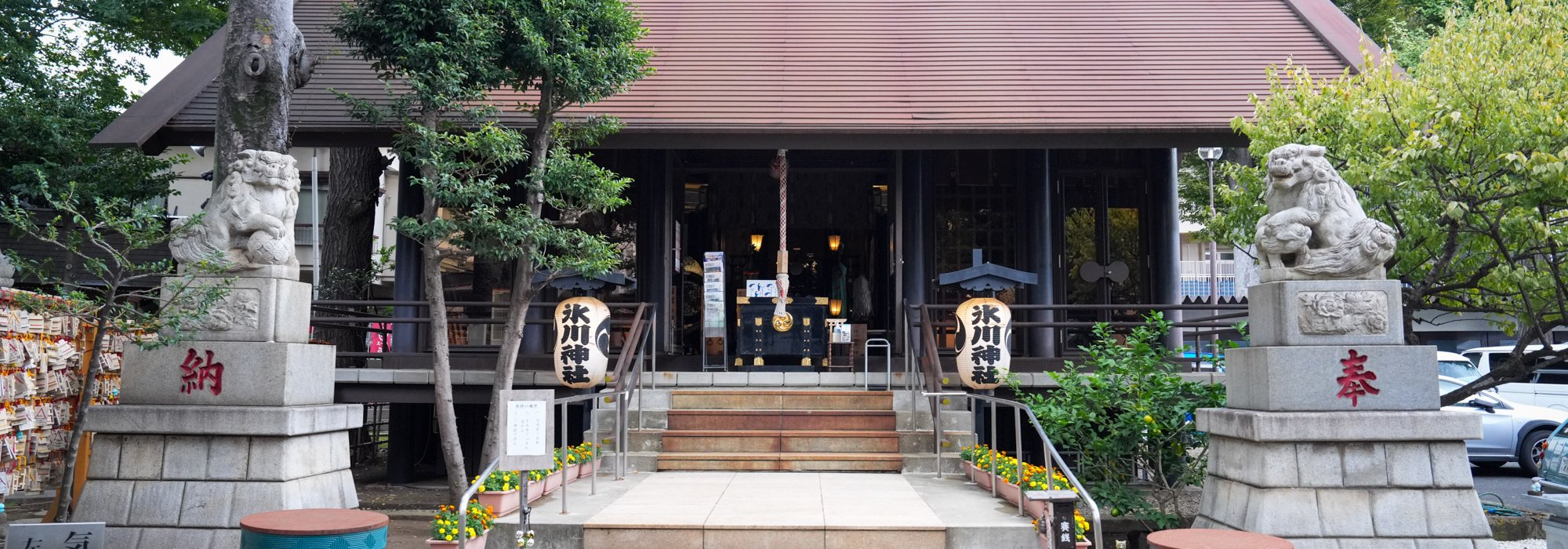
Koenji Hikawa-jinja
The Only Weather Shrine in Tokyo
Koenji Hikawa-jinja is a shrine located in Koenji neighborhood, in Western Tokyo’s Suginami ward. Founded in 1189, it is characterized by an altar dedicated to weather. Visitors come to pray for clement weather and protection against natural disasters in Japan.
Located in the residential western Tokyo, Koenji Hikawa-jinja shrine was erected around 1189 upon the order of Minamoto no Yoritomo (1147 - 1199) so that people could worship:
- Susanoo no Mikoto, the kami deity of storms; and,
- Yagokoro Omoikane no Mikoto, the god of wisdom and meteorological phenomenons.
By enshrining these very specific deities, Koenji Hikawa-jinja is the only Shinto shrine dedicated to weather in Japan. While it was founded several centuries ago, the main pavilion dates back to 1974 and was built with a steel structure after the site was destroyed in the 1945 aerial bombings, during World War II. Located only a few minutes’ walk away from the south exit of Koenji JR station, the place is also connected to Hikawa-jinja great shrine located in Saitama City’s Omiya ward.

Kisho-jinja, the weather forecast shrine
Koenji Hikawa-jinja, a small neighborhood spiritual enclosure, recently gained popularity thanks to its weather forecast altar that appears in Makoto Shinkai’s animated movies Weathering with you (2019).
Founded in 1944 in the Japanese Imperial Army’s Weather Forecast Service as a support for its weather previsions, Kisho-jinja was transferred to Koenji Hikawa-jinja shrine in 1948. The current pavilion was reconstructed in 2004 as the previous one fell into disrepair.
Worshipers usually come here to pray for a good weather on a wedding day or a big event, but recently a growing number has been praying for being safe from a natural disaster. Sitting on the Pacific Ring of Fire 🔥, the archipelago is indeed used to suffer from massive weather and geologic phenomenons, such as typhoons 🌀 and earthquakes. Lastly, the country has also been impacted by the effects of climate change with increasingly stronger summer heat waves. Therefore the shrine is also visited by farmers and even people who are sensitive to summer heats to pray for a clement weather.

A Shinto worship place with unusual symbols
The enclosure’s main entrance is marked by a great torii ⛩️ gate of a dark color. Komainu dogs statues are guarding each side of the main walkway that is lined with toro stone lanterns 🏮. All these traditional Shinto elements guide visitors to the shrine’s main esplanade, that is displaying unusual cult objects, such as:
- A large LED screen continuously displaying weather in Japan;
- The temizuya ablution pavilion, which is nicely decorated with seasonal flowers;
- Ema votive plates, shaped into geta Japanese socks: they are specific to Kisho-jinja shrine and to weather forecast. The tradition is to throw them for a prevision. If the geta falls on the right side, the weather will be nice, and if it falls the bottom on top, it indicates bad weather. They are shown in Makoto Shinkai’s movie.
- Teru teru bozu dolls, that have no face or arms, are traditional amulets to ward off rain ☔️. Japanese children often make them at school, and they are supposed to make rain stop falling the day following their making or purchase. If the rain stops on said day, the doll is rewarded with a drop of sake on the head and the child draws a smile on its head to give it some life. Various teru teru bozu of all colors are available at Koenji Hikawa-jinja shrine. And,
- Omamori lucky charms, with patterns of sun or clouds for a weather-themed decoration.
Every year on June 1, Kisho-jinja shrine is holding a festival dedicated to weather that also celebrates the founding of the first meteorological observatory in 1875 in Tokyo. Visiting Koenji Hikawa-jinja is also highly recommended in spring 🌸 for the cherry blossoms that add a particular charm to the place. This sacred site is very inspiring with its combination of spiritual tradition and nowadays’ consciousness of environmental challenges.