
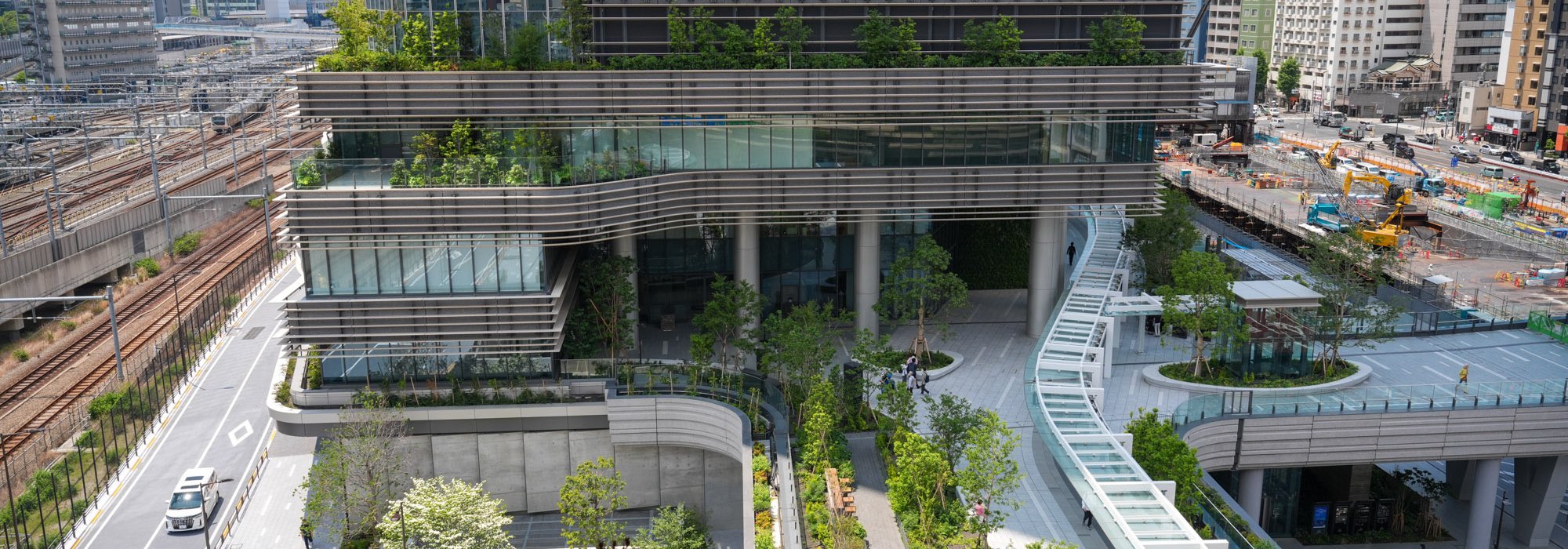
Takanawa Gateway City
Tokyo's Green Futuristic Architecture
Takanawa Gateway City is a new upscale urban complex built around the JR Yamanote Takanawa Gateway station and its surroundings, in the southern part of Minato ward in southwestern Tokyo. Opened in March 2025, this innovative development aims to bridge the present and the future, weaving together technology, nature, and humanity.
Takanawa Gateway City is ideally located in and around the new Takanawa Gateway station, built in 2020 on the circular Yamanote line, putting the complex 10 minutes from Tokyo Station, 2 minutes from Shinagawa (the major Shinkansen 🚅 hub), and not far from Haneda Airport.
The urban complex opens onto the upscale neighborhoods of western Tokyo, including Shirokanedai, and sits just steps from Hamamatsucho and Tokyo Tower 🗼, the Hama-rikyu and Kyu-Shiba Rikyu gardens, and the Tokyo Bay waterfront area, including the piers for river cruises to Asakusa, Odaiba, or Toyosu.

A City Within the City
The Takanawa Gateway City complex is made up of 5 buildings spread across 4 blocks, with openings staggered between March 27, 2025 and spring 🌸 2026. Its vast 845,000 m² space houses offices, shops, restaurants, residences, healthcare facilities, and a museum. These are arranged from south to north along the railway tracks:
- The Linkpillar 1, the first block completed, consists of twin towers to the north and south. They connect directly to Takanawa Gateway station via the large Gateway Park esplanade, and house two major shopping centers dedicated to design and luxury goods.
- The Linkpillar 2 is a single tower located near Sengaku-ji station, containing offices, a clinic, and a fitness center, as well as a shopping mall (NEWoMAN Takanawa MIMURE).
- MoN Takanawa Museum of Narratives is a museum whose organic design by Kengo Kuma helps soften the surrounding landscape. This cultural facility offers stunning views over Tokyo while hosting a variety of immersive exhibitions. And finally,
- Takanawa Gateway City Residence, an upscale residential tower and international school that complete the development.
Takanawa Gateway City also includes numerous other services tied to local life and its international outlook:
- A tourist information center,
- Business incubators,
- Conference and event halls,
- Daycare centers,
- And more.
The overall architecture is unified by the curved lines that run through the bases of the four towers, which are otherwise fairly classic in design. Circularity is a key element in the MoN museum's design as well. This trend toward organic lines can also be seen in several recent urban development projects, such as Azabudai Hills and Tokyo Torch Tower in Nihonbashi.

A Concept Built Around the Future
Takanawa Gateway City aims to be an open-air laboratory for imagining life 100 years from now, built around 3 core themes:
- Creating a decarbonized society;
- Collaboration between humans and robots; and,
- Health.
These experiments are especially visible around The Linkpillar 1: robots are used for cleaning, security, and deliveries. Mobility is also being reimagined through automation, with the Iino autonomous mobile platforms powered by hydrogen, which can carry up to 3 people between shops, as well as autonomous buses running on dedicated lanes that planners hope to extend into surrounding neighborhoods. A model of a flying car 🚙 illustrates the ambitious project to connect hard-to-reach destinations in northeastern Japan by 2028.
The urban complex also has its own app to help visitors navigate and make the most of the site, with booking features, online ordering, and notifications for the many cultural and entertainment events held there.
Overall, the site fits into a broader movement toward a greener architecture, with airy interior spaces, a strong emphasis on greenery, open areas, and pleasant outdoor walkways. That said, be careful on the large staircase between the two towers of The Linkpillar 1: the central section is actually designed to serve as seating, but due to an optical illusion, several people were injured after falling down as they thought it was a regular staircase. The area has since been made safer, and pedestrians are now directed to use the sides of the staircase.
A Nod to the Past
While Takanawa Gateway City is firmly focused on the future, it hasn't forgotten its roots: built on the site of what was once the southern gateway into Edo, it also stretches along the route of Japan's first railway line, connecting Shinbashi to Yokohama, built in 1872. At the time, the train ran along the coast on a roughly 2.7 km long embankment called Takanawa Chikutei, remnants of which were uncovered during the construction of Takanawa Gateway station in 2019.
A tribute to the area's industrial past can be found along the Takanawa Link Line promenade, partly built with stones recovered from the old embankment. An exhibition on the subject is also on display in the Gallery at The Linkpillar 2 and at the MoN Takanawa museum, which train enthusiasts can visit alongside the reconstructed Old Shinbashi Station in Shiodome.
Takanawa Gateway City is an urban leisure destination combining ecology, science, history, and contemporary art exhibitions to create a hub of international appeal. While it isn't a tourist attraction in its own right, it can make for a pleasant stop thanks to its green, art-filled setting, its selection of cafes and restaurants, and some lovely views over Tokyo from its towers or from the viewpoints of MoN Takanawa museum. Easily accessible from both Narita and Haneda airports, it can also serve as a convenient base for exploring the whole capital, thanks to its station on the JR Yamanote line.