
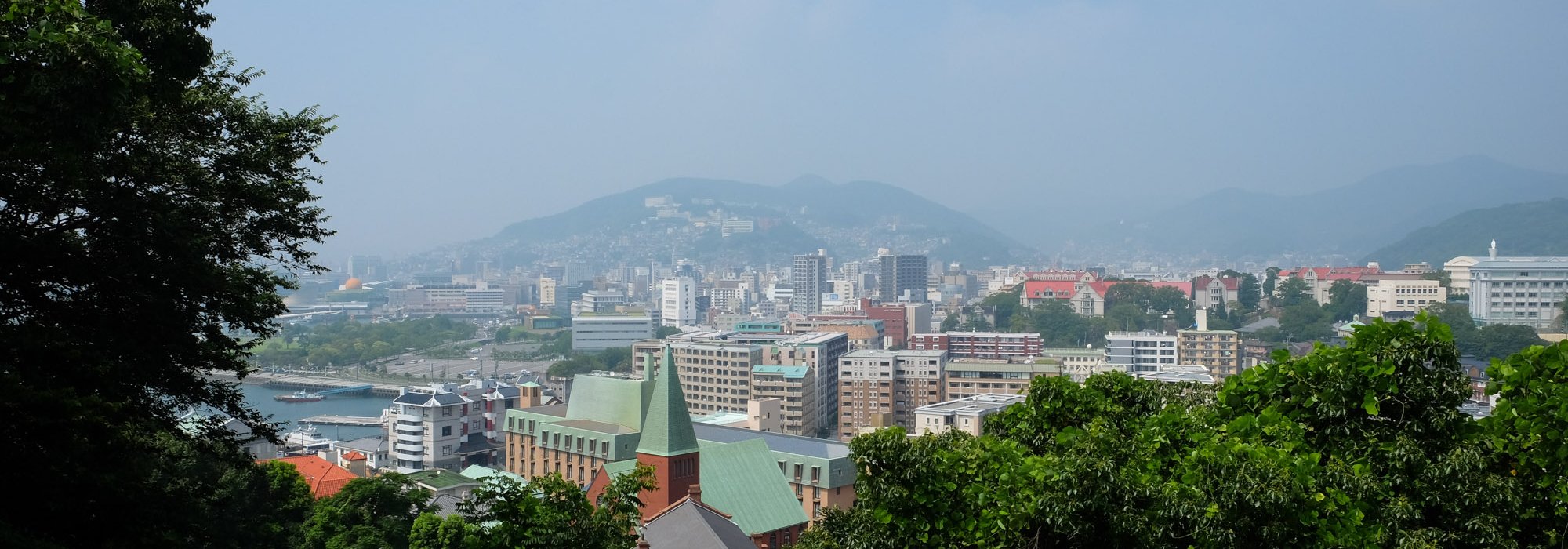
Nagasaki (Prefecture)
Japan’s Historical Window on the West
Nagasaki prefecture is a Japanese prefecture located in the north-west of Kyushu island, in the south of Japan. Its long and jagged coastline strewn with countless small forsaken islands used to be an important gateway to the West for the archipelago. Its eponymous capital, Nagasaki, is also famous for being the victim of atomic bombing on August 9, 1945, whose 80th anniversary was commemorated in 2025 along with Hiroshima. The prefecture is now offering a blend of European influences and memorials.
Located on the southern Kyushu island, Nagasaki prefecture offers a slightly different flavor of Japan, being almost an exotic destination even for the Japanese especially due to its history deeply entangled with the West:
- It received the 1rst European migration waves in Japan starting with Portuguese sailors and missionaries who arrived in the archipelago as early as the 16th century;
- It is one of the 4 gates and commercial hubs opened to foreigners during the sakoku, the isolationist period of Japan, during the Tokugawa shogunate of the Edo period (1603 - 1868);
- Its capital, Nagasaki was struck by the 2nd atomic bombing of Japan in August 1945;
- The port of Sasebo has been home to an American naval base since the end of World War II;
- The prefecture and its neighbor Kumamoto have been enlisted in the UNESCO World Heritage for the "Hidden Christian Sites in the Nagasaki Region" since 2018.
Local gastronomy does have traditional Japanese food specialties, but several famous dishes were also created under international influence, such as:
- Castella, a Portuguese cake;
- Champon, a noodle soup inspired from Chinese cuisine;
- Shippoku cuisine that blends in Chinese, Japanese and Western cuisines;
- Kakuni, a dish of pork belly simmered in soy sauce and sugar; and,
- The classical but delicious wagyu beef of Nagasaki.

Intricate reliefs between sea and mountains
Its geographic features are also quite distinctive: the prefecture has indeed one of the longest coastlines of Japan, highlighted by a steep and hilly landscape, with some of its volcanic mounts still active. The cities spread on a scattered territory made of several bays and peninsulas, and also includes more than 1,000 islands in the East China Sea that are usually sparsely populated. Among them, the Goto archipelago is one of the most famous touristic destinations, along with the islands of Kujukushima, Iki and Gunkanjima, as well as Tsushima, off towards South Korea and that came to fame in 2020 thanks to the excellent PlayStation video game Ghost of Tsushima.
The prefecture’s main cities, Nagasaki, Sasebo and Hirado are easily accessible by JR train and private local railways. Since September 23, 2022, the Nishi Kyushu Shinkansen 🚅 Line departing from Takeo Onsen ♨️ in Saga prefecture connects to Nagasaki station, and direct trains from Hakata Station (Fukuoka) in the north are expected to be rolled out in the future.
Nagasaki Airport, set on an artificial island in the central Omura Bay, provides quick flights ✈️ to Tokyo and Osaka, and connects to some of the prefecture’s remote islands. Ferry ⛴️ boats cruise on the Ariake Sea between Shimabara Peninsula and Kumamoto’s Unzen-Amakusa National Park.

Nagasaki, a cosmopolitan city and symbol of Peace
Nagasaki is the prefecture’s capital and the 1rst touristic destination in the area. In the collective mind, Nagasaki is strongly associated with the tragedy of WWII: the atomic bomb Fat Man dropped on August 9, 1945, 3 days after Hiroshima. The Atomic Bomb Museum, in the north-east of the city and near the hypo-center remembers the victims of the raid. Its exhibition features many testimonies and archive footage, as well as the National Peace Memorial for the victims of the atomic bomb. Nearby, the Nagasaki Peace Park is home to a unique peace statue. All these places were built in 1955, 10 years after the explosion, whose 80th anniversary was commemorated in 2025. In the vicinity, we recommend visiting the Urakami Cathedral and Sanno-jinja shrine of which half of a torii ⛩️ remained standing after the atomic blast. Nowadays, there is no particular risk due to radioactivity when visiting Nagasaki.
In the lower city, near the port and the industrial area, traces of Nagasaki’s international past before World War II remain. The various cosmopolitan neighborhoods show Chinese, Portuguese and Dutch influences. The mansion of merchant Thomas Blake Glover is standing on a hill, along with several other colonial houses in a park. The Oura Catholic Church is the oldest in Japan. For another viewpoint on the city, take the ropeway to Mount Inasa and enjoy a full view on the port and sunset on the city.
Nagasaki is also a matsuri city, holding each year a spectacular lantern 🏮 festival for the Chinese New Year, and Kunchi Matsuri in October.

Memory of the Dutch presence
The Dutch stand out among the European nations that managed to settle durably in Nagasaki prefecture. They successfully maintained trade relationships with Japan by renouncing any kind of religious proselytism, which was seen a threat for Japan’s interior order at the time. The 1rst Dutch counter in Japan, the Dutch East India Company, is inaugurated in Hirado city in the early 1600s.
Dejima island in Nagasaki
In the 1640s, foreign traders, including the Dutch delegation, are ordered to settle on the artificial Dejima island built near Nagasaki port in 1636 and to live in isolation. Dejima was then crucial into maintaining trade relationships with other countries during Japan’s isolationist period that lasted over 2 centuries under the Tokugawa shogunate.
Thus, Nagasaki prefecture helped Japan to keep a connection with the outside world and also inherited Western expertise regarding medicine, new technologies, science or astronomy. The word rangaku meaning "Dutch studies" was coined in Japanese to refer to the knowledge that later helped the archipelago entering its post-feudal age modernization.
Nowadays, Dejima is an open-air historical museum with exhibitions reconstituting the exchanges with the Dutch and the daily life on the island at the times. It provides additional tidbits on the relationship between Japan and the Netherlands, that is also visible at Huis Ten Bosch, a Dutch-themed park located in Sasebo city, about 1,5h drive from Dejima.
Huis Ten Bosch theme park in Sasebo
The extensive leisure area opened in 1992 and faithfully replicates the aesthetic of a city of 17th century Netherlands. Its has windmills, waterways, red brick buildings and endless tulip fields. Its name precisely derives from the replica of the Huis Ten Bosch palace it is home to, which is the exact copy of the Netherlands’ royal family residence.
A visit can be enlightened by various shows, exploring museums dedicated to the country and riding attractions such as a roller coaster and a ghost train. Several hotels 🏨, including one entirely operated by robots, can accommodate visitors. The park was built to celebrate the 200 years relationship of Japan and the Netherlands, commemorate the cultural friendship and provide information about this history.
For about 10 years since 2011, a replica of One Piece’s Thousand Sunny used to offer cruises at Huis Ten Bosch, but it is not available anymore. On another note, the theme park 🎡 is the stage of Kyushu’s biggest firework festival that takes place every year in November, where about 30 firework makers compete in a contest, firing 22,000 fireworks 🎆 overall in one evening.

Goto Islands, the haven of Japanese Christians
It is no coincidence that Nagasaki is home to the country’s oldest catholic church: the prefecture used to be a center for Christianity in Japan and became a shelter for its worshipers. Japanese Christians were indeed persecuted by the Tokugawa shogunate that ruled during the feudal Edo period. Many hid in the Goto Islands, and were renamed kakure kirishitan, meaning "hidden christians."
Goto archipelago’s main islands are:
- 2 big islands, Fukue-jima and Nakadori-jima; and,
- 3 less populated island: Hisaka-jima, Naru-shima and Wakamatsu-jima.
After Christianity was allowed again during the Meiji restoration, many churches were built on these remote islands. They are about 50 and are enlisted in the UNESCO World Heritage under the designation "Hidden Christian Sites in the Nagasaki Region". Nowadays, 15% of the archipelago’s population is Catholic, whereas there is only 1% of Christians in the country.
The Goto islands are also loved for their seaside and their steep landscapes shaped by former volcanoes. Far from the urban areas, they are a literal haven of peace offering a large and varied range of accommodation and restaurants suitable to both local and international tourism.

Shimabara peninsula for volcanic activity
Beside its historical heritage, Nagasaki prefecture is home to many and varied natural landscapes. In addition to the jagged coastline and its many islands, we recommend exploring the area of Mount Unzen located in the heart of Unzen-Amakusa National Park on Shimabara Peninsula. It is an active volcano 🌋 whose last eruption dates back to 1991. However, it is possible to walk safely into these "hells" at the Unzen Onsen spa resort, where people come to enjoy the benefits of Japanese hot springs, between small ponds of boiling mud and rocks that have witnessed lava flows.
Nearby stands the area’s landmark: Shimabara Castle 🏯, a white 5-story structure where visitors follow the samurais’ footsteps by donning old warrior garments; several Shinto shrines and Buddhist temples line the neighboring streets, and the traditional villa Yuusui-Teien Shimei-so (Shimei-so Spring 🌸 Water Garden) offers a tea break in its wonderful garden of several carp ponds.
A last attraction is located at the entrance of the peninsula, in the vicinity of Konagai station, on Isahaya city’s territory. On the side of Road 207 hugging the coast of the Ariake Sea, nicknamed for the occasion Tokimeki Fruits Basutei Dori, 16 quirky bus stops, displaying the shape of 5 different colorful fruits (strawberry, melon, water melon, orange and tomato) are to be seen and essentially photographed. Then, the road continues to the rural Saga prefecture full of destinations that remain unknown to international tourists in Kyushu.